
-By A Special Correspondent
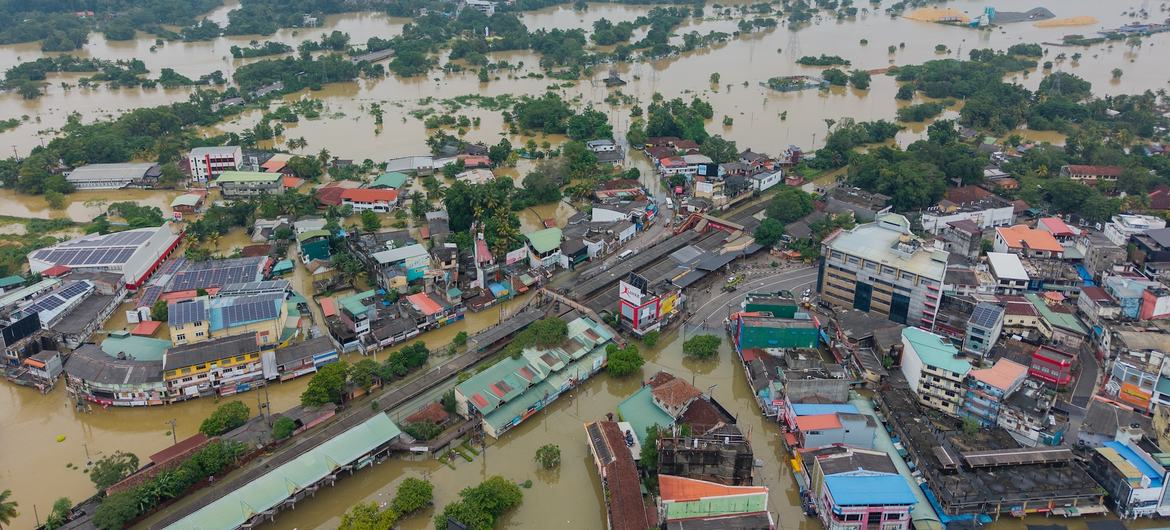
(Lanka-e-News -01.Dec.2025, 10.45 PM) The whole country now knows that Sri Lanka has been struck by a powerful storm — described by many as the worst rainfall event since 1978. With YouTube and Facebook “experts” throwing around all manner of accusations, and with some of our own friends inclined to believe anything said with confidence, I felt compelled to set down a few facts. Much of the criticism being circulated online centres on one claim: that the government “handled it wrong”.
To begin with, we must look at the numbers — tragic as they are. Yet without context, numbers reveal little.
Only last week, floods in Indonesia claimed 442 lives and displaced 300,000 people. Around 3,000 homes were destroyed. Indonesia’s economy, in comparison with Sri Lanka’s, stands on a considerably stronger footing. By that logic, should the Indonesian government also be accused of “failing to handle” the disaster, as our YouTube and Facebook commentators insist is the case here?
In southern Thailand, similarly, between 160 and 170 people died in a severe storm. Just two or three months ago, flash floods swept across Spain’s Valencia region, killing 229 people and destroying 60,000 homes. Although the Spanish government faced public criticism, most citizens recognised that these disasters were consequences of extreme climate shifts. The response demanded greater environmental protection, not clairvoyance. No one expects governments to foresee with perfect accuracy the speed, scale or path of modern climate events — only that they act to mitigate their impact.
With this in mind, I reviewed both the official meteorology briefings and the interviews that have been circulating online. The Department of Meteorology had already warned that rainfall could exceed 250mm (25cm) — and possibly fall below it. That is, they presented both possibilities. YouTube pundits conveniently clipped only the parts that suited their outrage.
A prominent video posted on 23 November — still available online — clearly states that 196mm of rainfall had already fallen and that further warnings were issued. Meanwhile, government officers publicly announced that spill gates at the Polgolla Mahaweli reservoir had been opened. One YouTuber demanded to know why “all the reservoirs weren’t opened”. His credentials? A former hotelier and a self-styled “expert”. The question itself reveals ignorance. Spill gates are opened based on rainfall catchment patterns — not social media pressure.
It is documented that spill gates at the Angamuwa and Rajanganaya reservoirs in Anuradhapura had already been opened. So too were the gates along the Deduru Oya. All of these actions were taken on 23 November — yet the fabricated claims continue to be shared by those who never bothered to check the facts.
If anyone takes the time to read the full set of district disaster notices, they will see that landslide alerts had been repeatedly issued. So who exactly “failed to listen”? Clearly not the government officials but those YouTube propagandists who spread misinformation without reviewing a single official notice.
To many of these individuals, disaster becomes an opportunity — not for national solidarity but for political manoeuvring. The appetite appears to be for a government collapse rather than a national recovery.
Let us put aside, for a moment, the public’s failure to heed warnings. Could any government prevent sudden landslides within just two or three hours of intense rainfall? The honest answer is no.
Since the 1950s, deforestation, the cutting of hill slopes, unregulated construction, village expansion, and the filling of wetlands have created systemic vulnerabilities. These cannot be undone in two hours — or two months. Landslides in illegally built floodplains and fragile slopes cannot be magically halted by a government, any government. Only long-term planning can change the trajectory.
Which is why this disaster will serve as a litmus test for the government. Not in the childish sense peddled on social media, but in a serious governance sense:
Can the administration demonstrate its capacity to rebuild, reform zoning laws, prevent illegal construction, strengthen environmental safeguards, and create climate-resilient communities?
If the government fails this test, then indeed the public is justified in demanding answers. But replacing truth with noise serves no one.
Some critics argue: “The Red Star didn’t come; the government didn’t come.” There is little point responding to such statements. Ravi Siriwardena, a government figure, has already explained that during disasters, the first responders are always the armed forces, police, and emergency services — as is standard in all countries. These deployments are not partisan acts but national obligations.
Those who refuse to understand this cannot be helped.
To their credit, the SJB leadership — particularly Sajith Premadasa and Harsha de Silva — refrained from petty politics during this crisis. They put the country first. In times like these, such maturity deserves acknowledgement.
Several thoughtful analyses have been written about the disaster. Don Supz shared an article drawing on the expertise of Professor Lakshman Galagedara, who explained the scientific patterns behind the rainfall. Shenou Perera also offered a well-reasoned response. Sujeewa Kokawala wrote at length about management failures; while his political positions are known, setting aside that bias, his article contains important insights.
The government must also recognise that during states of emergency, it has the authority — and sometimes the responsibility — to act against those who intentionally spread dangerous misinformation. President Anura Kumara Dissanayake is a committed democrat, but even he must occasionally use tough legal measures to protect the public during disasters.
One heartening aspect of this tragedy is the extraordinary response from ordinary Sri Lankans. Citizens across the island are helping day and night, without rest. Sri Lankan communities in Britain, Canada and elsewhere — Sinhalese, Tamil, Muslim and Burgher alike — have joined hands to support relief efforts. The abusive voices of a few online propagandists are overshadowed by the compassion of tens of thousands.
How can one witness such solidarity and feel anything but love for this country?
Sri Lanka has risen from worse catastrophes, and it will rise from this as well — not once, but a thousand times over.
-By A Special Correspondent
---------------------------
by (2025-12-01 17:19:16)


 Read 56166 Times
Leave a Reply
 0 discussion on this news