
-London, December 1, 2025 - By A LeN Special Correspondent
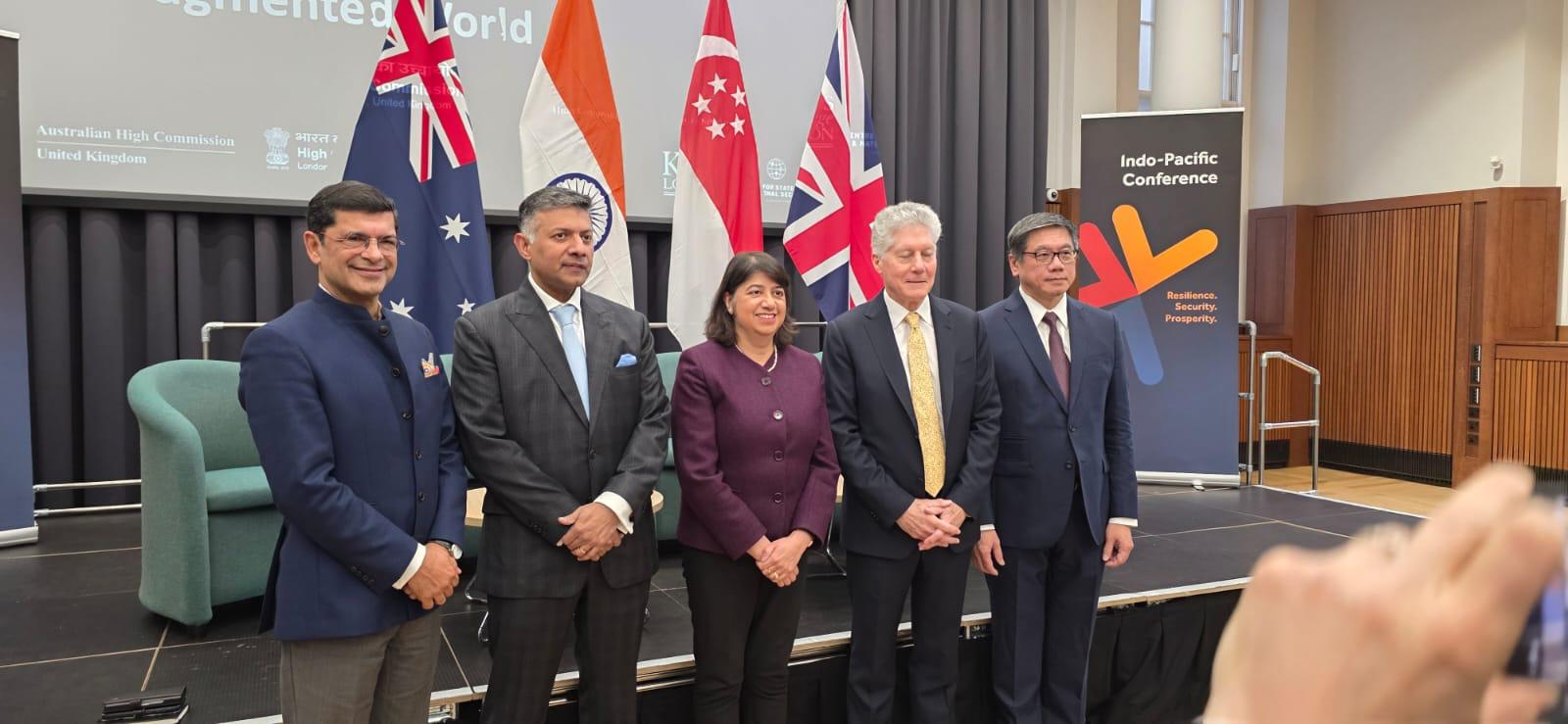
(Lanka-e-News -01.Dec.2025, 11.00 PM) In a year marked by fractured geopolitics, intensifying technological rivalries and a warming planet that has battered Asia with floods, King’s College London became—at least for one day—the quiet centre of gravity for the world’s most contested region.
Under the banner “Rethinking Cooperation in a Fragmented World,” the Indo-Pacific Conference 2025 convened diplomats, scholars, security strategists and policymakers for a full day of reflection and recalibration. Organised by the War Studies Department of King’s College London, with support from the Australian High Commission, the High Commission of India, and the High Commission of Singapore in London, the conference sought to re-imagine strategic alignment across a region whose importance to global prosperity is difficult to overstate.
The Indo-Pacific Conference, now in its third year, has swiftly become one of the UK’s most prominent academic-diplomatic platforms. Its 2025 edition brought together a remarkable coalition: the Centre for Statecraft, the King’s College London Centre for Defence Studies, and the diplomatic missions of Australia, India and Singapore.
Professor Siddhi Kapoor, Vice-Chancellor and President of King’s College London, opened the proceedings by warning that “the world is no longer merely multipolar—it is multidirectional, unpredictable and persistently fragmented.” She reminded the audience that the Indo-Pacific now determines not only the world’s economic trajectory but increasingly the contours of its security architecture.
“The Indo-Pacific is the hinge upon which the 21st century turns,” she said.
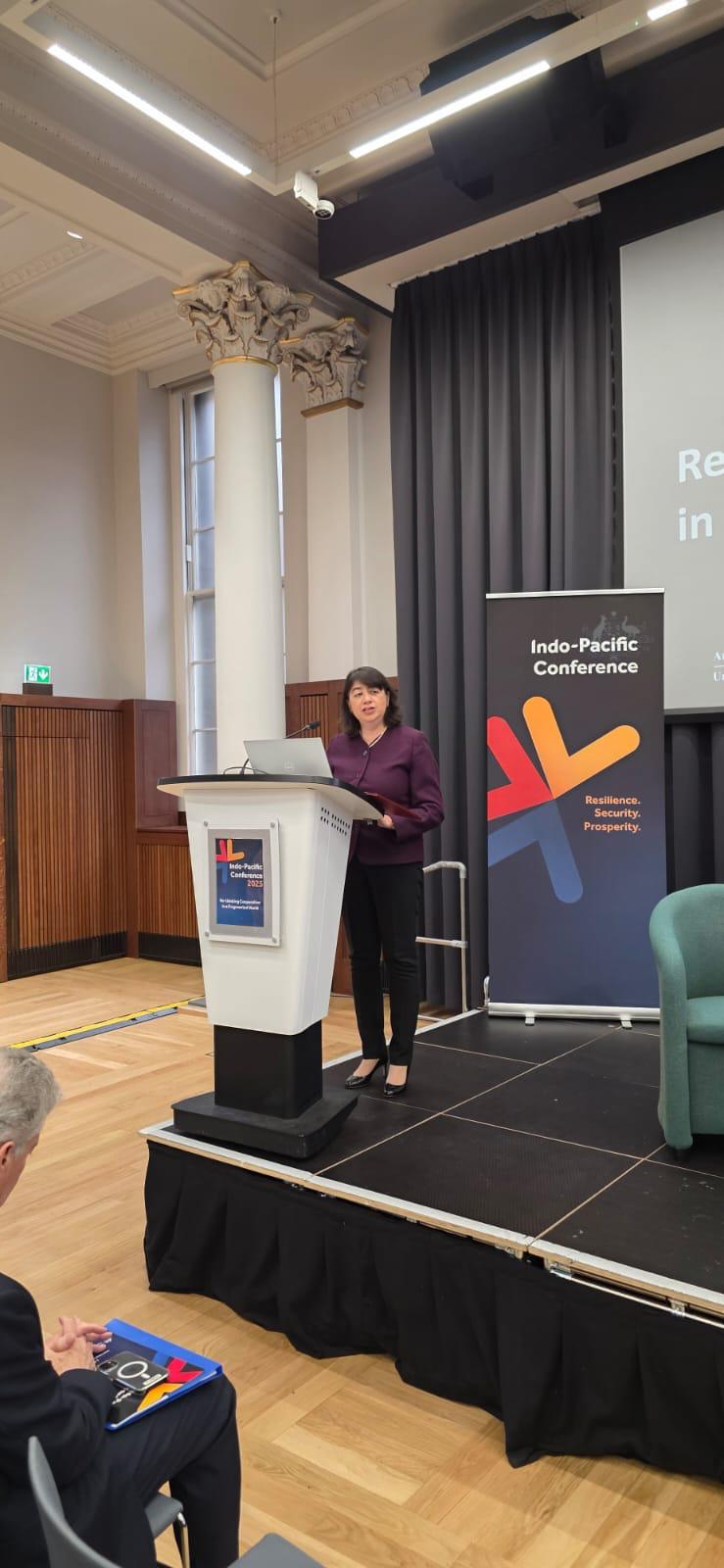
The keynote speaker, Hon. Seema Malhotra MP, Parliamentary Under-Secretary of State for the Indo-Pacific at the Foreign, Commonwealth & Development Office (FCDO), delivered a measured but resolute address outlining Britain’s deepening strategic engagement with the region.
Malhotra emphasised three principal reasons for the UK’s sustained attention:
1. Economic Gravity Shifting East
By 2050, she noted, the Indo-Pacific is expected to generate 50% of global GDP—a projection that underscores why the region’s prosperity is inseparable from Britain’s own economic future.
2. The Region’s Strategic Importance to the UK’s Security Framework
For the UK, the Indo-Pacific is not just a distant theatre but a security ecosystem that influences supply chains, maritime stability, cyber standards and counter-terrorism cooperation. Malhotra reiterated the Government’s commitment to raising defence spending with a dedicated Indo-Pacific focus.
3. The Emerging Indo-Pacific–Euro-Atlantic Convergence
Highlighting the quieter but consequential conversations within NATO, she argued that the Indo-Pacific must not be treated as an abstract extension of Euro-Atlantic security.
“There is no longer a distant ‘East’ and a familiar ‘West’,” she said. “There is a single, interconnected risk environment.”
In one of the most striking portions of her speech, Malhotra turned to the catastrophic floods unfolding in Sri Lanka, describing them as a sobering reminder of the climate-fragility that increasingly shapes the Indo-Pacific’s security discourse.
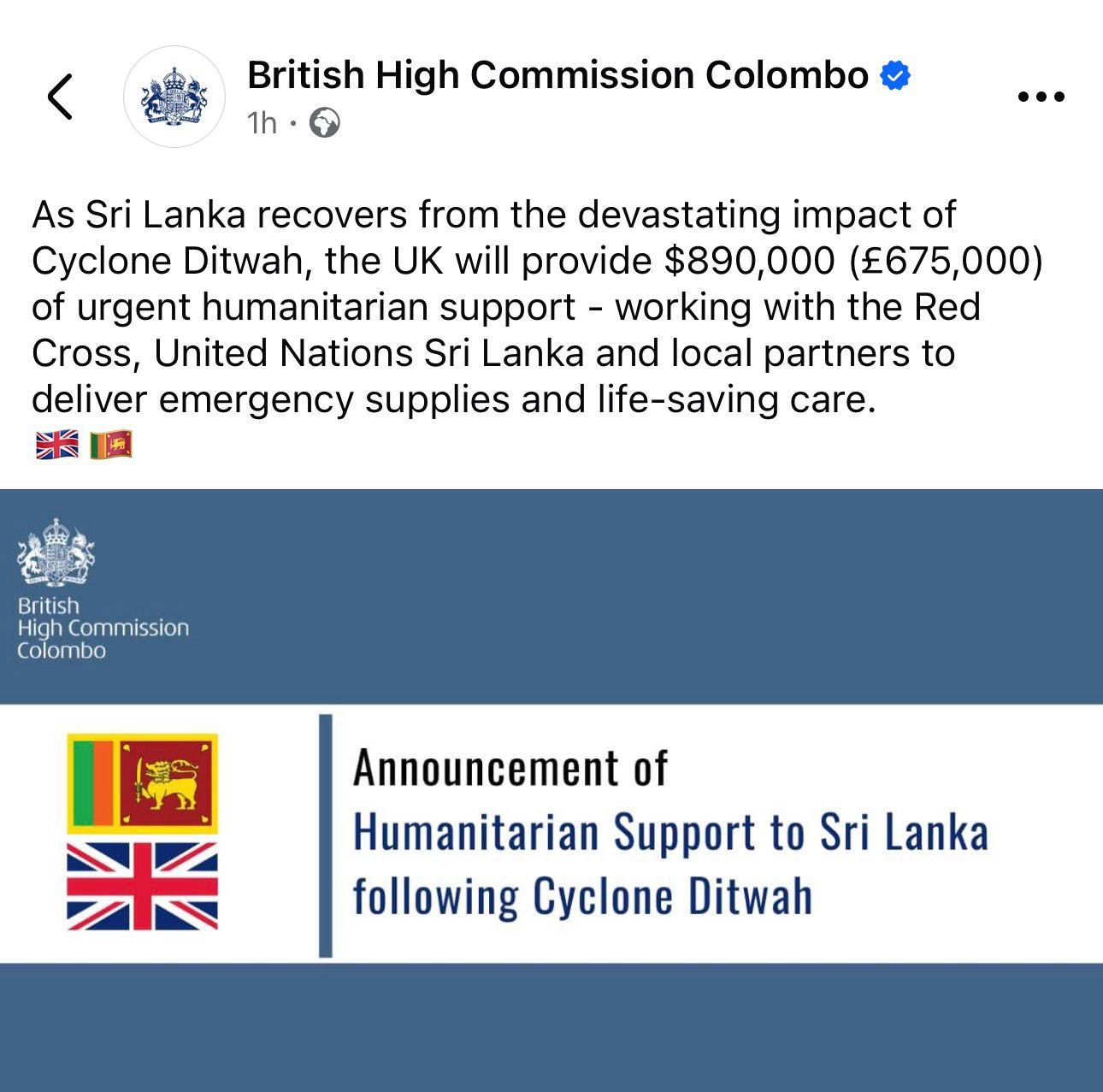
She confirmed that the United Kingdom would extend targeted humanitarian assistance to Sri Lanka, as well as to other regional partners battling severe flooding.UK Donated £675,000 for urgent Humanitarian support, more assitance will follow in future.
“These crises are not ephemeral storms. They are structural shocks,” she warned, calling for a shared Indo-Pacific resilience architecture capable of confronting everything from natural disasters to cyberattacks.
The morning’s first panel set the intellectual tone for the day. Scholars and strategists dissected the geopolitical, economic and technological currents driving global fragmentation.
The themes included:
the US–China strategic contest, described by one panellist as “the gravitational pull around which much of the region is forced to orbit”;
the intensifying competition over semiconductor supply chains, artificial intelligence standards and undersea data cables;
the region’s vulnerability to maritime chokepoints, accentuated by conflict in the Red Sea and regional flashpoints such as the Taiwan Strait;
the question of whether fragmentation is accelerating a new era of minilateral cooperation—small, issue-based coalitions that bypass slow formal alliances.
A policy advisor from the Australian High Commission remarked that fragmentation “is no longer merely the problem—it is the operating environment.”
The second session shifted from theory to diplomacy, featuring candid reflections from senior representatives of Australia, India and Singapore.
Australia: Building Resilience, Not Rivalry
The Australian High Commissioner stressed Canberra’s long-term commitment to an Indo-Pacific where “capabilities matter, but so do choices and values.” He emphasised Australia’s investment in maritime security partnerships, climate adaptation projects, and defence cooperation.
India: Strategic Autonomy in a Fragmented Order
India’s High Commission representative emphasised New Delhi’s stance of strategic autonomy, noting that India would neither be drawn into exclusive blocs nor tolerate attempts to circumscribe its regional role.
“Middle powers are not buffers,” he said. “They are engines.”
Singapore: The View from the Region’s Core
Singapore’s High Commissioner offered a distinctly Southeast Asian perspective.
“For us, fragmentation is not an academic idea—it is a lived reality between giants,” she noted. She urged partners to avoid forcing binary choices on smaller regional states.
Collectively, the High Commissioners painted a picture of a region attempting to navigate great-power rivalry without surrendering agency.
If the first panel diagnosed the world’s fragmentation, and the second explored national responses, the third sought solutions.
The session examined how middle powers—including Australia, India, Japan, South Korea, Indonesia and Singapore—can pool strengths to stabilise the region. The discussion centred on three pillars:
Practical Security Cooperation
Expanding maritime domain awareness, joint exercises, and anti-piracy operations.
A former naval strategist from Singapore argued that “security cooperation does not always need grand alliances; it needs practical seams of cooperation.”
Economic Interdependence as Stabilising Glue
Singaporean and Indian panellists proposed linking digital trade frameworks and supply chain resilience networks to reduce over-reliance on any single power.
Inclusive Strategic Thinking
Speakers stressed that the Indo-Pacific must be an open architecture, not an exclusive club.
“If we create an Indo-Pacific that mirrors Cold War logic, we will have already failed,” an Indian scholar warned.
While no single agreement dominated the conversation, the shadows of AUKUS, the Quad, and the Indo-Pacific Economic Framework (IPEF) loomed large.
British commentators used the platform to reaffirm that the UK’s new Indo-Pacific posture—stemming from the 2023 and 2024 defence reviews—was not an ideological pivot but a pragmatic one. As one panellist put it:
“Britain has rediscovered the Indo-Pacific not because of nostalgia, but because global stability demands it.”
Although the event’s formal theme revolved around fragmentation, the implicit narrative was Britain’s maturing relationship with the region.
The UK’s participation—once seen as symbolic—is now grounded in:
expanded defence cooperation,
increased maritime deployments,
deeper trade linkages,
and growing climate and development assistance.
Malhotra’s announcement of additional humanitarian support for Sri Lanka underscored the point. She repeatedly framed the Indo-Pacific not as a distant strategic puzzle but as a partnership space requiring empathy and accountability.
“The Indo-Pacific is not merely a set of coordinates,” she said. “It is home to more than three billion people whose resilience shapes our collective future.”
Several speakers reflected on the origins of the Indo-Pacific Forum, first hosted at King’s College London in 2023. What began as a modest academic gathering has evolved into a cornerstone event drawing policymakers from across three continents.
The 2025 edition stood out not only for the high-level participation but for its timeliness. With wars in Europe and the Middle East, climate disasters sweeping South Asia, and unprecedented technological dependencies, the Indo-Pacific was portrayed as the crucible where the world’s emerging order is now being tested.
As participants filtered out of the historic halls of King’s, the consensus was clear: fragmentation is here to stay. But cooperation—if recalibrated, diversified and grounded in shared interests—remains possible.
The Indo-Pacific Conference 2025 offered no naïve optimism, but it did provide a map of the region’s competing priorities and converging anxieties. In doing so, it reminded attendees why Britain’s engagement is not optional but essential.
If the Indo-Pacific truly will generate half of global economic output by mid-century, and if its straits, cables and alliances will underpin the world’s security, then London’s presence is a strategic necessity rather than a diplomatic accessory.
As the keynote speaker Malhotra concluded:
“The Indo-Pacific is where the future happens first. The question is not whether the UK engages, but how we shape that future together.”
-London, December 1, 2025 - By A LeN Special Correspondent
---------------------------
by (2025-12-01 17:49:57)


 Read 57138 Times
Leave a Reply
 0 discussion on this news