
How a careless claim about the Victoria Reservoir unleashed a storm of misinformation in the middle of a national tragedy
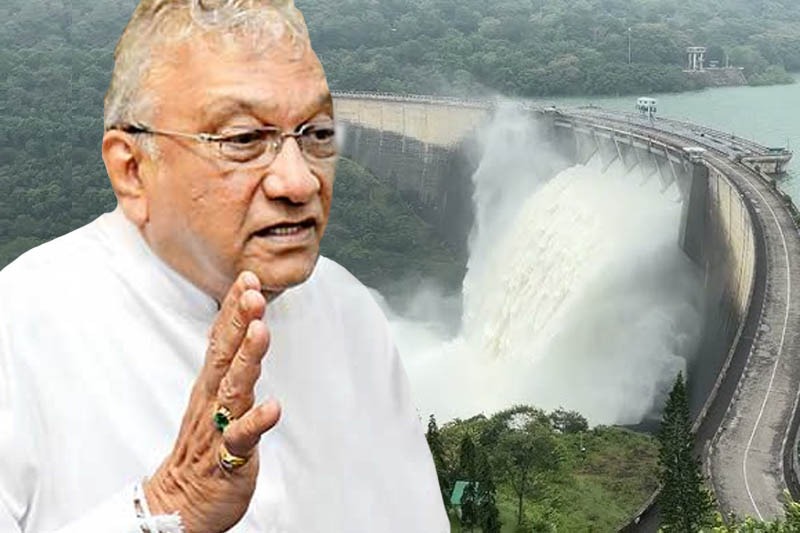
(Lanka-e-News -02.Dec.2025, 11.00 PM) In the quiet hills of Kandy, where the Mahaweli River winds like a silver blade through ancient temples and bustling streets, tragedy has become a chilling new intruder. This year’s monsoon did not merely arrive—it descended with fury. Entire villages disappeared under raging torrents, bridges buckled, roads disintegrated, and more than a hundred lives across the central district were swept away. In these fragile hours, Sri Lankans desperately searched for clarity, accountability, and leadership.
What they received instead was a political grenade lobbed into an already burning landscape.
At a press conference held in Colombo on the 1st of December, former Samagi Jana Balawegaya (SJB) MP and lawyer Lakshman Kiriella delivered a sweeping, sensational allegation:
That the catastrophic floods in Kandy were not purely an act of nature, but the result of the Victoria Reservoir gates not being opened systematically. According to him, the reservoir’s sluice gates were kept closed, causing the Mahaweli River to overflow and submerge Kandy city—something, he claimed, “has never happened in any previous flood in history.”
It was, he insisted, government mismanagement—nothing less.
It was also, as subsequent hydrological reports and Mahaweli Authority briefings make clear, a distortion bordering on fiction.
To accuse reservoir engineers of deliberately withholding water release during peak monsoon season is no small matter. Such a claim implies negligence of the highest order—professionals who oversee life-and-death engineering systems acting recklessly, knowingly endangering millions.
Yet every piece of technical data available contradicts Kiriella’s assertions.
Senior engineers who spoke off-record confirmed that:
Victoria Reservoir gates were opened in stages, long before the river breached its banks.
Gate operations followed standard hydrological protocols, based on rainfall intensity and inflow measurements.
The monsoon cell that hit Kandy produced rainfall far beyond the basin’s design expectations.
To put it bluntly:
No reservoir in Sri Lanka—even Victoria—could have absorbed the sheer volume of water that fell within 48 hours.
In meteorological terms, this was a once-in-a-generation deluge.
In political terms, it quickly became a platform for opportunism.
Kiriella, a seasoned parliamentarian with decades in public life, is no stranger to controversy. But even longtime observers expressed disbelief at the audacity of his claim that “Kandy’s main roads have now become rivers—roads which have never flooded in history.”
It was a statement delivered with theatrical confidence, but one that wilted under factual scrutiny.
Kandy has experienced flash floods before—though rarely on this scale. The city’s natural topography, rapid urbanisation, blocked drainage systems, and insufficient riverbank protections have been flagged for years as high-risk factors by urban planners.
To imply that all of Kandy’s flooding could be traced solely to a reservoir gate is a staggering oversimplification. It ignores:
The 12th of November Meteorological Department warning predicting extreme rainfall
The already saturated soil conditions
Illegal construction along waterways
Encroachment on natural drainage paths
The lack of dredging and riverbank strengthening
But Kiriella’s target was not hydrological truth—it was political mileage.
By turning the Victoria Reservoir into a villain, he created an easy narrative: the Government failed, the system collapsed, the disaster was avoidable.
Yet the science says otherwise.
Where Kiriella’s comments drift from misleading to deeply troubling is in his attempt to link fatalities directly to supposed reservoir mismanagement. He told journalists that more than fifty people in the Kandy district were feared dead, and that Gampola town went underwater because “the Kotmale Reservoir was opened at once.”
Again, engineering data contradicts this.
Water release occurs in controlled increments, never in a single “opening” that unleashes a tidal wave downstream. Multiple engineers from the Mahaweli Authority have publicly clarified this point over the years: sudden, simultaneous gate openings are not physically or procedurally possible in modern reservoirs.
But nuance is seldom useful in a political narrative. Precision rarely excites a microphone.
By suggesting that lives were lost because reservoir gates were handled recklessly, Kiriella crossed a dangerous line—he transformed bereavement into a political weapon.
One cannot imagine what grieving families must feel hearing their personal tragedies exploited for partisan advantage.
When the Meteorological Department issued its November 12 warning forecasting abnormally heavy rainfall, every disaster management unit, local authority, and provincial council was placed on alert. This was no secret. It was widely broadcast.
So when Kiriella accuses the Government of “failing to operate the relief machinery properly,” one must wonder:
Where was his own involvement?
What preparedness did he advocate while in office?
Why does he gloss over decades of infrastructure neglect across the hill country under successive governments—including those in which he was a senior minister?
Blame is easy. Preparedness is not.
Indeed, Kiriella’s additional revelation—that the cross-party Disaster Management Committee, established to coordinate rapid decisions during emergencies, “has not met for an entire year”—is damning if true. But it is equally damning that opposition MPs themselves, including Kiriella, apparently did not demand its convening.
If the committee was asleep, so was the political class, not merely the ruling coalition.
Perhaps the most immediate impact of Kiriella’s comments was not political but psychological. Within hours of the press conference, social media exploded with panic-fuelled speculation:
Fears that reservoir gates were being mismanaged
Rumours that Victoria Dam was under structural strain
False alarms that water releases would sweep through villages without warning
In moments of national emergency, information is a lifeline.
Misinformation is a weapon.
Officials struggled to counteract the rumours, but the damage had already seeped into public consciousness. Families living near the Mahaweli River stayed awake through the night, frightened that another surge of water might arrive unannounced. Many evacuated unnecessarily; others refused to leave because they were confused about whom to trust.
Trust—arguably the most important currency during disasters—became collateral damage.
Kiriella insists he was merely “raising concerns.” But concerns must be rooted in fact, not political theatrics.
Hydrological officers provided a clear breakdown of events:
As rainfall intensified, pre-depletion protocols were initiated at both Victoria and Kotmale reservoirs.
Gates were opened in stages, in consultation with the Disaster Management Centre.
Downstream residents were notified through local authorities, police units, and SMS alerts.
The volume of water entering the reservoirs exceeded the outflow capacity—even with controlled release.
Soil saturation meant that riverbanks overflowed quickly, overwhelming drainage systems.
In other words:
This was an extreme natural event—not a man-made one.
Kiriella’s implication that engineers “kept the gates closed” is not only incorrect but insulting to the professionals who worked around the clock to prevent even greater devastation.
When a politician misleads the public during a flood, the consequences go beyond embarrassment. They risk:
Undermining trust in emergency institutions
Distracting from real vulnerabilities such as illegal construction and blocked waterways
Fueling unnecessary fear during rescue operations
Turning national tragedy into partisan entertainment
Sri Lanka is no stranger to political chaos, but disasters demand unity, not opportunism.
There is a moral responsibility—one that comes before party loyalties—to avoid spreading claims that circumvent science and undermine emergency response structures. Politicians wield influence; when misused, it becomes a threat to public safety.
Political analysts note that Kiriella has a history of making sensational statements at strategic moments. Yet this time, the reactions were swift and almost uniformly critical.
Even several opposition figures distanced themselves, privately describing his claim as “reckless,” “misinformed,” and “harmful.” One senior SJB strategist, speaking anonymously, said:
“This is not the time to throw stones without evidence. People are dying.”
But perhaps the most striking criticism came from environmental and engineering experts, who urged politicians to stop oversimplifying what are fundamentally structural and long-standing issues:
Urban drainage collapse
Sedimentation and silt accumulation
Encroachment into riverbanks
Lack of integrated flood-management planning
Underinvestment in forecasting technology
Climate-induced rainfall anomalies
These are complex challenges. Blaming a dam gate is convenient—but inaccurate.
In moments of national tragedy, political leaders have a choice:
To inflame or to inform.
To divide or to console.
To exploit or to elevate.
Sri Lanka needed the latter.
Instead, Lakshman Kiriella offered the former.
He could have urged unity.
He could have called for an emergency reconstruction plan.
He could have demanded a long-term flood-mitigation strategy.
He could have honoured the dead without weaponising their memory.
Instead, he chose spectacle.
Kiriella claimed that between 25 and 30 people from each electorate in the Kandy district had died. While the exact numbers remain under verification, the loss of life is undeniably severe.
But this is precisely why accuracy matters.
Inflated statistics frighten the public.
Misleading statements confuse families searching for loved ones.
Politicised narratives obscure the real causes—leaving the country vulnerable to the next disaster.
Every false claim is a disservice to the people who lost everything.
Sri Lanka’s flood crisis is not a one-off incident. With intensifying climate patterns, extreme rainfall events will become more frequent. Political leaders, regardless of party, must rise to a new standard of responsibility:
Listen to engineers, not conspiracy theorists.
Strengthen disaster-management structures.
Invest in climate-resilient infrastructure.
Stop romanticising and weaponising hydrological ignorance.
Tell the public the truth—even when it is complicated.
The country cannot afford myths when facing reality.
The Mahaweli River does not bend at the will of microphones.
Reservoirs do not wait for press conferences to open their gates.
Nature does not grant immunity to political mischief.
Lakshman Kiriella’s attempt to score political points during a moment of national grief has backfired spectacularly. His claim about the Victoria Reservoir has been dismantled by facts, disproved by science, and criticised across the political spectrum.
In the end, what remains is a cautionary tale:
When politicians play hydrologist to gain headlines, they not only mislead the public—they endanger them.
Sri Lanka deserves better.
Especially when the waters rise.
-By A Special Correspondent
---------------------------
by (2025-12-02 18:45:54)


 Read 65484 Times
Leave a Reply
 0 discussion on this news