
Why the SLMC leader’s dealings with a hardline Sinhala nationalist have sparked outrage across the Muslim community
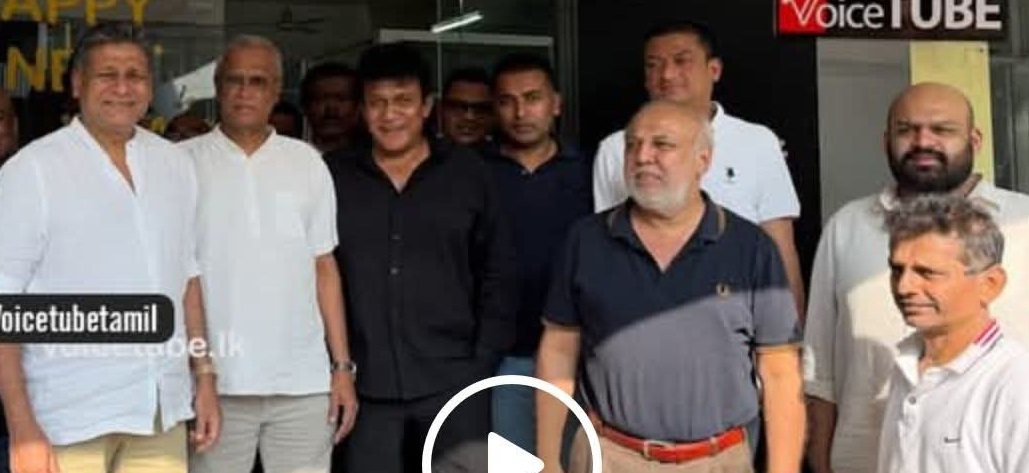
(Lanka-e-News -02.Dec.2025, 11.10 PM) By any measure, Sri Lanka’s political landscape has always been a theatre of strange alliances. But few partnerships have caused as much shock, confusion, and anger as the unexpected political engagement between Sri Lanka Muslim Congress (SLMC) leader Rauff Hakeem and the controversial nationalist media mogul-turned-politician Dilith Jayaweera.
Jayaweera — chairman of Derana Media network and founder of the Mawbima Janatha Party — is widely regarded as one of the most aggressive architects of post-Easter Sinhala-Buddhist majoritarianism. His media outlets championed narratives that demonised Muslims, promoted anti-Muslim conspiracies, and amplified public hostility during the COVID-19 pandemic. When Muslim Janaza burials were banned, Derana positioned itself at the forefront of commentary favouring forced cremations, a policy condemned internationally as discriminatory and inhumane.
So when news emerged that Rauff Hakeem, the most recognisable Muslim political face of the last three decades, had sat down for a political discussion with the very man whose media empire spread anti-Muslim propaganda, the backlash was swift and furious.
To many Muslims, the meeting felt like betrayal dressed as political strategy.
In Tamil commentary circulating across social media, critics framed the situation bluntly:
“Dilith Jayaweera plays politics using Sinhala racism.
Hakeem plays politics using Muslim nationalism.
And the Tamil leaders who rely on ethnic emotion — like the Shanakkiyans and the old Sumanthiran line — also run on ethnic grievance.
Now all these ethnic provocateurs are uniting at a single point, simply because they want to topple the government.”
This cutting assessment reflects a growing suspicion among minority communities: that ethnic politics in Sri Lanka has become less about identity and more about expediency.
Hakeem has built his career on being the voice of the Muslim minority; Jayaweera built his on inflaming fears about that same minority. Their sudden convergence demands scrutiny far deeper than the polite explanations offered in press briefings.
To understand the depth of the anger, one must revisit a painful timeline.
Easter Sunday, 2019
In the aftermath of the bombings — one of the darkest chapters in Sri Lanka’s modern history — Derana TV spearheaded narratives that painted the entire Muslim community as complicit. The network provided uncritical platforms for conspiracy theorists, security propagandists, and ultra-nationalist commentators. Complex security failures were reduced to simplistic narratives of “Muslim threat,” further deepening tensions.
The Muslim community felt besieged, publicly humiliated, and politically isolated.
COVID-19 Forced Cremations, 2020–2021
When the government imposed mandatory cremation on all COVID victims — despite World Health Organisation guidelines confirming burial was safe — Derana’s primetime discussions framed Muslim objections as “unreasonable demands” or “extremist cultural rigidity.” Several Muslim children, infants even, were cremated against their parents’ wishes.
The trauma remains unhealed.
Yet during that entire period, Rauff Hakeem positioned himself as the chief defender of Muslim dignity, condemning forced cremations in Parliament and accusing nationalist elements of using the pandemic to suppress the community.
That is the same nationalist ecosystem Dilith Jayaweera represents.
It is not surprising, then, that many Muslims view Hakeem’s engagement with Jayaweera as a capitulation — if not a political sell-out.
For years, Jayaweera has strategically courted anti-Muslim sentiment to build his political base. His party’s rhetoric echoes the familiar grammar of Sinhala majoritarian populism: cultural protectionism, moral nationalism, and suspicion of minorities.
So why would Hakeem — a man who repeatedly styled himself as the guardian of Muslim rights — choose this moment to open dialogue?
Several political analysts suggest the answer lies in the shifting winds of Sri Lankan politics.
The NPP’s rise has weakened the traditional bargaining leverage of minority parties.
The older ethnic-based power blocs — SLMC, TNA, even certain Sinhala nationalist groups — are losing the ability to command votes solely through communal identity.
In this new landscape, everyone is searching for new alliances, sometimes with awkward, even dangerous partners.
What emerges is an uncomfortable truth: ethnic entrepreneurs are adapting to survive.
The Tamil commentary that went viral captured this reality with surgical precision:
“None of these ethnic leaders question the racism of their allies.
Because their goal is not justice, but power.
They are deliberately provoking ethnic emotions within their communities to build pressure against the government.
Behind it all lies a collective harvest — a political payoff they all seek.”
The metaphor of collective harvest is chilling. It suggests a cynical strategy: stoke communal grievances within each ethnic group, then unite momentarily in political theatre to bring down a common enemy.
This is not governance.
This is political brokerage masquerading as leadership.
When confronted, Hakeem insisted the meeting was harmless — merely a “political exchange.” But the explanation did little to quell the anger. Critics argue:
A private meeting with a figure known for demonising Muslims is not neutral.
It signals a willingness to negotiate Muslim dignity in exchange for political advantage.
It legitimises the very nationalism Hakeem claims to protect his community from.
It undermines the credibility of Muslim grievances suffered over the last decade.
One Muslim civil society organiser put it starkly:
“How can Hakeem sit with a man whose media justified cremating our dead?
How can he engage a politician who built his career by insulting our faith?
If this is political maturity, it is nothing more than betrayal painted as dialogue.”
Hakeem is not the only leader recalibrating his alliances.
Across the spectrum:
Certain TNA politicians are flirting with Sinhala nationalist groups.
Some Sinhala nationalists, weakened by public frustration, are reaching out to minority leaders they once vilified.
Every ethnic party, feeling its base shrinking, is scrambling to remain relevant in the emerging political order.
This is the backdrop against which Hakeem’s meeting must be understood: not as an isolated mistake but as part of a larger collapse of traditional identity politics.
The irony is profound
Those who once built power by polarising communities are now seeking common cause — not out of moral reconciliation but out of political desperation.
To dismiss the backlash as mere sentimentality would be wrong. The distrust runs deep and is rooted in painful historical experience.
1. The Post-Easter Media Witch-Hunt
Muslims remember being treated as suspects, not citizens.
Derana was central to shaping that hostile environment.
2. The Forced Cremation Policy
Families still carry the trauma of denying religious rites to their dead.
Many still believe major media houses helped normalise this cruelty.
3. Targeted Surveillance and Discrimination
Muslim women wearing hijab or abaya were stared at, questioned, or harassed in certain parts of the country — fuelled by narratives that coded Muslim identity as suspect.
In this context, Hakeem’s dialogue with Jayaweera does not appear as political negotiation.
It appears as normalisation of hostility.
Does Hakeem Fear Political Irrelevance?
For decades, Hakeem monopolised Muslim political representation. But the ground has shifted dramatically:
Younger Muslims distrust the old SLMC leadership.
Urban Muslim voters are leaning toward multi-ethnic coalitions like the NPP.
Eastern Province Muslims are increasingly fragmented among rival parties.
The SLMC’s vote base is shrinking with every election.
Hakeem’s critics argue that his overtures to Jayaweera are part of a survival strategy — an attempt to remain politically indispensable by inserting himself into every possible alliance, even those at odds with the community’s emotional memory.
But such manoeuvres can be dangerous.
To be clear, Dilith Jayaweera benefits enormously from this controversy:
It softens his image after years of anti-Muslim rhetoric.
It signals he is a negotiator capable of cross-ethnic engagement.
It helps him rebrand from propagandist to statesman — without altering any of his hardline positions.
It allows him to claim legitimacy among moderate Sinhala voters disillusioned with extreme nationalism.
In a single photograph or political handshake, he acquires what his rhetoric could not: minority credibility.
For Hakeem, the benefits are far less obvious.
Political dialogue is not inherently harmful.
But dialogue without accountability can be catastrophic.
Nowhere in the meeting did Jayaweera retract:
His network’s support for forced cremations
His inflammatory coverage of Muslim communities
His role in shaping anti-Muslim public discourse
His flirtation with Sinhala supremacist rhetoric
Without accountability, the meeting achieves one thing only:
It normalises everything he has done.
That is the real danger.
Muslim intellectuals, activists, youth groups, and clergy are increasingly vocal in their criticism of Hakeem. Many argue that the SLMC has become a personal political enterprise rather than a defender of Muslim rights.
One prominent Muslim academic summarised the sentiment:
“Muslims are tired of leaders who negotiate everything, defend nothing, and apologise for everyone else’s misconduct.
Hakeem’s meeting with Jayaweera shows exactly why the community needs new leadership.”
The erosion of trust in ethnic-based political parties is part of a wider national shift. But the path forward is unclear.
Should minorities:
Align with multi-ethnic national movements?
Rebuild their own political institutions?
Advocate for new leadership?
Demand accountability from old leaders like Hakeem?
Or abandon identity politics altogether?
These are questions the Muslim community can no longer postpone.
Rauff Hakeem’s political engagement with Dilith Jayaweera is more than a miscalculation. It is a symbolic rupture — a sign that ethnic politics in Sri Lanka is mutating into something unpredictable and potentially volatile.
When politicians who built their careers on communal mobilisation suddenly begin mingling with former adversaries, one must ask:
Is this reconciliation — or opportunism?
Is this maturity — or manipulation?
Is this unity — or a new kind of political cynicism?
The Tamil commentary that sparked the debate concluded with a stark warning:
“People must understand:
These leaders are not uniting out of principle.
They are uniting out of strategy.
Their harvest is political.
And the public is paying the price.”
Sri Lanka has seen too many tragedies born from reckless political games.
It cannot afford another — especially one fuelled by leaders who treat communities as bargaining chips in their personal negotiations for relevance.
-By A Staff Writer
---------------------------
by (2025-12-02 19:10:07)


 Read 69198 Times
Leave a Reply
 0 discussion on this news