
-By A Special Correspondent
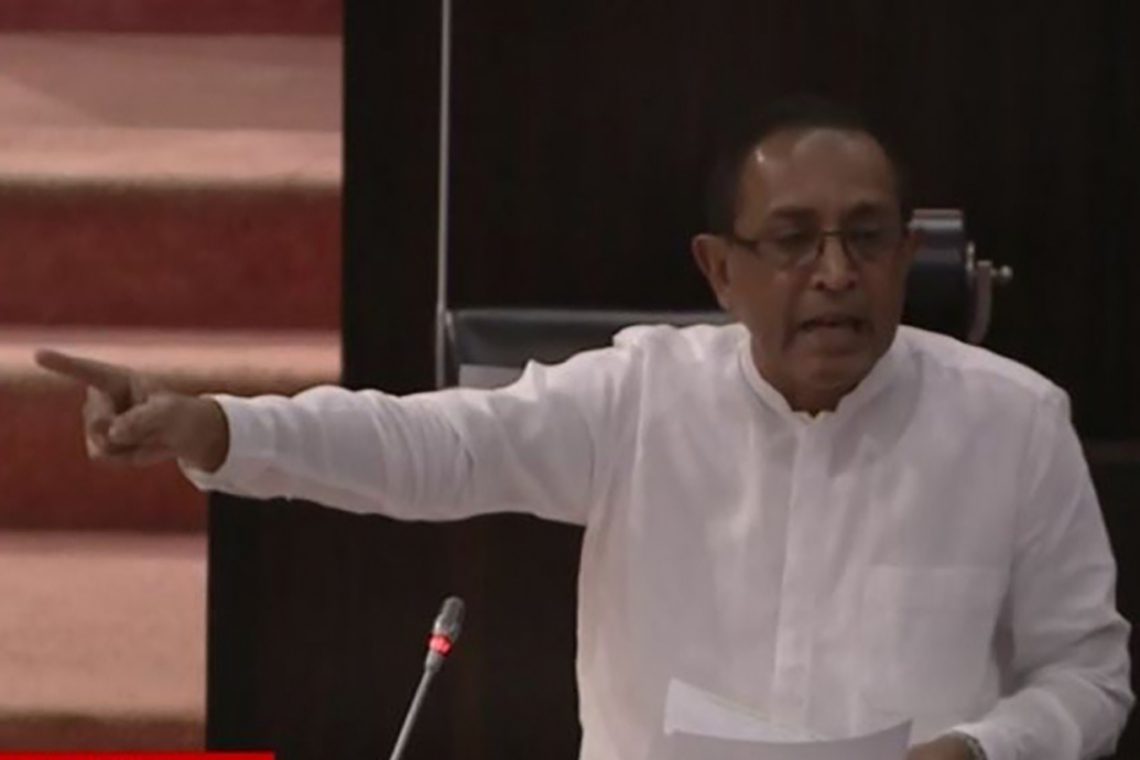
(Lanka-e-News -02.Dec.2025, 11.30 PM) In the aftermath of Sri Lanka’s latest climate catastrophe, the country is witnessing no shortage of political opportunism. Yet among all the voices rushing to claim moral high ground, one statement stood out—less for its insight, more for its audacity.
SJB parliamentarian Kabir Hashim, the son of a respected barrister but not a lawyer himself, and a self-declared economist who has never produced an academic paper nor held down a conventional job,living on income of the family plantation, his economist knowledge was questioned when Kabir’s involvement with Airbus scandal, who declared in Parliament yesterday that he would “sue the NPP government for ignoring the disaster.”
It was a performance characteristic of Hashim: dramatic, indignant, and suspiciously detached from scientific reality.
His personal story is well known. Born into privilege as the grandson of E. L. Hajiyar of Thunduwa, near Bentota, and married into a well-endowed political family from Kahawatta, Married daughter of Hussain Hajiyar’s daughter for drawry, became relative to dirty Governor -Muzzamil Hajiyar, Hashim has long fashioned himself as an intellectual heavyweight—despite a record that suggests he has inherited more than he has earned. Yet that does not deter him from lecturing governments on governance, economics, or now, disaster management.
And so, as floodwaters swallowed vast swathes of the island, Hashim seized the moment.
In Parliament, Hashim alleged that the government “failed to take necessary pre-emptive measures” despite advance warnings issued by the Department of Meteorology and the Department of Irrigation on 11 and 12 November.
According to him, the devastation—lives lost, homes destroyed, towns drowned—could have been avoided if only the NPP administration had acted “systematically” and opened major reservoirs gradually in response to the warnings.
“It is my firm belief,” Hashim declared, “that 75 per cent of those who died could have been saved had the sluice gates been opened gradually.”
The remark was met with raised eyebrows across the chamber—not only because it was speculative, but because the parliamentarian uttered it with the confidence of a seasoned hydrologist, meteorologist, legal expert and economist wrapped into one.
The scale of the disaster is unquestionable. Entire districts were submerged. Reservoirs overflowed with unprecedented force. Dozens lost their lives across Kandy, Kotmale, and Gampola. In Parliament, SJB’s Dayasiri Jayasekara went as far as likening the government’s alleged inaction to the negligence seen prior to the 2019 Easter Sunday attacks—a comparison that strained both logic and responsibility.
But Kabir Hashim’s claim that reservoir gates were opened “all at once” as a reckless, panic-driven decision is directly contradicted by technicians on the ground. According to internal reports from reservoir engineers—none of which Hashim produced or referred to—gate openings were timed according to established hydrological thresholds. The unprecedented rainfall was not merely heavy; it was record-breaking.
Yet Hashim’s narrative required a villain. The NPP government fit the role.
What he omitted, however, was that weather advisories do not automatically translate into operational feasibility. Reservoirs cannot simply be drained “in advance” on the assumption of disaster. If the heavy rains fail to come—as has happened many times before—the water shortage triggers an entirely different crisis: hydroelectric shortfalls, agricultural collapse, and drinking water scarcity.
These are not subtleties that fit neatly into a political soundbite.
Hashim’s assertion that “75 per cent of lives could have been saved” is not just unsubstantiated—it is scientific nonsense.
Flood behavior is governed by:
Soil saturation levels
Catchment dynamics
River morphology
Storm intensity and movement
Reservoir interconnections
Urban construction patterns
Illegal reclamation and blocked waterways
A parliamentarian waving numbers in the air is not evidence.
For decades, successive governments—including ones supported by Hashim—ignored warnings from hydrologists, environmental scientists, and urban planners. The country concretised riverbanks, filled marshlands, built houses on floodplains, and allowed commercial developers to devour natural drainage systems.
Hashim did not speak of these factors.
Instead, he zeroed in on a single talking point: reservoir gates.
It was a political choice, not a hydrological one.
There is an emerging trend among certain SJB figures to capitalise on natural disasters by drawing comparisons to unrelated national traumas. Jayasekara’s Easter attack analogy, for instance, was spectacularly irresponsible.
Hashim continued the theme by suggesting government indifference and negligence, turning a complex meteorological event into a courtroom drama with himself as the crusader.
“This is like the Easter Sunday negligence,” Jayasekara declared.
“This government ignored warnings,” Hashim insisted.
Neither statement acknowledged the distinction between intelligence failure and extreme weather.
But outrage plays well in the media.
The irony is difficult to ignore.
Kabir Hashim served in multiple governments that presided over:
The destruction of wetlands around Colombo
The illegal reclamation of flood zones
Unregulated construction along riverbanks
Policy paralysis on climate resilience
Zero investment in modern hydrological monitoring systems
Yet not once during those years did he threaten to sue his own government for failing to protect the public from predictable floods.
Nor did he raise his voice when meteorological equipment sat outdated for decades.
But today—when a new administration is barely months into office—he suddenly discovers his passion for disaster accountability.
What is unfolding appears to be a calculated political strategy:
Amplify public anger during disasters
Portray the government as incompetent
Invoke legal threats to create headlines
Shift blame away from decades of systemic neglect
Position themselves as the alternative
Hashim’s speech carried all these hallmarks.
Suing the government is not the point; being seen threatening to sue is.
Hashim’s central accusation—that the reservoirs were opened “all at once”—immediately went viral. Yet engineers from multiple sites have already dismissed the claim as an oversimplified political distortion.
Reservoirs are not taps.
They are complex hydraulic systems governed by strict protocols, not ministerial whims.
For Hashim to imply otherwise is to mislead the public.
His claim that the authorities “should have opened the gates slowly from the 11th” ignores the fact that rainfall patterns were erratic, localised, and intensified only after a critical threshold. Opening gates too early would have emptied reservoirs unnecessarily and created water shortages downstream.
But such operational realities have never stopped political rhetoric.
Hashim’s vow to sue the government faces several practical obstacles:
Governmental disaster response is protected by multiple legal immunities
Causation is nearly impossible to prove in court
Reservoir operations followed technical thresholds, not political decisions
The lawsuit would be seen as political theatre rather than legal necessity
Hashim would need to establish himself as an “aggrieved party,” which he is not
The chances of such a lawsuit surviving judicial scrutiny are slim.
But again, the objective is not legal victory.
The objective is a headline.
Sri Lanka’s floods have claimed lives, destroyed homes, and uprooted tens of thousands. In times like these, political parties should be uniting around relief and reconstruction—not turning climate tragedies into campaign platforms.
Yet Hashim, Dayasiri, and others appear committed to scripting their own melodrama.
The NPP government, while not flawless, is dealing with an acute disaster shaped by decades of neglect—neglect that transcends party lines and includes SJB’s own political ancestors.
The blame for Sri Lanka’s climate vulnerability cannot be placed on a government a few months old.
It belongs to those who allowed the country’s natural defences to be crushed under concrete, corruption, and political indifference for more than half a century.
If Kabir Hashim truly wishes to help the nation, he has options:
Propose climate adaptation legislation
Demand investment in updated meteorological systems
Advocate for modernised reservoir infrastructure
Call for audits of illegal landfilling and riverbank encroachment
Work with hydrologists rather than blame them
But leadership requires substance, not soundbites.
Instead, Sri Lanka receives courtroom threats, speculative numbers, and a political performance masquerading as accountability.
In a time of national mourning and suffering, Kabir Hashim’s attempt to weaponise a natural disaster against the government reveals more about his political strategy than about the disaster itself.
His threats of lawsuits may capture headlines, but they do not ease the grief of families who lost loved ones, nor do they help communities still under water.
Sri Lanka deserves a more honest conversation about climate resilience—one grounded in science, memory, and responsibility. Not another performance from a politician whose indignation grows only when the cameras switch on.
-By A Special Correspondent
---------------------------
by (2025-12-02 19:16:38)


 Read 52974 Times
Leave a Reply
 0 discussion on this news