
-By LeN Political Correspondent
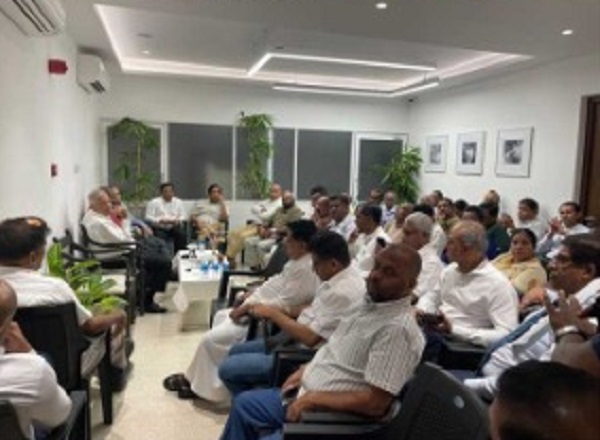
(Lanka-e-News -03.Dec.2025, 11.20 PM) It takes a special sort of political irony to watch a former President—one who spent years centralising power in his own office—suddenly crying out for the sanctity, dignity, and supremacy of Parliament. That irony arrived this week in the weary form of Ranil Wickremesinghe, who emerged from political semi-retirement to declare, with great solemnity, that the country must immediately shift disaster-response authority back from Pelawatte to Parliament.
For Sri Lankans awash in floodwaters—literally—this spectacle has raised eyebrows. Why now? Why the sudden devotion to parliamentary process from the very man who, not too long ago, treated the legislature like an inconvenience to be tolerated rather than respected? And why does this sermon come at a moment when the NPP government, operating from its disaster coordination hub in Pelawatte, has been delivering the most efficient, decentralised rescue operations Sri Lanka has seen in decades?
To understand Ranil’s lament, one must return to the current crisis: four days of torrential rains, thousands displaced, dozens dead, infrastructure crippled, and an entire nation struggling to breathe between storms. In this chaos, the NPP government mobilised its political network, local committees, youth cadres, and state machinery to move rapidly—at speeds far faster than the traditional bureaucratic chain allows. The administration’s decision to centralise emergency operations in Pelawatte, rather than the archaic structures buried in Colombo 07, has been widely praised by international observers and countless citizens.
But not by Ranil Wickremesinghe.
Appearing before political party leaders at his Flower Road office, the former President lamented that the NPP Politburo in Pelawatte was effectively running the state, thereby supposedly “bypassing official structures” and “politicising aid distribution.”
A bold claim, especially coming from the architect of multiple parallel institutions, ad-hoc economic councils, unelected technocratic bodies, and presidential task forces that never bothered to consult Parliament.
The irony is thicker than the monsoon mud.
In his address, Wickremesinghe thundered that the President must “immediately transfer authority back to Parliament” and restore the Disaster Management Act—legislation which his own governments, in various eras, allowed to wither without teeth, budgets, or proper national training.
He pointed fingers at the NPP leadership for allegedly sidelining ministries, departments, and officials who had “clear responsibilities” under the National Disaster Management Plan (2023–2030). The striking part is that these officials were nowhere to be found until the NPP mobilised them.
Ranil also insisted that:
The government “failed to activate disaster-management provisions” on 27 November.
Declaring 28 November a public holiday “froze all departments responsible under the plan.”
Aid distribution “became politicised” because the Pelawatte command centre operated outside the traditional bureaucratic chain.
The absence of workshops, drills, and simulations in 2025 contributed to institutional failure.
But even a cursory review of the situation shows something clearer: the disaster response machinery failed long before the rains began. It failed in the years Sri Lanka’s disaster infrastructure was deliberately underfunded. It failed during Ranil’s premierships and presidency, when warnings from climate agencies were ignored. It failed when the NDMC was left under-resourced and unmodernised. And it failed because political elites—Ranil included—never treated climate resilience as a national priority.
In contrast, the NPP government, only months into office, found itself confronting the worst climate event since 1978 with systems built by predecessors who never imagined a flood of this scale.
And yet, the NPP’s response—rapid, decentralised, and driven by local disaster committees—has received a level of public praise Ranil never enjoyed during his own tenure. That praise, perhaps, explains the former President’s sudden rediscovery of parliamentary supremacy.
1. The NPP Government Handled the Crisis Too Well
Ranil Wickremesinghe is a man who prides himself on being the adult in the room—calm, technocratic, and supposedly above the chaos of populist politics. But watching the NPP government respond with discipline, speed, and coordination must sting.
Pelawatte has become the epicentre of national crisis management—not Temple Trees, not the Presidential Secretariat, not the Disaster Management Centre on Vidya Mawatha.
This inversion of traditional power centres has clearly irritated Ranil.
2. Parliament Now Represents a New Majority - Not His
The Parliament Ranil speaks of today is not the Parliament he controlled through fragile coalitions or elite bargains. It is now dominated by fresh NPP MPs, independents, and reform-minded members who do not owe their careers to Ranil’s patronage networks.
Calling for more parliamentary authority today is effectively calling to constrain the President—an office he himself once used expansively without apology.
3. Ranil Needs Political Relevance
Since leaving office in 2024, Wickremesinghe has been adrift. His party is disintegrated. His political space has been overtaken by the NPP. His technocratic image has been challenged by a younger, more dynamic leadership.
Raising alarm about constitutional breaches, climate governance, and disaster acts gives him a platform to be heard again.
There is no political oxygen like a national crisis.
In his speech, Wickremesinghe laid out a laundry list of proposals:
✔ A Parliamentary Oversight Committee on Disaster Management
Chaired—interestingly—by someone like Kabir Hashim, his loyal ally. Equal representation for government and opposition. The committee to investigate the failures of 28 November within six months.
The implication: this government must be audited, but not the decades of negligence that preceded it.
✔ District Secretaries must lead relief and reconstruction
He insisted the JVP/NPP cadres be “kept away” from relief operations—despite the fact that many were the first responders on the ground, long before formal state machinery arrived.
✔ Disaster reconstruction will require international loans
He predicted that:
UK and EU will be unable to offer much due to financial crises
US will not fund reconstruction
ADB, AIIB, KOICA, JBIC should be the primary lenders
India may help rebuild railways
A fair point—but also a reminder that Sri Lanka’s climate vulnerability was worsened by decades of borrowing without investment in resilience.
✔ Sri Lanka must revive its climate adaptation policy
Something he, as President and Prime Minister, could have done—but didn’t.
✔ Religion must be brought into the national reconstruction conversation
This was perhaps the most curious suggestion.
Ranil proposed an all-religions summit chaired by the four Mahanayakes, with Christian, Hindu, and Muslim leaders also coordinating. He named officials who could represent the state under Articles 9 and 10 of the Constitution.
It was a vision that seemed less about disaster recovery and more about reviving his trademark elite consensus politics.
Throughout his speech, Wickremesinghe blamed the NPP government for bypassing Parliament, ignoring the Constitution, and politicising disaster relief.
But he did not mention:
The 2015–2019 period, when Parliament was sidelined by secretive bond deals and technocratic task forces.
The 2019 Easter Sunday aftermath, during which he clashed with the security establishment and left key systems paralysed.
His 2022–2024 presidency, when he governed through emergency regulations, ad-hoc committees, and a form of executive rule deeply distrusted by the public.
Nor did he acknowledge that the National Disaster Management Centre, over many administrations, became a bureaucratic museum piece—its digital platforms outdated, its staff under-trained, and its funding inconsistent.
In short: the Pelawatte emergency hub exists because Colombo’s disaster infrastructure was never modernised when Ranil had the chance.
The NPP’s approach has been unorthodox but effective:
Real-time situation rooms
Crowdsourced mapping
Satellite-assisted flood modelling
District-level units reporting directly to the national command centre
Independent volunteer networks integrated with state operations
Parliament, by contrast, still operates on printed order papers, faxed documents, and committee meetings that take two weeks to convene.
The NPP government realised that when a monsoon wall collapses on civilians, governance cannot wait for the Speaker to schedule debate.
Emergency powers are meant to be used in emergencies.
The public understands this. Ranil, it seems, does not.
For the first time in years, Sri Lanka’s disaster response is driven by:
1. Data, not rhetoric
2. Decentralised action, not ministerial ego
3. Community networks, not political intermediaries
4. Transparency—daily briefings, real-time dashboards, and open data
Public trust has surged, particularly in rural districts that felt abandoned under previous governments.
The NPP’s method is not perfect—many shelters are overcrowded, and food distribution still uneven—but it is undeniably more coherent than the last several administrations combined.
Ranil represents a political class that prefers procedural legitimacy over operational efficiency. Meetings, committees, reports, consultations—sometimes endless.
The NPP represents a class that prioritises outcomes over ceremony.
The clash is generational, ideological, and institutional.
Ranil’s plea for returning to “proper structures” would be more credible if those structures had ever worked. But Sri Lankans remember the failures: droughts mismanaged, floods responded to sluggishly, ministerial tours for photo-ops while citizens drowned.
Today, the NPP’s rapid, near-military style coordination feels refreshing in comparison.
For a public battered by rain, landslides, and economic pressure, the questions are simple:
Who showed up first?
Who delivered food?
Who evacuated families?
Who repaired the first roads?
Who provided live updates instead of political soundbites?
The answer, in nearly all cases, has been the NPP government and its local structures.
Ranil’s critique therefore reads less like a constitutional warning and more like a man trying desperately to stay politically relevant.
Sri Lanka does need a modern parliamentary framework for disaster governance.
Sri Lanka does need strong oversight, transparency, and post-disaster audits.
Sri Lanka does need international financing and long-term adaptation strategies.
But Sri Lanka also needs rescue boats now, shelters now, clean water now, and functioning roads now.
Governance is meaningless if lives are lost waiting for procedure.
The NPP government, whatever its imperfections, has acted decisively. Ranil Wickremesinghe has acted politically.
And therein lies the contradiction of the moment:
A former President who ignored Parliament for years now demands that Parliament command a rescue operation he never built. A new government, criticised for acting outside traditional structures, has delivered precisely the sort of leadership those structures failed to provide.
Sri Lankans know the difference.
In Pelawatte, the floodwaters are still receding.
In Flower Road, the political tears continue to flow.
-By LeN Political Correspondent
---------------------------
by (2025-12-03 20:01:02)


 Read 66576 Times
Leave a Reply
 0 discussion on this news