
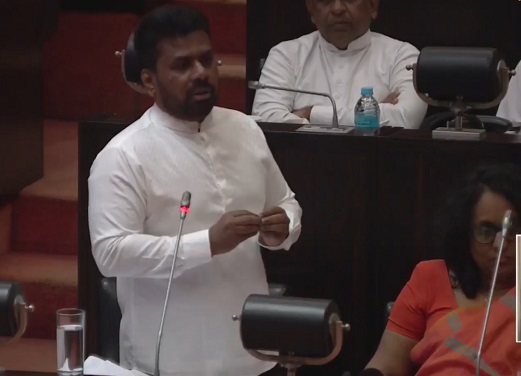
(Lanka-e-News -05.Dec.2025, 11.00 PM) In one of the most sweeping post-disaster relief announcements in Sri Lanka’s modern history, President Anura Kumara Dissanayake told Parliament today that families who have lost both their homes and the land they stood on during the recent floods and landslides will receive compensation of Rs. 10 million.
Even households that suffered only partial damage — “even if it is merely a roof tile blown off,” the President said — will receive Rs. 1 million, signalling an extraordinary shift in the State’s approach to disaster recovery.
Delivering his response during the final day of the Third Reading Budget Debate, the President outlined what he called “the largest relief umbrella ever extended to disaster-affected Sri Lankans.”
The budget vote itself passed with a commanding majority — 158 votes in favour, with just one vote against.
The President said that the scale of the disaster demanded an unprecedented intervention by the State, adding that the Government had chosen to elevate victims “not back to where they stood before, but to a higher and safer footing.”
He went on to detail a comprehensive list of benefits now being rolled out across the country, covering everything from emergency sanitation to rebuilding homes, restarting agricultural activities, restoring livelihoods, and relocating families from hazardous terrain.
According to the President:
Rs. 40 billion has been set aside for road rehabilitation.
The dry-ration allowance for a four-member family has been raised from Rs. 3,200 to Rs. 8,400 per week.
Larger households of five or more will now receive Rs. 10,500 per week, up from Rs. 3,600.
A supplementary estimate of Rs. 50 billion has been tabled, with an additional Rs. 22.2 billion allocated, bringing the total to Rs. 72.2 billion for immediate relief over the next 25 days.
District Secretaries have already been authorised to spend Rs. 10,500 million.
Every home inundated by floodwaters will receive:
Rs. 25,000 for mandatory cleaning and disinfection (previously Rs. 10,000).
Rs. 50,000 for essential household goods — including cooking utensils, bedding, and basic furnishings — regardless of whether the household owns or rents.
A circular authorising these payments was issued today, the President confirmed.
Families displaced by landslides or total destruction of property will receive:
Rs. 25,000 per month for three months (December 2025 to February 2026) to secure temporary accommodation.
The Government intends to extend this support to six months.
Even families opting to leave temporary shelters will receive the allowance, the President said.
Households whose income sources have been disrupted — whether they remain in camps or return to temporary housing — will receive:
Rs. 50,000 per month for three months for families of more than two members.
Rs. 25,000 per month for two-member households.
For damaged agricultural lands:
Paddy, maize, and other grains: Rs. 150,000 per hectare (previously Rs. 16,000–40,000 per acre).
Vegetables: Rs. 200,000 per hectare.
With 160,000 hectares of paddy reportedly affected, the President said the Government intends to replant “every last hectare.”
For livestock farmers registered with the Department of Animal Production and Health:
Rs. 200,000 per affected farm.
All registered micro and small businesses destroyed or severely damaged by the disaster will receive:
Rs. 200,000 to resume operations.
The Government is currently negotiating with banks and insurers to provide payment holidays, restructuring options, and further concessions.
Additionally, Rs. 80 billion, already allocated in the budget for SMEs, will now be prioritised for recovery and reconstruction.
Any registered fishing vessel rendered inoperable will receive:
Rs. 400,000 to restore livelihood capacity.
For the nearly 300,000 affected schoolchildren, the Government will provide:
Rs. 25,000 per child for books, uniforms, bags, and shoes
Rs. 15,000 from the Treasury
Rs. 10,000 from the President’s Fund
Students who already receive the Rs. 6,000 allowance under the Aswesuma programme will receive this in addition, bringing their total assistance to Rs. 31,000.
Businesses with damaged premises will be compensated up to:
Rs. 5 million per unit for structural repairs and reconstruction.
Families whose homes are entirely uninhabitable will receive:
Rs. 5 million to construct a new dwelling.
“We cannot calculate who lived in a house worth Rs. 3 million or Rs. 7 million — the destruction is total. We will give Rs. 5 million so that every family has the foundation to rebuild,” the President said.
For those who have lost both home and land:
The Government will provide either a new State land parcel or
Rs. 5 million to rebuild plus another Rs. 5 million to buy land in a safe location,
bringing the total compensation to Rs. 10 million.
“We will not permit anyone to rebuild in a hazardous zone,” the President stressed.
For partially damaged homes:
Compensation will be allocated across four categories — Rs. 1 million, 1.5 million, 2 million, and 2.5 million, depending on the severity.
“Even if a single roof tile has blown off, the family will receive Rs. 1 million,” the President said. “Not to restore them to the same vulnerable place, but to uplift them to a safer, more secure location.”
Families of those who died in the disaster will receive:
Rs. 1 million each.
“Human life is priceless,” the President said. “But the State will support the families left behind.”
Total Estimated Cost: Rs. 72.2 Billion for 2025, and Rs. 500 Billion for 2026
The Government expects to mobilise:
Rs. 72.2 billion for immediate expenditure in 2025
Rs. 500 billion for the broader long-term recovery effort in 2026
The President reiterated that debt ceilings would not be raised to fund these measures.
The President issued a firm directive:
No reconstruction will be permitted on dangerous slopes,
Reservoir bunds,
Riverbanks,
Or any area classified as a hazardous zone.
He urged Opposition MPs to support the relocation programme and not provoke public unrest by claiming the Government was attempting to “evict” residents.
“This is a national duty,” he said.
In a further strategic long-term measure, the President said that hilltops above 5,000 feet would be reforested to reduce soil erosion, siltation, and rapid runoff that contributes to flooding.
Siltation in major reservoirs has filled 40–50% of their capacity, he warned, making upstream reforestation essential.
A full video of the President’s hour-and-a-half address is available below
---------------------------
by (2025-12-05 19:14:53)


)


 Read 81444 Times
Leave a Reply
 0 discussion on this news