-By LeN Foreign Affairs Editor -New Delhi / Colombo
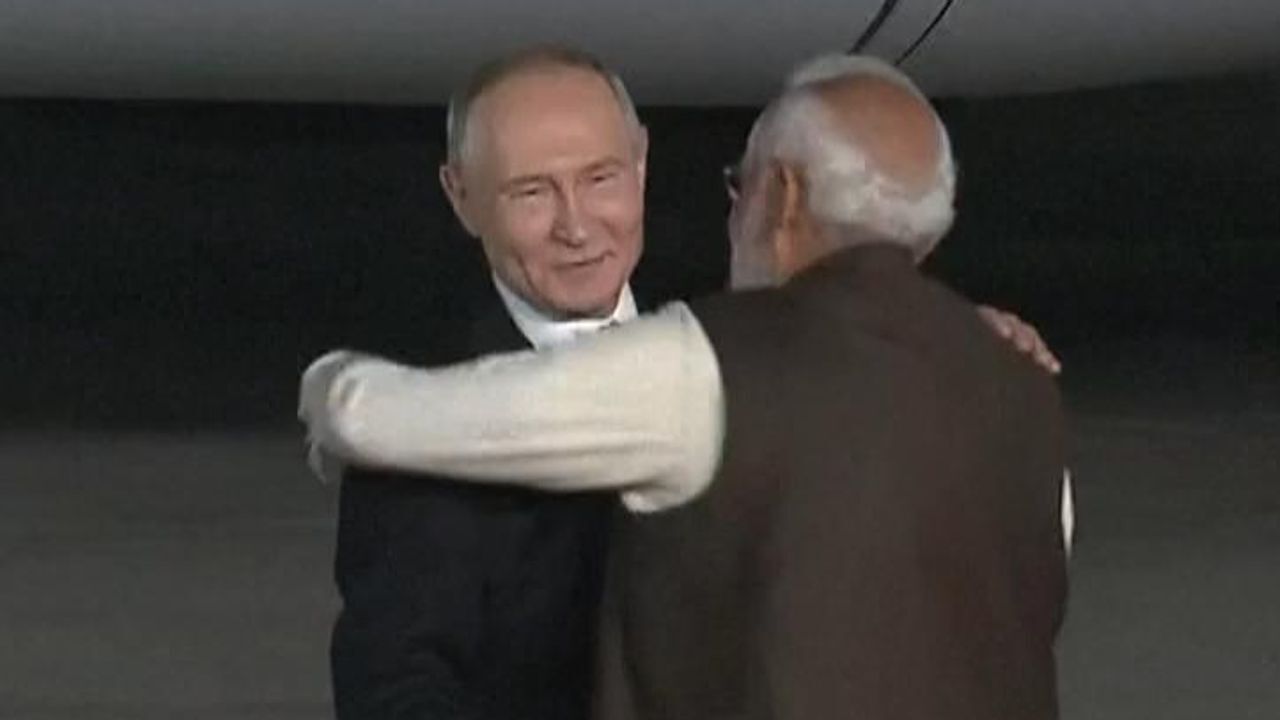
(Lanka-e-News -05.Dec.2025, 11.30 PM) Russian President Vladimir Putin’s arrival in New Delhi yesterday has sent tremors across the Indo-Pacific strategic map, with a slew of leaked agreements hinting at a deepening Russia–India security axis that could redraw naval power balances from the Arctic Circle to the Indian Ocean — and place Sri Lanka at the uncomfortable centre of great-power manoeuvring.
While India presented the visit as a “normalisation of strategic cooperation,” documents allegedly leaked to Lanka e-News paint a far more ambitious picture: joint Arctic expeditions allowing Indian naval personnel to be embedded with Russian units, enhanced nuclear-sharing consultations, operational access for Russian vessels at an Indian air station in Tamil Nadu, and a revived push for the Chennai–Vladivostok maritime corridor, a corridor that notably bypasses Sri Lankan waters.
For Colombo — under the NPP government and trying to maintain a rigidly neutral, non-aligned posture — the symbolism was unmistakable. As Putin and Modi clasped hands in Delhi, their joint communiqué was delivered with what many diplomats described as an “extended glance southward.”
Among the most striking revelations is a proposed Russia–India Arctic cooperation framework. Ostensibly a scientific research pact, the agreement reportedly allows Indian naval observers — and possibly limited operational detachments — aboard Russian vessels operating in the Northern Sea Route.
Western intelligence officials warn this could quietly evolve into a long-term Indo-Russian military footprint in the Arctic, allowing India access to Russian satellite, sonar, and nuclear-submarine domain awareness at a time when New Delhi remains deeply anxious about China’s growing polar presence.
The pact also includes “advanced nuclear dialogue mechanisms,” wording that in diplomatic circles denotes technology-sharing at the outer edges of what is legally permissible under nuclear non-proliferation rules.
“This is not casual cooperation; it is structural alignment,” said one European diplomat stationed in Delhi. “If true, it is the deepest defence linkage between Russia and India since the Soviet period.”
Behind India’s eagerness lies a deep strategic insecurity.
Last year’s brief but sharp India–Pakistan air confrontation exposed glaring vulnerabilities in India’s airborne early-warning and air-defence systems. Pakistani jets, operating with Turkish-supported 5th-generation upgrades, reportedly penetrated Indian airspace more effectively than anticipated. Pakistan’s new Chinese-supplied radars and missile batteries also demonstrated striking capabilities.
Indian defence planners, already overstretched with only a handful of operational fighter squadrons, emerged from the conflict with a grim conclusion: India’s air defence network is outdated and dangerously thin.
That urgency is believed to be driving renewed talks for India to purchase — or co-develop — elements of Russia’s SU-57 fifth-generation fighter, aircraft long considered unattainable for export.
For Moscow, isolated from Western markets, Delhi provides both cash and influence. For India, desperate to close the gap with China and Pakistan, Russian technology offers a lifeline.
Putin’s trip coincides with intensified Indo-Russian cooperation on long-range missile systems, including:
BrahMos upgrades, extending range, guidance, and sea-skimming capability
The NG-1500 km transformation missile, an Indo-Russian project intended to give India a deep-strike capability spanning the Arabian Sea, Bay of Bengal and parts of the Western Pacific
These systems, analysts argue, could cement a long-term military dependency between the two countries — even as India publicly claims its doctrine is “multi-aligned.”
Perhaps the most geopolitically sensitive piece of the puzzle is a leaked discussion about granting Russia access to INS Rajali, the massive naval aviation base at Arakkonam, Tamil Nadu. It is India’s largest naval air station, home to reconnaissance aircraft monitoring key Indian Ocean shipping lanes.
Sources claim the arrangement resembles a “lease-light” model, allowing Russian naval aviation units periodic basing and refuelling rights.
If true, this places Russian military assets a short flight from the southern tip of Sri Lanka — and within the operational envelope of US, UK, Australian, and Japanese naval routes in the Indo-Pacific.
This would be Moscow’s first semi-permanent positioning of forces in the Indian Ocean since the Cold War.
The Chennai–Vladivostok maritime corridor, long discussed and often dismissed as impractical, has surged back onto the agenda. The proposed shipping line — which skirts Sri Lanka — could form a Russia–India logistical superhighway from the Arctic to the Indian Ocean.
But Western diplomats warn the route may face significant geopolitical friction:
The US and UK maintain heavy operational presence around Diego Garcia and the wider Indian Ocean
Australia and Japan view Russian expansion with suspicion
Sri Lanka, despite being geographically bypassed, sits at the strategic “choke point” of the central Indian Ocean
“If the US wanted to complicate the corridor, Sri Lanka is where it would do it,” said a former Pentagon official familiar with maritime strategy.
Overlaying these security concerns is another disturbing pattern: evidence of Russian financial support flowing to far-right political movements across Europe, the UK, the US, India — and even segments of the Hindu nationalist ecosystem aligned with the BJP.
Recent intelligence leaks from European services suggest that Russia has channelled funds to:
Far-right parties in Germany and Hungary
Fringe anti-Semitic networks in the US
Populist nationalist groups in the UK
And, more recently, ideological affiliates of India’s BJP
The alleged aim, according to Western analysts, is to undermine liberal democracies, weaken institutional resilience, and fracture Western alliances — a strategy Moscow has employed since the mid-2010s.
If these campaigns expand into South Asia, Colombo will not be immune.
“Sri Lanka has always been vulnerable to external ideological financing, whether from Gulf Islamism or South Asian nationalism,” one British intelligence officer observed. “The Kremlin sees identity politics as a strategic tool.”
For Sri Lanka, the geopolitical implications are enormous.
Colombo has faced recent proposals — particularly from Western analysts and Gulf security consultants — urging it to adopt a Djibouti-style “multi-base leasing” model, allowing foreign navies to bid for access in exchange for revenue.
But under the NPP government, Sri Lanka has leaned firmly back into non-alignment, refusing to become a permanent extension of any great power’s naval strategy.
With Russian naval forces potentially operating from Tamil Nadu, and Indo-Pacific alliance states operating from Diego Garcia, Trincomalee, and Malé, Sri Lanka sits in the middle of a widening strategic triangle.
It cannot afford missteps.
It cannot afford alignment.
And yet, neutrality is becoming harder by the day.
Putin’s Delhi visit, analysts say, may accelerate that pressure.
“Moscow is pointing toward Colombo not as a threat, but as a reminder: geography commands obedience,” said a senior Sri Lankan diplomat. “If India and Russia tighten their corridor, and if the West counters it, Sri Lanka becomes the silent battlefield — unless we play this perfectly.”
As Putin departs Delhi, one truth is clear: the Indo-Pacific is entering a new phase of great-power manoeuvring, with India emerging as the unlikely hinge between Russia’s Arctic vision and Asia’s contested waters.
Sri Lanka’s role — or refusal to play one — may be decisive.
For now, Colombo watches quietly. Neutral. Unaligned. But increasingly aware that the world’s strongest men, from Moscow to Delhi, are pointing in its direction.
-By LeN Foreign Affairs Editor -New Delhi / Colombo
---------------------------
by (2025-12-05 19:40:15)


 Read 28674 Times
Leave a Reply
 0 discussion on this news