
-By Chula Goonasekera - Citizen Analyst
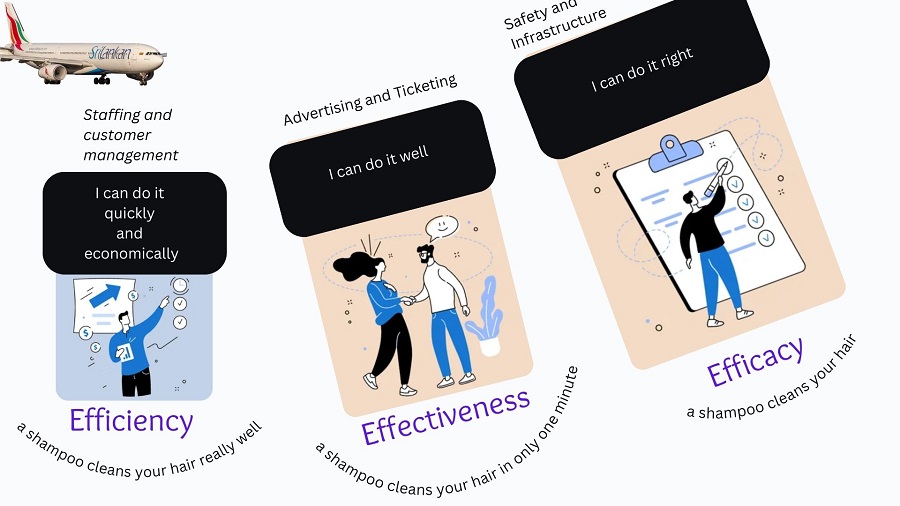
(Lanka-e-News -09.March.2026, 7.10 PM) Efficacy measures an organisation’s capacity to achieve its mission and intended outcomes under planned or optimal conditions. It differs from efficiency, which focuses on achieving objectives with minimal resources, and effectiveness, which evaluates results in real-world conditions. Today, modern AI tools, using publicly available data, enable objective assessment of the efficacy of Sri Lanka’s government institutions.
Among key public bodies, the Supreme Court of Sri Lanka emerges as the most efficacious, outperforming the Department of Inland Revenue, Sri Lanka Customs, the Election Commission, and Parliament. In the financial and regulatory sector, the Central Bank of Sri Lanka (CBSL) ranks highest, ahead of the Securities and Exchange Commission, the Public Utilities Commission, the Telecommunications Regulatory Commission, the Insurance Regulatory Commission, and the Sri Lanka Standards Institution.
Among state-owned enterprises, the Sri Lanka Ports Authority (SLPA) leads in efficacy, followed by Bank of Ceylon and People’s Bank. Other institutions assessed included the State Pharmaceuticals Corporation, the National Water Supply and Drainage Board, the Ceylon Electricity Board, the Ceylon Petroleum Corporation, and the Sri Lanka Transport Board. At the lower end of the spectrum were Lanka Sathosa and Sri Lankan Airlines, highlighting a critical challenge for the national economy.
Sri Lankan Airlines, consistently ranked at the bottom, has long been a financial drain. Despite successive governments’ reform attempts, sustainable solutions remain elusive.
Globally, the most profitable airlines operate as highly integrated, technology-enabled ecosystems rather than as fragmented departments. Operations, finance, fleet management, route planning, engineering, marketing, and customer service are closely coordinated, sharing real-time data to maximise efficiency, safety, and profitability.
The challenge for Sri Lankan Airlines is structural. Its operations are fragmented, overly hierarchical, and poorly aligned. Simply replacing the CEO or senior leadership will not address these deep-seated weaknesses. What the airline needs is a cohesive, integrated organisational ecosystem that leverages technology for cross-functional planning and real-time decision-making.
The government must urgently consider restructuring Sri Lankan Airlines to encourage:
* Joint planning across operational divisions
* Data-driven, evidence-based decision-making
* Continuous cross-functional consultation
* Collaborative strategic decisions on route rationalisation, fleet renewal, partnerships, and cost management, rather than exclusive top-down mandates
Sustainable reform requires systemic change. Without modernised organisational structures, stronger accountability, and aligned incentives across divisions, financial recovery will remain out of reach. An integrated, performance-oriented model offers the most realistic path to operational efficiency and long-term viability.
Reforming loss-making institutions like Sri Lankan Airlines is not merely a matter of leadership change — it is a structural overhaul essential to ensuring these entities contribute productively to the national economy rather than remain perpetual burdens.
---------------------------
by (2026-03-09 13:47:29)


 Read 10608 Times
Leave a Reply
 0 discussion on this news