
-By Prof. Desmond Mallikarchchi
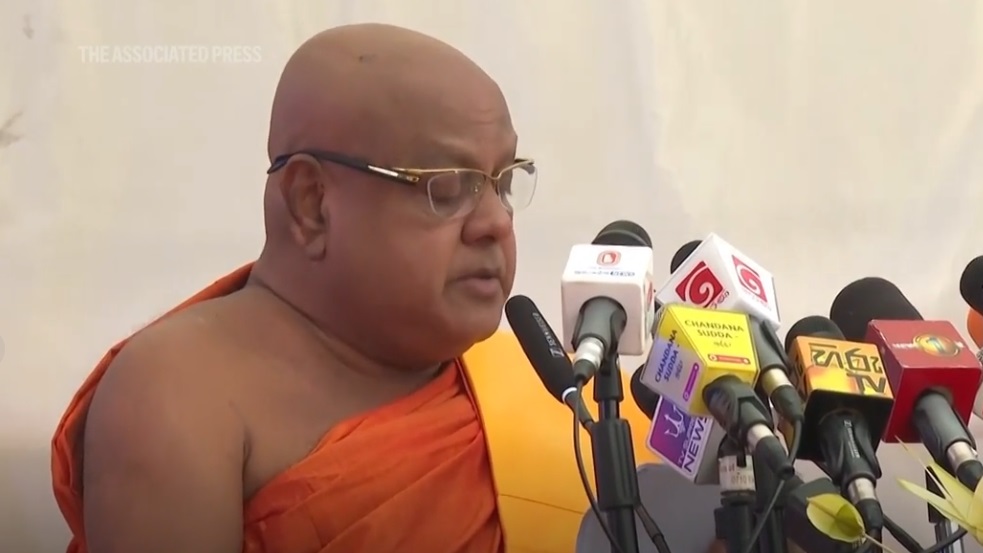
(Lanka-e-News -21.March.2026, 2.00 PM) On February 20, a group of monks announced publicly that 10,000 monks from all over Sri Lanka would march to Colombo and that they would organize the entire Sangha to expel the Malimawa government if immediate action was not taken to stop the alleged injustices and insults being committed against Buddhism and the mistreatment of monks.
However, although it was claimed that ten thousand would attend, only about 270 odd monks were actually present at that gathering which can be rated as one of the most unsuccessful events in the history of the post-independence Sri Lankan Sangha conventions. This happened so for the following reasons among others.
1. The questionable background of the monks who organized it.
2. The attempt to create the false impression that Buddhism is facing an existential crisis under the present government.
3. The people’s realization of the rally’s hidden agenda or true intent—
4. The use of inappropriate and immoral language, including offensive sexual analogies (for example, likening a moving train piston to sexual intercourse), contradicts the Buddha’s teachings and accepted standards of monastic conduct..
Although the fiasco drew significant criticism in both mainstream and social media, most discussions remained limited to observations and partisan perspectives rather than deeper theoretical analysis. This article, therefore, makes an attempt to briefly analyze the disastrous Bhikku rally using four theoretical concepts: authority (Max Weber), symbolic capital (Pierre Bourdieu), sexual fetishism (Freud), and sexual discourse (Foucault).
The failed Sangha rally held on 20 February can be understood through the concept of authority developed by Max Weber. Weber identifies three main types of authority: traditional, charismatic, and legal-rational. The authority historically held by the Buddhist Sangha in Sri Lanka largely derives from traditional authority, rooted in long-standing religious respect and moral leadership within society.
However, when members of the Sangha become directly involved in partisan political mobilization, this traditional moral authority may be weakened. In the case of the rally, the overt political messaging and controversial public speeches appear to have conflicted with the public’s expectation of monks as neutral moral guides rather than political actors. As a result, the symbolic legitimacy that normally supports monastic authority was challenged.
From a Weberian perspective, the rally’s failure can therefore be interpreted as a crisis of legitimacy, where the Sangha’s traditional authority did not successfully translate into political influence or public support. This suggests that when religious authority is used for explicit political purposes, its social legitimacy may decline rather than strengthen.
In Buddhist doctrine, especially the Noble Eightfold Path, Right Speech (samma vacha) and Right Action (samma kammantha) are essential virtues. When organizers are perceived as lacking moral consistency or ethical restraint, their charismatic legitimacy weakens. Public trust (or what Weber describes as the “legitimacy belief ’) is indispensable. Once diminished, the persuasive force of religious leadership declines accordingly. When religious leadership declines and the behaviour of monks is perceived as dishonourable and corrupt, the virtuous Sangha and pious laity refrain from participating in the rally.
The rally can also be interpreted through the theoretical framework of Pierre Bourdieu, particularly his concepts of symbolic capital, religious capital and social fields. According to Bourdieu, symbolic capital refers to the prestige, recognition, and moral authority individuals or groups accumulate within society. In the Sri Lankan context, the Buddhist Sangha traditionally possesses significant symbolic religious capital derived from their role as custodians of the teachings of the Buddha and as moral guides within society. This symbolic authority historically grants monks a high degree of social respect and influence. By entering overt political mobilization, the monks attempted to translate religious authority into political power, but the rally’s limited impact suggests that this capital is no longer fully recognized or easily convertible. Rather than demonstrating strength, the event revealed the fragility and possible erosion of the Sangha’s symbolic authority in contemporary Sri Lanka.
Bourdieu also argues that society is composed of different fields—relatively autonomous areas such as religion, politics, and education—each governed by its own rules, forms of capital, and struggles for power. When actors move from one field to another, the forms of capital that grant them authority in one arena may not automatically translate into influence in another. The rally’s latent but clearly visible and perceived aim of regime change transformed religious /spiritual capital into partisan currency. This translation or conversion devalued its symbolic worth. To put the same in economic metaphor in relation to the failed rally: ascetic or religious capital will be depreciated when exchanged it for personal and political gain.
Thus the Sangha rally appears to illustrate this tension between fields. While monks possess considerable symbolic capital within the religious field, their attempt to mobilize within the political field may not have generated the expected public support. Political legitimacy requires different forms of capital, such as electoral credibility, policy leadership, and broad political alliances. As a result, the religious prestige of the Sangha did not necessarily convert into effective political mobilization.
From a Bourdieusian perspective, the rally’s limited impact can therefore be understood as a misalignment between fields, where symbolic religious capital lost some of its effectiveness when deployed in the competitive and contested arena of politics. This helps explain why traditional moral authority alone may not guarantee success in political activism
A particularly damaging episode unfolded when a monk (probably the keynote speaker at the rally), employed a crude analogy that compared the motion of pistons in a moving train to sexual intercourse. (As locomotives did not exist during the time of the Buddha these kind of metaphors were not mentioned in his discourses hence cannot be found in texts and cannons though some Buddhist monks today use such metaphors in their sermons—(e.g.Tibetan monk Mingyur Rinpoche).However, if viewed from a doctrinal perspective, Kotapitiye Rahula’s deployment of this analogy contradicts the monastic commitment to celibacy, restraint, and purity of speech. The Vinaya tradition demands careful regulation of speech, while right speech requires communication that is truthful, beneficial, and free from vulgarity.
Let’s explore this a little further through Sigmund Freud’s theory of sexual fetishism.
The Train-Piston analogy which caused a furore can best be interpreted through psychoanalytic theory. Sigmund Freud proposed that repressed sexual impulses often surface symbolically in language and metaphor (Freud, Three Essays on the Theory of Sexuality 1905/The Ego and the Id (1960).Sigmund Freud proposed that repressed sexual impulses often surface symbolically in language and metaphor (Freud, 1905/1960). Mechanical or repetitive imagery, such as pistons in motion, may function as symbolic displacement of sexual content. Freud’s theory of fetishism highlighted that non-sexual objects can become invested with sexual meaning through psychological association. Within this framework, Kotapitiye Rahula’s analogy may reflect unresolved tensions between institutional celibacy and unconscious libido. While psychoanalysis does not offer moral judgments, it provides a lens for understanding how repressed impulses may manifest in symbolic speech. Kotapitiye Rahula’s widely condemned address is a classic demonstration of Freud’s theory of sexual fetishism.
For a monk—whose identity is constructed around renunciation and sublimation of desire—the public articulation of sexually charged imagery intensifies the perceived contradiction. At least if he had utilised this metaphor to explain the nature and the process of craving (thanha), (for e.g. the body as a machine driven by the "piston" of desire, which keeps the "train" of Samsara (cyclic existence) moving), he would not have succumbed to the opprobrium he faced. But he had a different motive: to condemn the new sex education policy introduced by the Malimawa government. The reverend monk unfortunately paid the price for forsaking wisdom for political expediency.
Aristotle’s concept of ethos (Aristotle, trans. 2007) emphasizes that credibility arises not only from moral character but also from the manner of expression. Harsh or sexually suggestive language undermines persuasive authority. Similarly, Jürgen Habermas (1984) argues that legitimate public discourse must aim at rational understanding and mutual respect. When rhetoric becomes crude or sensational, it compromises deliberative legitimacy. Keynote speaker Rev. Rahula provided empirical support for Habermas’s theory of legitimacy. Besides, this inconsistency between professed spiritual values and sexually provocative imagery produces cognitive dissonance among observers. This explains why venerable Rahula, above all others, became the primary target of criticism.
I am aware that the technical analogies often used to describe the mechanical and cyclical nature of desire and the body—such as those employed by the Tibetan monk Rinpoch—function primarily as psychological and metaphysical critiques within Buddhism, whereas the work of the late French philosopher Michel Foucault offers a socio-political critique of how power shapes the body. Nevertheless, Foucault’s ideas are immensely helpful for understanding the rally in general and Kotapitiye Rahula’s “train-piston” analogy in particular. This article, however, focuses only on two of these concepts, drawing on his The History of Sexuality, Volume 1.
(a) Foucault shows that sexual meanings are not natural or fixed; they are socially produced through discourse. Rahula’s “train piston” analogy not only contributes to the sexual discourse in Sri Lanka but also it sexualizes monastic activity, transforming a moral or religious act into an eroticized image. From a Foucauldian perspective, this is not just a metaphorical slip; it participates in a discursive production of sexuality, inserting monks into a framework of desire and bodily power that is alien to traditional monastic norms and ideals.
(b) Foucault emphasizes that power operates through the regulation and knowledge of bodies. By using sexualized language, Rahula attempts to claim authority through provocative, per formative control over how his audience perceives monastic bodies. The analogy, rather than enhancing moral or spiritual authority, exposes a troubling attempt to manipulate desire and attention — a misuse of the monk’s symbolic and religious capital. The failed rally indicates that this strategy did not produce obedience or mobilization, highlighting how sexualized discourse can backfire when applied to sacred authority.
(c)Finally, Foucault’s idea that discourse produces subjects shows that Rahula’s speech attempts to reshape both monk and lay audience as sexualized subjects. It transforms monks from moral and spiritual actors into instruments of eroticized analogy, and positions the audience to perceive monastic authority through a sexualized lens — a move that destabilizes rather than reinforces the Sangha’s traditional religious and moral capitals.
From Foucault’s perspective, the “train piston” analogy illustrates how discourse shapes both power and subjects. Sexualized imagery inserted monks into a framework of desire and bodily power, destabilizing traditional religious authority and producing the audience and the monks themselves as sexualized subjects. Rather than consolidating influence, this Foucauldian lens shows that the analogy transformed sacred authority into spectacle, weakening both spiritual and disciplinary legitimacy.
Together, these theoretical frameworks suggest that the rally’s failure was not merely organizational but structural: a Weberian crisis of authority, a Bourdieusian mismanagement of symbolic capital, a Freudian concept of sexual fetishism, and a Foucauldian discursive destabilization of religious subjects. All these factors converged to reveal the fragility of monastic political influence in contemporary Sri Lanka. The Sangha rally held on 20 February served as a concrete example of this broader degeneration.
Prof. of Philosophy (rtd)
University of Peradeniya
[email protected]
---------------------------
by (2026-03-20 09:20:10)


 Read 57150 Times
Leave a Reply
 0 discussion on this news