By Ajith Dharmakirthi.
(Lanka-e-News -2026.April 07, 3.00 A.M.) The 1971 rebellion and the JVP's evolution to the formation of a government led by the JVP are as amazing as a miracle. But we do not believe in miracles. What really happened?
The JVP was founded in 1965. It is sixty-two years old today. The founder of its formation, Don Jinadasa Nandasiri Wijeweera, or Rohana Wijeweera, was a revolutionary with a strong political personality who studied medicine at the Lumumba University of the Soviet Union. Inspired by Marxist-Leninist and Maoist thought, he later broke away from the traditional communist party of the time. He initially joined Shanmugadasaman's Communist Party (Chinese faction) but left it when he found that it did not bring the changes he had hoped for. The Chinese faction of the Communist Party was a party based on workers in Colombo. The JVP attracted rural youth from its inception.
The ideological series of lectures that Rohana Wijeweera used to form the Janatha Vimukthi Peramuna (JVP) in the late 1960s is known as the "Panthi Paha" (Five Classes). This was the main tool used to inspire the unemployed and oppressed rural youth of the time to join an armed revolution. The JVP was mainly composed of educated but unemployed rural youth who were ignored by the traditional political elite.
1. The crisis of the capitalist system
Here, the current economic system in the world and in Sri Lanka was discussed. It was explained that capitalism is a system that exploits people, and in that system, the common people and the youth inherit only unemployment and poverty. This emphasized that the people will not get relief without changing the existing system.
2. Freedom - A Lie Held in the Hand
This class taught that the freedom that Sri Lanka gained in 1948 was not real freedom. It was argued that Sri Lanka was still under the indirect grip of British imperialism (Neo-colonialism) and that the rulers of our country were acting as agents of the British. It was said that real freedom could only be achieved by overthrowing the pro-imperialist regime.
3. Indian expansionism
This was a very controversial class at the time. It was said that India was trying to spread economic and political dominance over Sri Lanka, and that people of Indian origin in the plantations could be used as a "fifth force". Because of this, a certain nationalist tendency could also be seen in the JVP at that time.
4. The betrayal of the left
The aim was to criticize the "old left", such as the Lanka Sama Samaja Party and the Communist Party at that time. The JVP argued that they had betrayed the working class by abandoning the revolutionary path and agreeing to parliamentary politics and forming coalition governments with capitalist governments.
5. The path that the revolution in Sri Lanka should take
This was the last and most important class. It was decided that socialism could never be established through the parliamentary system and that the only path was "armed struggle". Here, basic instructions were given on how to seize state power through guerrilla warfare or immediate attacks, depending on the geographical location of Sri Lanka.
This lecture series was held in secret, and it succeeded in instilling strict discipline and a common purpose among party members. Since it was delivered in simple Sinhala and used rural examples, it was very popular among educated rural youth. These five classes were the ideological strength of thousands of youth who participated in the 1971 uprising against the government of the Great Queen.
The 1971 uprising was a decisive turning point in the history of Sri Lanka. This was the first time since independence that a government in this country faced a strong armed challenge from within its own main community (the Sinhalese), and it fundamentally changed the political trajectory of the island.
At that time, the Sri Lankan army was small and poorly equipped. The government sought international support, and despite the Cold War, Britain, America, the Soviet Union, India, and Pakistan all supported the government in suppressing the rebellion. The Soviet Union, a socialist country, supported the left-wing United Front government, which was forming a coalition government with the Communist Party of Sri Lanka.
Although the rebellion was suppressed in a short period of two months, it was very brutal. Although official reports say that about 1,200 deaths occurred, independent reports indicate that between 5,000 and 20,000 youths sacrificed their lives for the rebellion and socialism.
Wijeweera was sentenced to life imprisonment (later reduced to 20 years), and his statement during the trial, "We may be killed, but our voice will never die", managed to create some excitement among the leftist youth about the rebellion.
Before the rebellion began, its leader, Rohana Wijeweera was arrested and detained in the Jaffna prison by the government. Two of the team sent to rescue him were H. B. Gunaratne and Ranjitha Henayake Arachchi. The book '71 Uprising Jaffna', edited by the two, contains the following note:
"We were in a self-induced trance. That mood was created in us, young people, by the organization. We are those who are committed to the revolution of the oppressed people. We are the saviors of the people. We have given up our education, jobs, and middle-class lifestyles and are dedicated to the people. We, who will provide the people with a complete socialist way of life tomorrow, have nothing wrong with killing and eating two chickens from their chicken coop today. Because we are doing all this for them." (*Quote p. 123) I quoted this to give some impression of those who participated in the '71 uprising.
However, the National People's Force, which is the basis of the current Janatha Vimukthi Peramuna, has largely deviated from this early "five classes" ideology and operates within the democratic political flow.
Rohana Wijeweera and the Central Committee changed the five classes only after independence in 1977.
The five classes included:
1. The economic crisis
2. The Menshevik movement (the betrayal of the old left and the reason for the emergence of the JVP based on the Bolshevik-Menshevik split before the Russian Revolution)
3. The experiences of the Russian, Chinese, Cuban, and Vietnamese revolutions
4. The fundamentals of Marxist philosophy and the need for a Leninist Bolshevik party and its form
5. The history of the JVP party (this is somewhat similar to the history of the Soviet Communist Party that we studied in the Soviet Union)
A major difference here is that Wijeweera himself abandoned the idea of Indian expansionism.
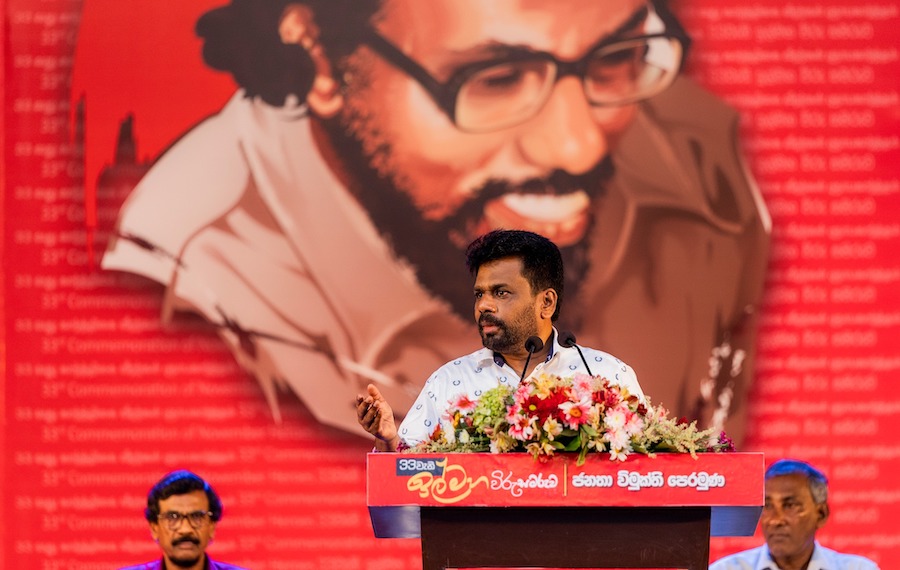
When comparing the current President Anura Kumara Dissanayake-led National People's Power (NPP) government and the 1971 uprising, we can see how an armed youth movement came to democratic power.
The main objective of the '71 rebellion was to seize state power by force and establish a fully socialist state.
The National People's Party (NPP) took power through the existing democratic system, and its main objectives were to eliminate corruption, establish the rule of law, and provide a better living environment for all.
The main ideology of the rebels was Marxism-Leninism. The question arises here: why did the rebellion not receive support from the Soviet Union, China or Cuba? The reason is that the JVP did not have any international relations in those days. Also, the Communist Party of the Soviet Union called this youth rebellion a far-leftist utopia.
The rebels were left-wing hardliners, and anti-Indiaism was the basis of their foreign policy, if they had one. They looked at India and the West with suspicion.
The National People's Power government values practical social democracy and prioritizes the welfare of the people in a market economy, giving priority to merit and creating a more just and law-abiding society. The NPP government, which maintains balanced relations with India, China, and the West, works in cooperation with the International Monetary Fund.
The youth of the 1971 generation are a group of mostly rural youth who were marginalized by the English-speaking elite and believed that only violence could change the system.
Today, not only rural youth, but also the urban middle class, professionals, and university students have rallied around the National People's Power. They came to power not through guns but through the 'struggle' and the ballot box in 2022. But even those who are barely connected to that generation can still be seen using their ability or inability to speak English to tease the current leaders.
This is a rather complex question.
On the one hand, the youth of 1971 wanted to break the political power that was limited to a few families. That hope has been fulfilled through the huge victory achieved by the National People's Power in 2024. Looking at the struggle of those families to regain power, won't the brothers of the '71 rebellion, who are currently living, be excited?
Some of the NPP members in the 71 rebellion disagree with the NPP...
But a JVP member who was in 1971 would be surprised that the current government is working with the International Monetary Fund. The current government is not on a "revolutionary" path but a "pragmatic" economic path. That will be difficult for them to understand. Also, instead of the strong anti-India stance that existed then, the current government is working closely with India at a very close diplomatic level. Indian aid and international support are very important for Sri Lanka.
The youth of 1971 sacrificed their lives for a "fully socialist government". But the current JVP has gone beyond that ideology and evolved towards a "successful democratic government". While this may be seen as a victory for those who survived the 1971 rebellion, hard-line leftists may see this as a departure from their original ideology.
The Janatha Vimukthi Peramuna was a party that was badly battered by the '71 rebellion as well as the youth uprisings of 88-89. It was a party that was considered destroyed by its enemies both times. After its nationalist part and a more leftist hardline part separated, it was a party that was re-branded as a more moderate and practical party, according to the current socio-political situation.
Today, there is only one country in the world that can build a fully socialist state. That is Russia. The reason for this is that they are a self-sufficient country in terms of the energy sources needed to maintain themselves as a single country. Also, not only oil and gas but also other raw materials are available in the country itself, and there is no shortage of valuable resources, such as diamonds, gold, etc., that can be sold. They are also self-sufficient in terms of food production. But Putin does not want to establish a socialist government. But we should not expect it in the same way. Even China, which buys raw materials and energy from other countries and is dependent on them, cannot establish a fully socialist government. Accordingly, the idea of the participants in the '71 uprising is just a hope that cannot be realized today.
Perhaps the reader would like to know an idea of the new five classes. As far as I know, it is as follows.
This new series of classes has been prepared in such a way that it can present solutions to current world politics and the crises in Sri Lanka. This new series of classes is devoid of the ideology that led to an armed struggle in the 1971 or 1980s, and it takes the form of a "policy manifesto" prepared to govern the country almost entirely through parliamentary democracy and public opinion. If necessary, compare these five reformist classes with the National People's Power Policy Manifesto.
1. The current economic crisis and its solution
This paper discusses the massive debt trap facing Sri Lanka, the collapse of the manufacturing economy and the failure of the current capitalist economic model. As an alternative, they propose an economic policy based on "humanitarian" and "production".
2. Governance and Democracy
The main topic here is the elimination of corruption, fraud, and waste. The emphasis is on changing the existing political culture, establishing the rule of law, and building a governance system that is accountable to the people.
3. National Unity and Reconciliation
The need to reject the racist and religious politics of the past in Sri Lanka and build all races, including Sinhalese, Tamils, and Muslims, as one Sri Lankan nation is explained here.
4. Education, Health, and Social Welfare
This includes how the government intervenes to ensure quality free education and health services without turning basic human needs such as education and health into commodities, and how to build a social safety net for the vulnerable in society.
5. Foreign Policy and International Relations
The importance of a "non-aligned" foreign policy that does not favor any faction in world politics, protects Sri Lanka's sovereignty, and how to deal with the international community respectfully is discussed here.
In concluding this article, I think it is right to mark the '71 rebellion as the last rebellion against the imperialists in Sri Lanka, against the Queen's government. Accordingly, the primary objective of the rebellion has been fulfilled by the current National People's Power government. If they can build a just and law-abiding society, then the rebellion and the rebels can be said to be victorious.
---------------------------
by (2026-04-06 21:43:12)


 Read 49470 Times
Leave a Reply
 0 discussion on this news