-By Anubhavananda
(Lanka-e-News -11.May.2026, 5.00 PM) Muthuvel Karunanidhi Stalin, better known as M. K. Stalin, is one of the most widely discussed political figures in the Global South. He became the Chief Minister of the Indian state of Tamil Nadu and gained prominence for transforming Tamil Nadu — once considered relatively underdeveloped — into a technological and industrial powerhouse. Many countries in the Global South closely studied the “Tamil Nadu model” to examine whether it could be adapted to their own economies. In Sri Lanka as well, politicians such as Harsha de Silva and Patali Champika Ranawaka openly admired Stalin’s Tamil Nadu approach more than Kerala’s social-democratic economic model.
M. K. Stalin is the third son of M. Karunanidhi, one of the most influential figures in Tamil Nadu politics. He graduated with a degree in history. In 1976, during protests against the Emergency imposed by the Indian National Congress government, Stalin and many university students were imprisoned in Madras Central Prison. One of his comrades, C. Chittibabu, died due to torture and abuse suffered in custody, while Stalin survived those brutal conditions. He sat for his final university examinations while imprisoned in Madras Central Prison.
In 1973, he was elected to the executive committee of his father’s Dravida Munnetra Kazhagam (DMK) party. Stalin began his political career at the grassroots level and later served as the Mayor of Chennai. He subsequently held positions as a minister and Deputy Chief Minister in the Tamil Nadu state government, gaining extensive administrative experience. He served as the acting president of the party from 2017 before officially assuming leadership.
In the 2021 Tamil Nadu state election, Stalin led the “Secular Progressive Alliance” campaign. The alliance achieved a decisive victory, winning 159 out of 234 seats, with the DMK itself securing 133 seats. With a two-thirds majority in the state assembly, M. K. Stalin was sworn in as Chief Minister on May 7.
Stalin openly identifies himself as an atheist. Strongly believing in the separation of religion and state, he became known as a serious and pragmatic politician. During his administration (2021–2026), Tamil Nadu experienced significant economic growth. Under the “Dravidian Model,” his government attempted to balance economic development with social welfare.
During his tenure, Tamil Nadu consolidated its position as India’s leading industrial and export hub. In the 2024–25 fiscal year, the state recorded an 11.19% Gross State Domestic Product (GSDP) growth rate — among the highest in India. For 2025–26, growth remained strong at 10.8%. Tamil Nadu’s GSDP exceeded 31 trillion Indian rupees (approximately USD 432 billion).
The manufacturing sector achieved a remarkable 14.74% growth rate, significantly above the national average. Stalin also introduced the ambitious goal of turning Tamil Nadu into a one-trillion-dollar economy by 2030.
Through overseas investment promotion tours, Stalin attracted international companies such as Google, VinFast, Ford Motor Company, and Tata Motors to Tamil Nadu. Over the past few years, more than 1,000 investment Memorandums of Understanding (MoUs) were signed, expected to generate investments exceeding 11 trillion rupees and over three million jobs.
Under Stalin’s administration, Tamil Nadu emerged as India’s leading automobile and electronics manufacturing center. By 2024–25, the state’s export value had nearly doubled to USD 52 billion. Tamil Nadu also rose to third place among Indian states in per capita income. By 2025, per capita income reached 361,619 Indian rupees.
According to the 2025–26 Tamil Nadu Economic Survey, unemployment declined from 5.1% to 3.5%. The government claimed that, on average, 1.25 million jobs were created annually since 2021.
Stalin’s government also succeeded in giving Tamil Nadu the highest female labor participation rate in India, at 41%. Under the “Dravidian Model,” popular welfare schemes such as free bus travel for women and breakfast programs for schoolchildren were introduced.
However, despite strong manufacturing growth, critics argued that sufficient employment opportunities had not materialized and that many promised jobs remained unfulfilled at ground level. Opposition parties claimed unemployment in Tamil Nadu was actually close to 10%, especially among graduates and educated youth. Allegations of corruption and fraud involving individuals linked to the ruling party also continued throughout Stalin’s administration.
Although Stalin’s government successfully transformed Tamil Nadu into a major industrial and export center while generating economic growth, political analysts identified unemployment among educated youth as a major factor behind the 2026 electoral defeat.
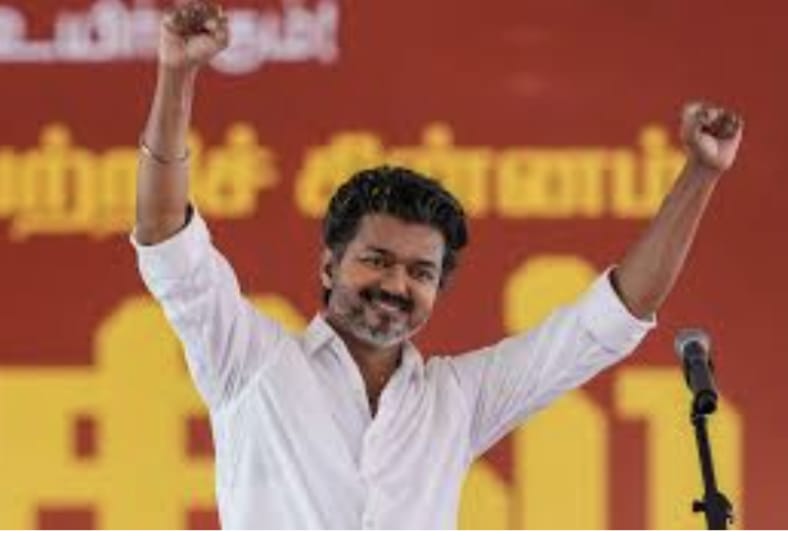
The alliance led by actor-turned-politician Thalapathy Vijay and his party, Tamilaga Vettri Kazhagam (TVK), defeated Stalin’s DMK alliance. TVK won 108 seats, while the DMK alliance secured 73 seats, including 59 won by the DMK itself. The alliance led by the All India Anna Dravida Munnetra Kazhagam (AIADMK) won 53 seats.
With Vijay’s victory, the decades-long alternating rule between the DMK and AIADMK effectively came to an end. However, TVK failed to secure the 118 seats required for a single-party majority government. Therefore, either a coalition government or a fresh election became necessary.
At that point, Stalin argued that Vijay should be allowed to form a government according to the people’s mandate and that another election was unnecessary.
Accordingly, Stalin agreed for parties within his alliance — including the Indian National Congress (5 seats), Communist Party of India (2 seats), Communist Party of India (Marxist) (2 seats), Viduthalai Chiruthaigal Katchi (2 seats), and Indian Union Muslim League (2 seats) — to support Vijay’s government.
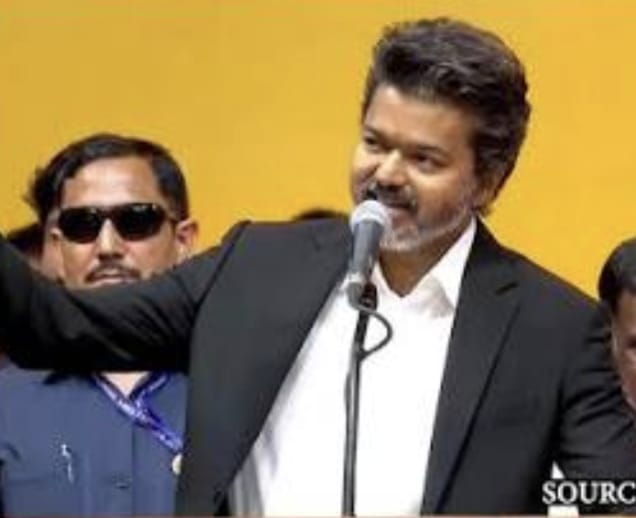
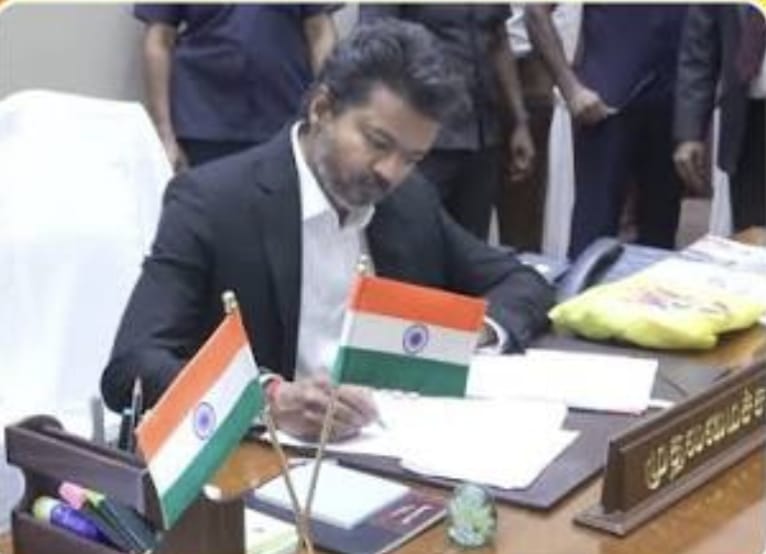
With a majority of 120 seats, Vijay was sworn in as Chief Minister last Sunday (10). This decision prevented the formation of a coalition between Vijay and the AIADMK alliance backed by Prime Minister Narendra Modi and the Bharatiya Janata Party (BJP).
Secondly, Stalin effectively pushed Vijay’s “celluloid politics” onto real political ground. Vijay’s cinematic heroism is now facing a real-world political test. For years, he won hearts on screen as “Thalapathy” (“Leader”), but now he must confront organization-building, policy-making, public expectations, and power politics. The colorful promises he made during the campaign must now be implemented in reality.
Joseph Vijay Chandrasekhar, popularly known as Thalapathy Vijay, is one of Tamil cinema’s biggest stars. Before entering politics, he was among India’s highest-paid actors and was adored by fans as “Thalapathy.” Films such as Ghilli, Thuppakki, Mersal, and Leo are among his most famous works.
In Tamil cinema, Vijay built an image as a righteous action hero. In 2024, he founded the political party Tamilaga Vettri Kazhagam (TVK). His politics also carries elements of Tamil nationalism and “heroic” cinematic populism.
Despite lacking advanced education or administrative and political experience, Vijay gravitated toward Tamil nationalist politics. He openly praised the LTTE and glorified Velupillai Prabhakaran while attempting to consolidate Tamil nationalist votes in Tamil Nadu. He even threatened to “erase Sri Lanka from the world map” and promised to intervene to reclaim Katchatheevu Island for India.
How did a man who formed a political party only two years ago manage to win his first election and become the new Chief Minister of Tamil Nadu?
Vijay’s immense popularity as a film star played a decisive role. In particular, the strong emotional and even sexual attraction many women felt toward him as a “dream prince” helped TVK secure overwhelming female support.
He also successfully consolidated youth votes. Many young voters had only witnessed alternating rule between the DMK and AIADMK throughout their lives. TVK emerged as an alternative to that cycle. Many young voters also used TVK as a vehicle for protest against the two traditional parties.
Although Tamil Nadu achieved notable economic growth under Stalin, anti-incumbency sentiment worked in Vijay’s favor. Unemployment among educated youth and corruption allegations against elements within Stalin’s administration pushed many voters toward TVK.
Vijay’s welfare-style campaign promises — resembling “Santa Claus politics” involving money and gifts — also helped him mobilize poor voters. Some of those promises included:
* Monthly financial assistance of 2,500 Indian rupees for homemakers from poor families.
* Six free LPG cylinders annually for every household.
* Eight grams of gold and a silk saree for brides from low-income families.
* Interest-free loans up to 500,000 rupees for women’s self-help groups.
* Education loans up to 2 million rupees without collateral for higher education students.
* Monthly allowances of 4,000 rupees for unemployed graduates and 2,500 rupees for diploma holders.
* Government jobs for 500,000 youth at village level as “Chief Minister’s Public Service Associates,” with salaries of 18,000 rupees per month.
* Full waiver of cooperative agricultural loans for farmers owning less than five acres.
* Guaranteed prices for rice and sugarcane.
* Free electricity up to 200 units for domestic consumers.
* Raising the minimum salary of police officers to 25,000 rupees.
Analysts estimate that implementing all these promises would cost over one trillion Indian rupees annually. Maintaining economic growth above 10% while managing enormous welfare expenditures will be the central challenge facing Vijay’s new government.
On screen, three minutes are enough for Vijay to defeat a villain. But governing a real economy is far more difficult. Since TVK failed to secure an outright majority, coalition politics may complicate economic decision-making. Furthermore, Vijay’s lack of political and administrative experience may weaken the stability of the new government.
Vijay’s cinematic heroism is now undergoing a real-world political examination. If he fails to fulfill his generous campaign promises, he may attempt to redirect public attention through emotional Tamil nationalist rhetoric.
In such a situation, Sri Lanka, Katchatheevu Island, and the issue of Sri Lankan Tamils could become convenient political targets. In recent days, Tamil nationalist elites in Sri Lanka appeared energized by Vijay’s victory.
Sri Lankan MP Ramanathan Archchuna even stated in Parliament that not only Katchatheevu, but Jaffna itself should be handed over to India. Archchuna, however, is merely the drummer in this political procession.
Fortunately for Sri Lanka, India’s foreign policy is determined by the central government in New Delhi. Moreover, Vijay’s coalition government does not include the BJP. Therefore, there is no immediate danger at present.
However, there remains a risk that the Northern and Eastern provinces of Sri Lanka could once again fall under the dominance of Tamil nationalist elites. According to this argument, the only way to prevent that outcome is for the current Sri Lankan government to provide sustainable solutions to the grievances of Tamil people in the North and East.
---------------------------
by (2026-05-11 11:32:44)


 Read 44886 Times
Leave a Reply
 0 discussion on this news