
-By G.W. Adams
(Lanka-e-News -26.May.2026, 5.50 AM) “Life can only be understood looking backward — but it must be lived forward.” - Søren Kierkegaard
Prageeth Ekneligoda vanished on the 25th of January, 2010. That sentence alone should disturb you — not because it is dramatic, but because it is unresolved. He did not die. He did not leave. He was made to disappear. And in Sri Lanka, that distinction carries the full weight of a civilization’s moral failure.
We can trace Prageeth’s life backward — his words, his cartoons, his laughter, his courage. But the disappearance severed the forward movement. There is no future to narrate. There is only the unbearable suspension of a life mid-sentence. Meanwhile, the witnesses of that life — his comrades, his companions, the people who loved and fought alongside him — are condemned to live forward, carrying his unfinished story like a wound that refuses to scar.
Sixteen years. The courts are still dragging. Justice is still pending. And a small, fierce circle of human beings continues to breathe on his behalf.
Death demands mourning and meaning. Societies have rituals for the dead — graves, ceremonies, the dignified language of loss. But disappearance? Disappearance demands something far more corrosive: the truth. And when the truth is withheld, disappearance becomes a second act of violence — not upon the body, but upon everyone who remains.
Think about what it means to love someone who has disappeared. You cannot grieve. You cannot move on. You are frozen at the last known moment, replaying phone calls, retracing footsteps, preserving relics. Sandhya Ekneligoda — Prageeth’s life companion — has lived in that frozen moment for over 5,500 days. Not by weakness, but by ferocious, deliberate choice.
Delayed justice is not a bureaucratic inconvenience. It is a philosophical obscenity. It says to the survivor: your suffering is administrative. Your loved one’s fate is procedural. Come back next year. Bring more documents. And so the disappearance is perpetuated — not only by those who abducted Prageeth, but by the very system that was meant to remedy the crime.
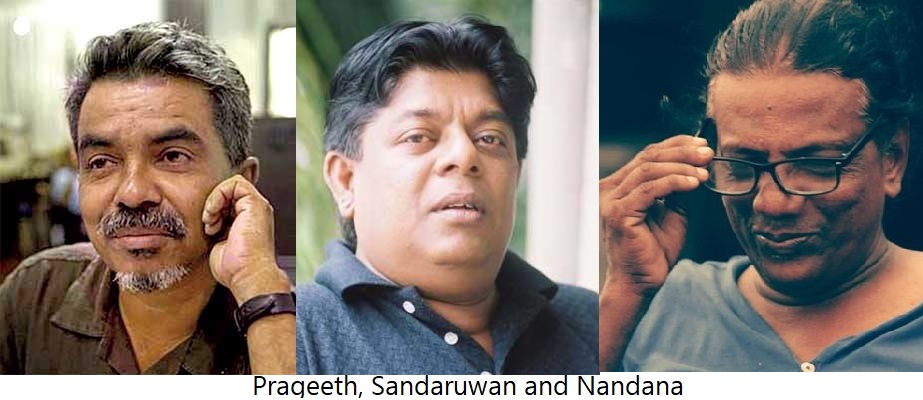
Sandhya is now testifying in court. So is LankaEnews editor Sandaruwan Senadeera. So is journalist Nandana Weeraratne — the man who received Prageeth’s last phone call, a simple request to arrange a cab, which became the last thread of contact before the silence descended. They are not just witnesses. They are the living proof that the state has not been allowed to fully bury its crime.
To understand what was lost when Prageeth disappeared, you must understand what he was. And to understand that, you must understand the world he shared with Sandaruwan Senadeera and Nandana Weeraratne — because these three men were not merely colleagues. They were kindred spirits shaped by the same crucible.
All three emerged from the JVP’s revolutionary orbit in the 1980s — a decade of insurrection, state terror, and ideological fire. They learned hunger before they learned comfort. They learned solidarity before they learned ambition. They developed the kind of survival intelligence that no university can teach: how to resist, how to endure, and critically, how to laugh at power without flinching.
They were, each in their own register, kings of sarcasm. Sandaruwan wielded language like a scalpel — his political writing placing him alongside the great Sinhala literary figures, B.A. Siriwardena and Thulsiri Andradi. Nandana pursued truth through investigative journalism, pioneering a field in Sri Lanka that required not just skill but an almost reckless personal courage. Prageeth deployed the pen differently — through the cartoon, that most democratic and devastating of political arts, reducing hypocrisy to a single irrefutable image.
They were not merely journalists. They were street philosophers — voraciously read, intellectually restless, fluent not only in Marxism but in the wider landscape of modern political thought, in constant dialogue with elite academic discourse while never losing their roots. They redefined morality in a context where power had become utterly corrupted.
Ask yourself: when tyranny gains the upper hand, what does politeness accomplish? When the powerful wrap themselves in robes and flags and call themselves heroes, what does measured critique achieve? These three men understood — viscerally, not theoretically — that there are moments when indecorous defiance is the only moral position. Civility in the face of indecency is not virtue. It is complicity.
If Prageeth was the artist and provocateur, Sandhya Ekneligoda is the strategist of grief. But not passive grief — weaponised grief. Transformative grief. The kind that the powerful fear most, because it refuses to become silent.
She has been isolated, ridiculed, threatened, and insulted by those who represent the very institutions that claim to uphold the law. A powerful Buddhist monk — draped in the saffron authority of the nation’s moral establishment — insulted her before the judiciary, invoking the sanctity of ‘war heroes’ as a shield above accountability. She did not collapse. She won.
Sandhya’s genius was to understand something that pure legal reasoning often misses: that resistance must also be symbolic, embodied, visceral. By adopting the persona of Kali Amma — shaved head, black dress, red scarf — she translated personal grief into mythic protest. She became a figure that not even tyranny’s foot soldiers could easily brutalise. Because to brutalise her was to brutalise the archetype of the grieving, defiant mother — and even the most ruthless systems hesitate before that image.
Compare her, if you will, to Rosa Parks, to Claudette Colvin, to Sophia Duleep Singh — women who made their bodies the argument when words had been stolen from them. The BBC recognised her among its 100 Women in 2022. The International Women of Courage Award found her in 2017. But the recognition that matters most remains outstanding: justice.
What is most remarkable about Sandhya is not her endurance — though that is extraordinary. It is her creativity. For over 5,500 days, she has continuously devised new initiatives, new angles, new ways to keep this case alive. She never allowed the state’s favourite weapon — the slow erosion of public attention — to win.
Sri Lanka has not convicted a single person for the killing or disappearance of a journalist. Read that sentence again. Not one. This is not an oversight. This is architecture — a deliberate structure of impunity, maintained across governments, parties, and ideological formations.
Nandana Weeraratne’s long crusade for justice in the Batalanda torture camp case offered a glimpse of what accountability could look like. A Presidential Commission was established. And then — nothing. Political calculus consumed moral imperative.
Sandaruwan’s two decades-long battle through LankaE news contributed significantly to the conditions that produced the 2015 Yahapalanaya transition — proof that journalism, even lonely and embattled, can shift political tides. But the Sirisena-Wickremesinghe dyarchy squandered that opening. They abandoned the pursuit of accountability, prioritised political survival over moral obligation, and the consequences cascaded: the 2018 constitutional coup, the Easter Sunday bombings, and the eventual collapse of any serious prospect of justice.
The lesson is not subtle. When governments inherit the mandate for justice and betray it, they do not merely fail morally — they fail politically. Power built on the avoidance of accountability is power that collapses under its own contradictions.
The NPP government now holds this inheritance. The Prageeth Ekneligoda case is not a litmus test for its righteousness. It is the spindle around which its entire political future will turn. A government that cannot deliver justice for a disappeared journalist — when the accused are named, indicted, and before the court — has already announced the terms of its own eventual collapse.
Benjamin Button is born old and grows younger as the world ages forward around him. In delayed justice systems, the disappeared move in a similar, perverse direction. As years accumulate, the victim does not grow in stature — they shrink. Memory fades. Attention drifts. The urgency dissipates. The disappeared are buried a second time, not in earth, but in collective indifference.
Prageeth was at the peak of his political relevance when he vanished. He was lifting Field Marshal Sarath Fonseka’s 2010 presidential campaign into the realm of popular art — a genuinely threatening figure to the Rajapaksa establishment. He was becoming dangerous in the way that artists are most dangerous: by making truth beautiful and accessible.
Sandaruwan once said with characteristic bluntness: if he had been taken instead of Prageeth, he would have been at peace — because Prageeth was the better fighter. That is not self-deprecation. That is a precise, devastating assessment of what was lost — not just a man, but a specific, irreplaceable quality of courage and creative intelligence.
The disappearance inflated Prageeth into legend. The sixteen years of delay are now deflating him back. This is what impunity ultimately achieves: not just the erasure of the victim, but the gradual erasure of the meaning of their erasure.
I have tried, in this essay, to understand these lives by looking backward. But Kierkegaard’s insight cuts both ways. Understanding backward is not sufficient. Life — and justice — must be lived forward.
Sandaruwan and Nandana walked into that courtroom recently carrying sixteen years of silence and small, stubborn objects — those little things people keep when they are not sure whether to have faith or not. They testified. They have not given up. Neither has Sandhya.
What Sri Lanka owes these people is not pity. It is not recognition. It is the one thing that has been withheld for sixteen years: a verdict. A conviction. An acknowledgment by the state that this crime happened, that it was committed by those in uniform and in power, and that no amount of political arithmetic can make it disappear.
Justice for Prageeth is not a sentimental gesture toward one disappeared man. It is the condition of possibility for every journalist, every activist, every citizen who dares to speak. It is the difference between a country where power is accountable and one where power is simply hungry — and occasionally, quietly, disappears those who remind it of its appetite.
-Prageeth Ekneligoda. Disappeared January 25, 2010.
Still waiting for justice.
---------------------------
by (2026-06-21 13:08:04)


 Read 81102 Times
Leave a Reply
 0 discussion on this news