When the Robe Becomes a Shield...And Finally Knelt Before the Dhamma
By Gerard Adams
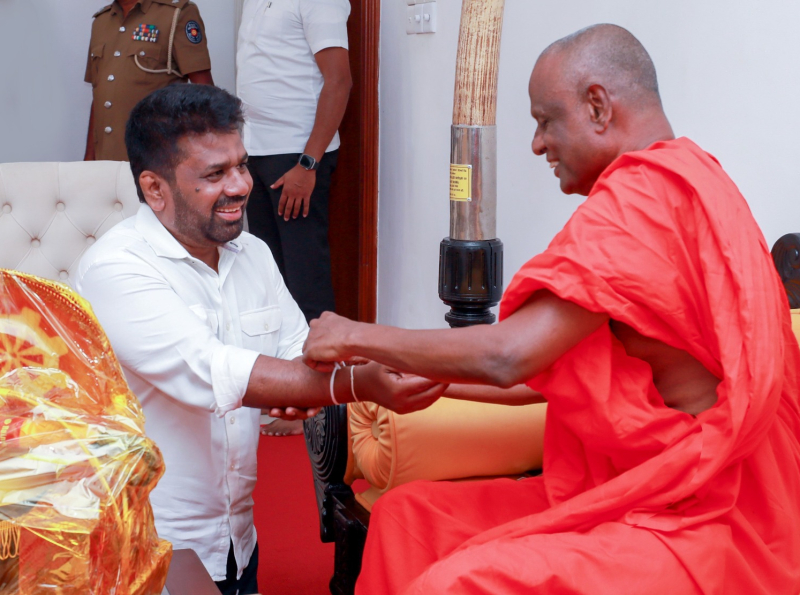
(Lanka-e-News -01 June.2026, 5.30 PM)
Na monena munī hoti mūḷharūpo aviddasu;
yo ca tulaṃva paggayha varāmādāya paṇḍito.
Pāpāni parivajjeti sa munī tena so muni;
Yo ubho anupassati majjhe ca so muni.
A person does not become a sage simply by remaining silent if their mind is still foolish and ignorant.
A true sage carefully evaluates life, embraces what is good, and deliberately rejects what is unwholesome.
One who sees both sides of things, and the middle — that one is truly a sage.
— Dhammapada, Verses 268–269
For the first time in living memory, the robe knelt before the Dhamma — not in prayer, but in consequence.
Sri Lanka's Buddhist hierarchy suspended Pallegama Hemarathana Thero, one of the most powerful senior monks in the country, accused of sexually abusing a child. The news did not merely shock the present moment. It shook history itself. In a nation where the saffron robe has functioned as armour against accountability, where monasteries have stood as fortresses against the law, this was — however incomplete, however late — a rupture. The Sangha, that ancient institution of power and reverence, had moved. Not willingly. Not generously. But it had moved.
And that movement tells us everything.
A monk is accused of raping a twelve-year-old child. Her own mother, it is alleged, sold her. The nation recoiled. And then — silence. Not the silence of grief. The silence of protection. Thirty lawyers appeared in court for the accused monk. Not one appeared for the girl. The machinery of power clicked smoothly into motion, as it always has, to shield one of its own.
But this time, something else happened too. The people did not forget. The Child Protection Authority did not yield. A young legal officer, watching thirty lawyers fill the courtroom while the child stood alone, wrote on Facebook:
"Religion above the law. Money above justice."
She was right to name it. And because enough people agreed and refused to be silent, the suspension came late.
That asymmetry — thirty lawyers for the powerful, none for the child — is a failure of justice. It is justice, as it has always functioned for the powerful in Sri Lanka. The robe did not corrupt the system. The system was put on the robe. What is new is not the crime, nor the protection. What is new is that this time, the protection of the powerful did not fully hold.
This essay is an attempt to understand why it held for so long — and what it will take to ensure it never holds again.
I. The Man Before Whom Prime Ministers Knelt
We must first understand who Pallegama Hemarathana Thero is, not merely as an accused man, but as a symbol of what made his accusation so shocking, and his protection so predictable.
He is not an ordinary monk. His family has governed the Atamasthana, the sacred seat overseeing eight of Sri Lanka's holiest Buddhist shrines in the ancient region of Nuwara Kalaviya, for more than half a century. This is an institution second in reverence only to the Temple of the Tooth Relic in Kandy. That is not merely religious authority. In Sri Lanka, it is political power in a different government.
.
His cultural reach stretches further still. He composed verse. He wrote lyrics for WD Amaradeva — arguably the greatest voice in Sinhala music. Amaradeva was the Sinhala language teacher of Prime Minister SWRD Bandaranayake. He gave words to Nanda Malini, the radical artist and conscience of a generation. He inspired Karunarathna Divulgane, Gunadasa Kapuge, and TM Jayarathna.
But perhaps nothing captures the extraordinary reach of his power more vividly than a single image from recent history. When Indian Prime Minister Narendra Modi visited Sri Lanka, he knelt before Hemarathana Thero to receive his blessing. The most powerful democratically elected leader on earth, commander of a billion people, master of nuclear weapons, architect of the world's fifth largest economy, prostrated himself before this monk.
It was not an act of personal piety alone. It was a political gesture of the highest order. Modi understood what every Sri Lankan politician has always understood: that the robe commands a reverence no elected office can manufacture. To be seen kneeling before the Sangha is to claim legitimacy that no ballot box can fully bestow.
That image now sits differently in the mind. The man before whom a Prime Minister knelt stands accused of violating a child. What was the blessing he dispensed to the powerful actually worth? And what does it say about power, that it seeks benediction from those who may be most in need of judgment?
The scene carries an echo that history will not let us ignore. More than two thousand years ago, the great Emperor Ashoka — conqueror of Kalinga, ruler of the largest empire the Indian subcontinent had ever known — knelt before a young samanera, a novice monk barely out of childhood, named Nigrodha. Ashoka had been transformed by the horror of war, by the rivers of blood Kalinga had cost. He sought something no empire could give him. He found it, the tradition tells us, in the presence of a child in robes.
Ashoka knelt before innocence and wisdom. Modi knelt before power, wearing the mask of wisdom. And a child — the most innocent person in this entire story — received no one's blessing, no one's protection, and no one's knee.
That is the distance between Ashoka's Dhamma and the system that has grown up in its name.
He was, in short, the embodiment of the Walpola Bhikkhu ideal: the engaged monk who carries the Dhamma into the world through art, literature, and social conscience. The fact that a man of such cultural grace stands accused of such moral catastrophe is not ironic. It is instructive. Power does not corrupt from the outside. It grows from within.
II. Landlord Buddhism and the Architecture of Impunity
This is not a new story. Historians Oliver Edmund Clubb and Richard Gombrich have traced how Buddhist monasteries became landholders, estate managers, and power brokers — a phenomenon scholars call Landlord Buddhism. In medieval Sri Lanka, this monastery-crown entanglement was not a corruption of the Dhamma. It was the political grammar of Sinhala civilization.
The British colonial administration recognized this danger. The Buddhist Temporalities Act of 1931 was designed to regulate monastic power — because the British had learned, painfully, that monks had fuelled the uprisings of 1818, 1834, and 1848. The robed man behind the rebellion was not an abstraction. He was a threat to the empire.
Independent Sri Lanka never fully resolved this inheritance. The monasteries retained their wealth, their networks, and their immunity. Investigative journalist Nandana Weerarathne documented how hereditary monastic families — the Pallegamas among them — controlled vast property and political influence across generations, passing power from uncle to nephew like a secular dynasty wearing a sacred mask.
The structural truth is this: unlike the Catholic Church, which operates under a single hierarchical authority, Buddhist institutions in Sri Lanka function as a federation of independent fiefdoms. Each regional temple is its own centre of power, largely answerable only to tradition and to itself. This decentralization does not weaken power. It distributes it in ways that make accountability nearly impossible.
III. The Architecture of Protection
What unfolded after the accusations became public was not justice in motion. It was power doing what power has always done: closing ranks around one of its own.
Consider the contrast. When twenty-three monks were caught at customs with narcotics, senior Buddhist leaders reportedly instructed them to disrobe immediately. The institution protected itself by cutting them loose. In the Pallegama case, the institution chose differently. It did not distance itself. It defended.
The Summathipala family — powerful Buddhist philanthropists operating through the All Ceylon Buddhist Congress — quietly mobilized. The Dharmadasa family made the resources of Navaloka Hospital available. The Bar Association provided unofficial support. Senior doctors, police officers, Correctional Department officials, and figures from the Attorney General's office all positioned themselves, visibly or invisibly, in the monk's corner.
And no women parliamentarians raised their voices for the child. No prominent women's organizations mounted a sustained campaign. The silence of those whose stated purpose is to protect the vulnerable is itself a form of violence.
A young legal officer from Sri Lanka's Child Protection Authority, Sajeewani Abeykone, watched the courtroom fill with more than thirty defence lawyers, while not one stood for the girl.
She wrote on Facebook:
"Religion above the law. Money above justice."
She was right to name what she saw. The question is whether the rest of us are willing to see it.
He received bail. The machinery held until it didn't.
IV. This Has Happened Before
One temptation when facing a case like this is to believe it is uniquely Sri Lankan. This temptation must be resisted.
In Austria, Cardinal Hans Hermann Gröër was permitted to retire with full honours despite credible allegations of abusing boys in his care. He died without facing justice. In France, Archbishop Philippe Barbarin was convicted for concealing abuse, then acquitted on appeal — while the abuser himself spent decades protected by the institution before finally being jailed. In Australia, Cardinal George Pell spent 404 days in solitary confinement, had his conviction overturned by the High Court, and yet the Royal Commission found separately that he had known of abuse and failed to act. In the United States, the John Jay Report documented nearly 11,000 allegations against Catholic clergy over five decades. A small fraction resulted in a conviction.
The robe, whether saffron or purple or black, has been used as a shield across every tradition and every civilization. Sri Lanka is not exceptional. But the universality of the failure does not diminish the urgency of confronting it here, now, in this case.
V. The Numbers Are Not Numbers
The National Child Protection Authority reports that over 39,000 child abuse cases remain unresolved in Sri Lanka. Less than 0.5 percent of complaints ever reach a courtroom. In 2024 alone, over 8,746 new cases were reported — a 38 percent increase over the previous year. Sexual abuse was the fastest-growing category.
We must pause here. Numbers slide past us too easily. These are not statistics. They are children. Each number is a small person whose trust was violated, whose voice went unheard, whose case joined a pile of 39,000 others quietly gathering dust.
Sri Lanka committed, at the 2024 Bogotá Global Conference, to comprehensive child protection legislation by mid-2025. The AKD government has begun launching child-sensitive courts, integrated case management, and enhanced helplines. And yet the same government, under pressure from conservative religious sectors, has retreated from certain child protection legislative amendments.
The Pallegama case did not emerge from a vacuum. It emerged from a system that has been failing children for decades. How it is handled will either begin to repair that system or confirm that the system is working exactly as designed.
VI. The Paradox at the Heart of the New Politics
One cannot discuss this case honestly without confronting a deep contradiction at the heart of Sri Lanka's current political moment.
The JVP-NPP grew from Marxist roots. In European tradition, Marxism and organized religion have historically been in tension. In Sri Lanka, the relationship is far more tangled. Asian Marxist movements have often cohabited with religious and cultural traditions, sometimes uncomfortably, sometimes strategically. The left in this country has deep emotional and historical bonds with Buddhist institutions. The writer of this essay, himself a radical of the 1980s, was fed, sheltered, and protected by Buddhist temples during periods of political danger.
It is worth recalling where the JVP once stood on this question. Rohana Wijeweera, the party's founding leader and a committed Marxist, was unambiguous in public: monks belong outside the state. Their place is in the temple, not in the legislature or the courtroom. If the JVP came to power, he said, the state would honour and provide for the Sangha, but the Sangha would stay out of politics. It was a clean, principled line. The ethnic war buried it, along with much else.
The JVP has genuinely transformed since those years. The departure of the chauvinist Wimal Weerawansa faction, the formation of the NPP, and above all, the experience of the Aragalaya, the great popular uprising of 2022, pushed the party toward a more inclusive politics. Today, it speaks openly about the rights of ethnic minorities, women, children, and LGBTQ+ communities. President AKD, at a Women's Day event in 2026, asked with evident passion: "Being a woman or a child - should they be abused?"
The question was right. But the government has not proposed a secular state. The constitutional clause granting Buddhism a foremost place remains untouched. The deep architecture of Sinhala Buddhist hegemony — the silent grammar of Sri Lankan political power — has not been challenged. Wijeweera's line has not been revived. It has been quietly folded away.
Is this a contradiction or a deliberate calculation? Probably both. In South Asian political ecology, power requires that one speak the language of progress while respecting the grammar of tradition. The Pallegama case now forces the question: at what point does 'respecting tradition' become shielding injustice?
VII. Gramsci's Modern Prince and the Dhamma
Unlike Dhammapada, Machiavelli taught that political virtue is distinct from personal morality. A leader may be judged successful for preserving power even by methods that private conscience would condemn. Political realism follows different rules from ordinary ethics.
Sri Lankan political history is rich in such realism. When Mahinda Rajapaksa's sons were racing cars on the Dalada Maligawa premises, the dispute with the Maha Sangha was swiftly resolved, reportedly through a combination of quiet but nasty reminders and the gift of tax-free luxury vehicles. When Ranil Wickremesinghe offered a senior cardinal a bulletproof car after the Easter bombings, the cardinal refused, and Wickremesinghe failed to secure the cultural legitimacy he sought. These are not corruption stories. They are powerful stories. The currency differs; the logic is identical.
Antonio Gramsci understood this logic precisely. In his theory of hegemony, force alone is unstable. Culture alone is insufficient. Lasting power requires both coercion and consent: the police baton and the poem, the prison cell and the temple bell.
Anura Kumara Dissanayake understands this. He will make the necessary deals with the Sangha, with lawyers, with media elites to secure cultural hegemony. The question is whether he will also use the coercive apparatus of the state, the police, the Attorney General's department, and the judiciary not to protect power, but to challenge it. Wijeweera once drew a clean line. Will his successor honour the spirit of it, even without the words?
VIII. A Promise Being Tested
"No one above the law."
This is one of AKD's most repeated commitments. It is the phrase by which his government has invited itself to be judged.
We have watched high-profile lawyers navigate around judicial accountability. We watched Ranil Wickremesinghe operate for decades in a political ecosystem that placed him beyond ordinary consequence. Now a high-profile monk, draped in saffron, appears to be receiving similar treatment. He received bail. The machinery held.
And yet something else also happened. Ven. Galkande Dhammananda Thero, head of the Walpola Rahula Institute, respected for his work in pluralism and post-war reconciliation, broke the long silence of the religious establishment. He watched the courtroom drama and spoke plainly: "Justice should be seen to be done."
The Child Protection Authority fought fearlessly. Sajeewani and her team exposed the conduct of the police, of the AG department, and of the lawyers who had positioned themselves as shields. They demanded that the investigation be handed over to their authority.
A silent revolution was beginning. Not from parliament. Not from party headquarters. From the people on social media, in courtrooms, in the streets. The sovereignty that produced the 2022 Aragalaya was still awake.
Senior monks, reading the pressure, publicly called on the government to reform the British-era Buddhist Temporalities Act of 1931. Even the Sangha was shifting.
IX. The Vesak Speech and What It Did Not Say
At his Vesak ceremony speech, President AKD said he was deeply saddened by what was happening to the religious establishment "as a person who has knelt on gravel roads and bowed before the Sangha."
He spoke of twenty-two monks who had been handcuffed. He did not mention Hemarathana. He did not mention a child.
Hemarathana had not seen handcuffs. He had received bail. He was, in the language of that courtroom, above the law. And the President's speech, with its careful silences, confirmed what many feared: that the grammar of power had not changed, even if its vocabulary had.
Though he promised to reform the Temporalities Act, this was not a highlighted commitment in his election manifesto. The promise, like so many promises made toward the powerful, arrived quietly, and may depart the same way.
X. The Child and the Constitution
The suspension of Hemarathana Thero from his ecclesiastical duties was not the result of decisive political leadership from Pelawatta. It came from the fearless work of the Child Protection Authority and from the relentless pressure of a people who had not forgotten what they fought for in 2022.
That is what sovereignty looks like when it refuses to sleep.
But we must be clear: this partial accountability would not have happened without the 2022 mass uprising, and without the electoral verdict of 2024. The people moved first. The institution followed. This is the correct order of things. But it is not enough.
The Sri Lankan constitution ends with the phrase Raja Bhawathu Dhammico may the Dhamma govern the ruler. That is not a blessing. It is a demand. A demand made not to kings, but to power itself.
Ashoka knelt before a child in robes and found the Dhamma. Modi knelt before power in robes and found a blessing. A child knelt before no one because no one came.
The difference among those three images lies in the entire moral history of Buddhism and its encounter with power.
Na tāvatā dhammadharo yāvatā bahu bhāsati;
yo ca appam'pi sutvāna dhammaṃ kāyena passati,
sa ve dhammadharo hoti yo dhammaṃ nappamajjati.
One is not a bearer of the Dhamma merely because one speaks much of it. But one who has heard even a little, and sees the Dhamma in the body, that one truly bears the Dhamma who is not heedless of the Dhamma.
Dhammapada, Verse 259
The Dhammapada does not ask whether a person wears the robe. It asks whether they see clearly, act rightly, and refuse what is unwholesome. It does not ask whether a president can quote the Dhamma. It asks whether he lives it — in the courtroom, in the law, in the protection of the weakest among us.
Speaking much of justice is not justice. Seeing justice in the body of the law — and acting on it without heedlessness — that is the only Dhamma that matters now.
Comrade President. You are better than this. And the Sri Lankans who knelt on gravel ground in 2022, and voted in 2024, especially the vulnerable, the voiceless, the smallest among us, they deserve better.
The girl is still waiting.
By Gerard Adams
---------------------------
by (2026-06-30 09:59:59)
We are unable to continue LeN without your kind donation.


 Read 71736 Times
Leave a Reply


 0 discussion on this news