
-By Gerard Adams
(Lanka-e-News -2026.June.23, 7.30 PM) Civilisation, Impunity, and the Men Who Refused to Bow
"He who builds his power on fear must fear those he has made afraid."
- Machiavelli
"The arc of the moral universe is long, but it bends toward justice."
- Martin Luther King Jr.
Civilisation was born in fear. Not fear of beasts alone — but fear of each other. And so we built walls, armies, courts, and gods. We built institutions to tame the chaos. But institutions, like the men who run them, can be corrupted. And when they are, they do not protect the people from fear. They become the fear.
The Taittirīya Upanishad said it plainly: "From every side fear rises for the one who does not know the Self." Civilisation did not end these fears. It dressed them in new clothes — intelligence files, arrest warrants, disappeared journalists, midnight phone calls to prosecutors.
What the ancient sages called ignorance of the Self, we now call the deep state. Not a conspiracy hatched in a basement. Something older and more ordinary: the organised refusal of those in power to be held accountable for what they have done.
"He who builds his power on fear must fear those he has made afraid." — Machiavelli
Sri Lanka's deep state was built from political dynasties and intelligence networks, from police chiefs and vigilante killers, from media empires and clergy who blessed what should never have been blessed. It ruled through silence — of editors who chose their lives over the truth, of prosecutors who chose careers over the law, of judges who chose comfort over justice.
But power built on fear is a house of mirrors. Every threat reflects back. Every silence has a price.
This is the story of four fears. Not the fears of the weak. The fears of the powerful — of men who once thought they were untouchable.
Shani Abeysekara
Power's deepest terror is simple: to be seen.
For years, Sri Lanka's intelligence machinery operated in darkness without consequence. Lasantha Wickrematunge was murdered on a public road in January 2009 by men on motorcycles. Prageeth Eknaligoda was disappeared by military intelligence in January 2010, never returned. Keith Noyahr was abducted and tortured in 2008. The message was ancient and universal: speak, and you will suffer.
And then came Shani Abeysekara — a man who had worked within the system since 1986 and understood exactly how it breathed, bent, and buried inconvenient truths.
As Director of the CID, Shani led investigations into the murder of Lasantha Wickrematunge, the disappearance of Prageeth Eknaligoda, the abduction of Keith Noyahr, the Navy abductions of eleven youth between 2008 and 2009, and the Easter Sunday attacks. He cleared Dr. Shafi Shihabdeen — the Muslim doctor falsely accused of sterilising Sinhala women in a calculated campaign of ethnic incitement — when the system was pressuring the CID to stay quiet. He had been the key prosecution witness in over 100 trials, including more than 20 murder cases that ended in convictions.
His reward: within days of the 2019 presidential election, he was stripped of the CID directorship and demoted. In July 2020, he was arrested — charged with fabricating evidence against a police officer close to Gotabaya Rajapaksa. A police sergeant told a magistrate in open court he was being pressured to give false testimony against Abeysekara. Shani contracted Covid-19 in custody. He was held for over ten months.
On 25 August 2023, he was acquitted of every charge. The fabrication had collapsed.
But in manufacturing those charges, the deep state had confessed its own fear. The arrest was louder than any testimony. It told the world: this man knows something we cannot afford to have known.
In 2025, Shani was reinstated as Director of the CID. The investigations resumed.
Exposure is the first fear because it does not require a verdict. It only requires a witness. And Shani Abeysekara — even in a cell — remained exactly that.
Dileepa Peiris, Ranga Dissanayake, and Chief Justice Surasena
Every civilisation has tried to solve the same problem: who watches the watchmen? In a captured state, the law becomes theatre — a performance of justice that protects the unjust. Cases opened to threaten, closed to reward. Prosecutors transferred when they came too close. Files vanished. Powerful men walked through the machinery of justice and emerged, again and again, untouched.
Until certain individuals refused to perform the theatre.
Additional Solicitor General Dileepa Peiris did not prosecute with speeches. He prosecuted with facts — specific, documented, cross-referenced facts spoken in the cold language of law before magistrates who could no longer look away.
In the Easter Sunday investigation, Peiris told the Colombo Fort Magistrate's Court that retired Major General Suresh Salley had functioned as the principal operational force behind the 2019 bombings that killed 278 people. He laid out in a 14-page report how planning began as early as 2017. He presented five notebooks obtained from Azad Maulana — former secretary to Pillayan — documenting meetings between military intelligence and Zaharan Hashim's network. He told the court the State Intelligence Service had submitted 347 reports on Zaharan and the NTJ to the IGP and Defence Secretary between 2016 and April 21, 2019, and nothing was done. He alleged that the same networks operating under Salley had carried out the abductions of Lasantha, Eknaligoda, and Keith Noyahr.
When Army intelligence began intimidating witnesses — visiting homes after court hearings, threatening testimony, planning to plant weapons at witnesses' residences — Peiris named it in open court. He warned he would be compelled to name the Army Commander as a suspect if obstruction continued. Salley's lawyers threatened to file a formal complaint against him. The Sri Lanka Army filed a complaint against him with the Attorney General.
Peiris did not retreat.
In the Eknaligoda case, it was Peiris himself who stood in the Colombo High Court and admitted on the record that the failure to call Shani Abeysekara as a witness was a "serious lapse" on the part of the Attorney General's Department. A prosecutor willing to name his own institution's failures in open court is a rare and dangerous thing to a deep state.
Ranga Dissanayake brought the same unsparing clarity to the territory the deep state fears most: money. As a Colombo Chief Magistrate in 2018, he had already demonstrated his character — presiding over the MiG fighter procurement case involving Rajapaksa loyalist and former Sri Lankan envoy to Russia, Udayanga Weeratunge, interrogating prosecutors for procedural failures and showing no deference to political proximity. He had ruled on cases against the former presidential Chief of Staff and multiple high-profile bribery matters without favour or malice.
Appointed Director General of CIABOC in January 2025, Dissanayake moved immediately. Within his first year, the Commission arrested former Ministers Keheliya Rambukwella and Prasanna Ranatunga, former MP Shasheendra Rajapaksa, the former chairpersons of SriLankan Airlines and the Ceylon Petroleum Corporation. The Commission filed 115 new cases in 2025 alone. When Salley's allies launched public media campaigns to undermine the judiciary and the investigation, Dissanayake's Commission investigated them for contempt of court. When critics attacked him personally to discredit his work, he answered plainly: "Our priority is to uphold the law and pursue grand corruption cases."
The deep state fears a good financial investigator the way a burglar fears a good accountant: because numbers do not lie, and they do not intimidate.
Chief Justice Preethi Padman Surasena assumed the country's highest judicial office on 27 July 2025, unanimously endorsed by the Constitutional Council. He inherited a judiciary burdened by over 800,000 pending cases and decades of executive interference that had turned courts into instruments of delay. His predecessors had already sent the signal: in a landmark 4-1 ruling on 13 November 2023, the Supreme Court held former President Gotabaya Rajapaksa, Basil Rajapaksa, Namal Rajapaksa, Finance Minister Ali Sabry, and Central Bank Governor Ajith Nivard Cabraal responsible for the economic mismanagement that caused Sri Lanka's sovereign default, the fuel queues, the blackouts, the hunger. For the first time, the most powerful had been found responsible by the highest court in the land.
Under Surasena, the judiciary continued its recovery of nerve — presiding over politically sensitive accountability cases with a steadiness that told the deep state something it had long forgotten: the courts were no longer guaranteed safe territory.
The second fear is the fear that the law might finally look back. That files thought buried might surface. That verdicts thought permanent might be revisited. That the machinery of justice, long captured, might begin — slowly, imperfectly, irreversibly — to function as it was designed to.
"The arc of the moral universe is long, but it bends toward justice." — Martin Luther King Jr.
The Salley–Gota Panic
The great lie every deep state tells itself is that it is a team. But it is not a team. It is a pact. And pacts are held together not by loyalty but by shared guilt.
Sri Lanka's deep state was a coalition: the Rajapaksa dynasty at its centre; Ranil Wickremesinghe as its bipartisan safety valve; Suresh Salley as the intelligence guardian who knew where every body was buried — sometimes literally; Deshabandu Tennakoon as the police enforcer; Pillayan and Karuna as the vigilante memory of a war never fully reckoned with; the media and segments of the Sangha providing moral cover for what was fundamentally immoral.
These actors did not love each other. They needed each other. The glue was mutual knowledge of mutual crime. You do not betray me because I can destroy you. I do not betray you because you can destroy me. This is not loyalty. This is organised terror directed inward.
When Gotabaya Rajapaksa faced a travel ban, the pact cracked. Four words spread through Colombo's corridors like smoke:
"Will Salley talk?"
Salley had been the Director of the State Intelligence Service — the man who sat at the intersection of every sensitive operation. Dileepa Peiris alleged in open court that his networks had carried out the Easter Sunday bombings, silenced journalists, and manipulated political outcomes across years. The five notebooks of Azad Maulana, if they speak fully in court, do not speak only about Salley. They speak about everyone who knew. Everyone who authorised. Everyone who benefited.
The moment Salley's loyalty became uncertain; every other member of the pact was forced to ask the same question: am I safe?
Internal betrayal is the third fear because deep states do not fall from the outside in. They fall from the inside out. They fall when the men who built the walls begin to whisper about what those walls are actually hiding.
Aragalaya and the End of Obedience
The fourth fear cannot be managed, arrested, bought, or killed. It is the fear that philosophers and revolutionaries have understood across every century: the fear of a population that has decided it will no longer be afraid.
In 2022, Sri Lanka crossed that threshold. A people — exhausted, hungry, betrayed — stopped obeying the logic of fear. Aragalaya was not organised by a party or a general. It rose from kitchens without gas, hospitals without medicine, parents watching their children's futures dissolve. Sinhala, Tamil, Muslim, Christian. Young and old. People who discovered, in their collective exhaustion, that the worst had already happened — and they had survived it.
They occupied Galle Face. They swam in the presidential pool. They sent the president fleeing. And they demonstrated something that cannot be unseen: the emperor had always been naked. It just took enough people looking at the same time.
Cardinal Malcolm Ranjith's sustained demand for full truth about Easter Sunday — the killing of 278 people at prayer — represented something deeper than institutional pressure. It was the moral delegitimisation of a state that had refused honesty about its own crimes. When the Church speaks in that register, it is not making a political argument. It is making a judgment. And judgments from that altitude do not easily fade.
Awakening is the fourth fear because it is irreversible. You can imprison an investigator. You can transfer a prosecutor. You can pressure a judge. But you cannot un-awaken a people who have already found their courage.
"The most powerful weapon in the hands of the oppressor is the mind of the oppressed." — Steve Biko
Power built on fear is a trap that closes on its builder.
The deep state produces fear to control others. But producing fear requires increasingly extreme measures. Extreme measures produce evidence. Evidence produces investigators. Investigators produce prosecutors. Prosecutors produce verdicts. Verdicts produce awakening.
It is not a cycle. It is a ratchet. Once it turns, it does not turn back.
Sri Lanka's deep state feared exposure — because truth has witnesses.
It feared the law — because justice has memory.
It feared betrayal — because power has no real friends.
It feared awakening — because people, once they find their dignity, rarely give it back.
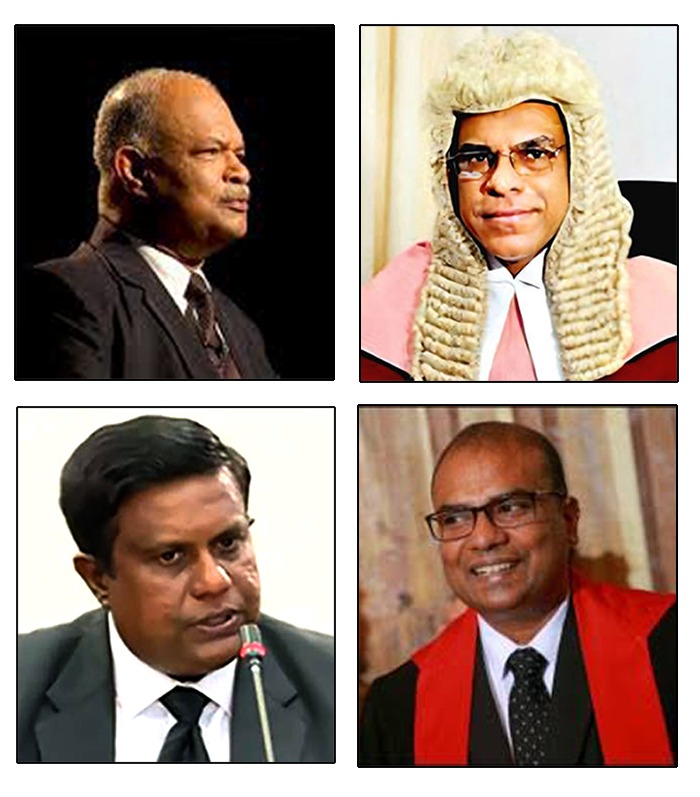
Shani, Dileepa, Ranga, Surasena — these men did not defeat the deep state. They did something more precise. They named its fears and kept working inside them. They walked into the places marked forbidden and kept walking.
Civilisation began with fear. But it also carries the antidote: truth that will not stay buried, law that can still be made to function, and the stubborn courage of people who decided that enough was enough.
Once a deep state begins to fear, it has already begun to fall.
Collection of articles written by Gerard Adams
https://www.lankaenews.com/category/22
---------------------------
by (2026-06-23 14:12:26)


 Read 70458 Times
Leave a Reply
 0 discussion on this news