
-By Gerard Adams
(Lanka-e-News -2026.July.12, 6.10 PM)
Where justice fails, violence becomes the language of the forgotten. -Anonymous prison reformer
Where power is unchecked, the body becomes the first site of punishment. -Michel Foucault
The most dangerous people are not the fanatics, but the bureaucrats who quietly enable them. -Hannah Arendt
The state of exception becomes the rule. -Giorgio Agamben
The ultimate expression of sovereignty is the power to decide who may live and who must die. -Achille Mbembe
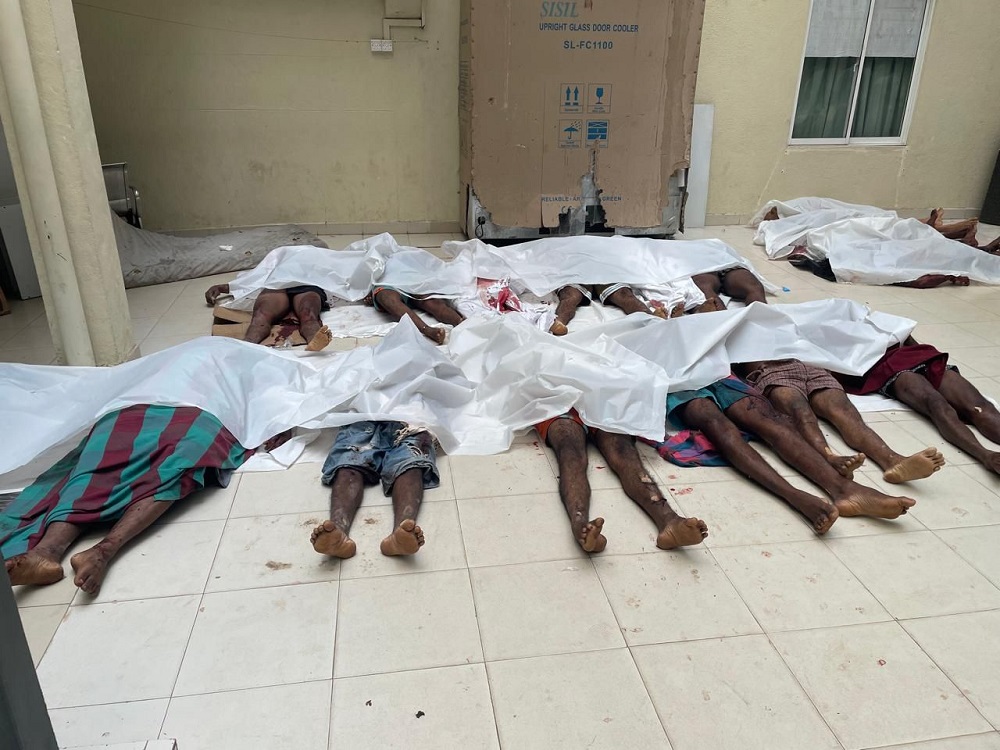
A massacre that repeats itself is no longer an event. It is a grammar. Sri Lanka's prisons have written the same sentence for forty-three years — subject, verb, corpse — read back each time as accident rather than design. Welikada 1983. Welikada 2012. Mahara 2020. Encounter killings that fill police blotters like weather reports. And now Negombo, 2025–26, where twenty-six or twenty-seven people, seven of them officers meant to guard them, died inside walls built for 650 and asked to hold 2,400.
To call this a crisis is to misname it. Crisis implies rupture. What Negombo reveals is continuity: pressure the state has manufactured and tolerated for decades. Foucault warned that the prison is where sovereign power performs its purest form — the body as proof the state can still punish. What he did not anticipate is a state so hollowed by impunity it no longer needs to perform punishment. It only needs to look away.
This essay is not a chronicle of tragedy. It is an indictment of a pattern — and an argument that the only exit from that pattern runs through the judiciary, not through the barrel of another gun.
Prisons are almost as old as civilization itself. Ancient Mesopotamia and Rome held the accused mainly to await trial, not as punishment. It took the Enlightenment — Bentham's panopticon, the penitentiary — to reimagine the prison as an instrument of reform, not mere confinement. Today, a prison's legitimacy rests on one premise: it punishes lawfully and rehabilitates — never disappears people beyond accountability. Sri Lanka inherited that architecture without inheriting its ethics.
Sri Lanka's prison massacres are not isolated tragedies. They form a coherent pattern, repeated across decades, across governments, across political cycles, and across institutional hierarchies. The pattern is brutal, predictable, and structurally engineered — which is to say, it is not an accident. Accidents do not recur with this fidelity.
Welikada 1983 — Ethnic Killing Ground. During Black July, fifty-three Tamil prisoners were massacred inside Welikada Prison. Guards reportedly opened cells and let mobs armed with spikes do what the state would not admit to ordering. No indictments, no accountability followed — the birth of the deep state's carceral impunity.
Welikada 2012 and Mahara 2020. In 2012, the STF entered Welikada for what was called a search. Gunfire erupted; twenty-seven inmates died, several execution-style. One superintendent was convicted; the chain of command above him remained untouched. In 2020, COVID fear and overcrowding pushed Mahara inmates to demand testing; the state answered with live ammunition. Eleven died. Again, no command responsibility — the state deciding which bodies are disposable.
Encounters and Torture. Dozens of drug suspects have died in staged "encounters" rubber-stamped by the AGD without forensic challenge. The Human Rights Commission has separately verified hundreds of custodial torture cases, almost none prosecuted — a tax the state lets its agents levy on the powerless.
Negombo 2025–26 — When Gangs Lose Their Guardianship. Negombo Prison housed 2,400 inmates in a facility built for roughly 650 — overcrowding that was political, not accidental. When rival drug networks reportedly lost the guardianship that had long protected them — allegedly connected to senior police and ministerial figures named in ongoing controversy — the prison became a battlefield. Twenty-six to twenty-seven died, including seven officers, with CCTV disabled and weapons seized inside what is meant to be the state's most controlled environment.
Justice Minister Harshana Nanayakkara told Parliament that drug gangs were behind the bloodshed. He is right, and dangerously incomplete: gangs acted with impunity because their guardianship had fractured, not disappeared. Negombo is a mirror — inside, gangs and corruption; outside, the same actors reshuffled but not cleansed.
One detail separates Negombo from the earlier massacres: there, the dead were exclusively inmates. At Negombo, seven wore the state's own uniform — its own agents dying to confront networks that deep-state guardianship had let entrench themselves inside its walls. Negombo reads less like a riot and more like a state finally, belatedly, at war with an architecture it had itself built.
In the aftermath, the government pledged reform: addressing capacity, staffing vacancies, and outdated custodial legislation through new amendments. Whether that pledge becomes law, or joins the long list of promises that quietly expired, will decide whether Negombo is a turning point or the next paragraph in an old story.
If any single episode illustrates how the deep-state machine operates, it is the twin scandal that engulfed the Prisons Department and its most notorious inmate in 2025–26. In June 2025, Commissioner General of Prisons Thushara Upuldeniya was arrested after the CID found he had unlawfully released a convicted fraudster under a presidential pardon absent from the official list. Prosecutors told the court he had run the department like a "private empire"; further investigation found up to 68 additional inmates may have been released without authorisation in preceding years. If a Commissioner General can manufacture presidential mercy at will, Article 34 becomes the deep state's most elegant instrument: a legal-looking door through which the well-connected simply walk out.
The same prison system has, for years, hosted former MP Duminda Silva, sentenced to death for the 2011 murder of MP Bharatha Lakshman Premachandra, pardoned by President Gotabaya Rajapaksa in 2021, and returned to custody in 2022 after the Supreme Court ruled that pardon "arbitrary, irrational," and corrosive of public confidence. Silva has spent much of his sentence in hospital wards rather than a cell — treated as VIP privilege. In March 2026, the Bribery Commission named him a suspect in a further case: bribes running into tens of millions of rupees, allegedly paid to secure bail for a large-scale drug trafficker known as "Dematagoda Ruwan," arranged with Silva's knowledge during his tenure at the National Housing Development Authority.
This is not new territory for Silva. In 2015 the CID questioned him over alleged financial ties to drug baron Gampola Vidanage Samantha Kumara, "Wele Suda," who testified he had paid Silva a commission; a senior police spokesman described Silva as the politician behind Wele Suda's heroin network. A decade on, the same name recurs in a new bribery case tied to a different trafficker.
Two scandals, one system: a prisons chief allegedly forging presidential mercy, and a convicted killer allegedly buying his way through bail and hospital beds. Between them sits the same overburdened AGD and the same public left wondering whether accountability is a matter of law or of leverage. This is the deep state made visible — not a metaphor, but a case file.
Prisons do not bleed on their own. They bleed because they are embedded within a deep-state architecture — intelligence services, the CID and STF, political guardians, criminal networks, and an AGD that functions less as a check on power than as its final custodian. Intelligence has historically shaped arrests and influenced prosecutions, functioning in massacres as an unseen author deciding who is transferred or exposed to danger — Agamben's state of exception made literal.
Public filings in the separate Harak Kata extortion case allege associates close to senior political and legal figures demanded hundreds of millions of rupees from a detainee's family, claiming influence over the AGD, police, and intelligence. Whatever the judicial findings, the filings illustrate a mechanism common to every case above: guardianship, not law, decides who is protected and who is erased. Drug networks operate inside prisons with phones and money — a shadow sovereignty inside the state's own walls — and when guardianship collapses, as before Negombo, these internal sovereigns turn on one another.
Overcrowding is usually framed as a logistical failure. In Sri Lanka it functions as a political weapon: a tough-on-drugs campaign filled prisons with minor suspects and expanded remand populations, treating incarceration as theatre rather than policy. Negombo's 2,400 inmates in a space built for 650 is the outcome of a narrative that needed full prisons more than functioning ones.
The government's own stated position sharpens this contrast: the NPP has declared combating narcotics a national priority pursued lawfully — through prevention, treatment, and rehabilitation, not mass incarceration for its own sake. That philosophy stands, on paper, opposed to the overcrowding strategy that produced Negombo. Lawful enforcement and structural overcrowding are incompatible goals — Negombo is what happens when a state pursues both at once.
The Attorney General's Department is the keystone of the impunity network. Every prison massacre, every torture case, every custodial killing ends here. If the AGD does not indict, justice dies — not loudly, but administratively, in the silence of an unopened file.
Welikada 1983 ended with no indictments; Welikada 2012 narrowed to a single conviction; Mahara 2020 produced none. Encounter killings are rubber-stamped without forensic challenge; torture cases are almost never prosecuted. Negombo 2026 — the largest massacre since Welikada — now sits on the AGD's desk. If it repeats the pattern, Negombo joins the rest, a ledger with no final page. And if the AGD stays politicised, the deep state does not merely evade the judiciary — it becomes it.
Chief Justice Surasena, who struck down Duminda Silva's pardon as "arbitrary and irrational" and has since disciplined corrupt magistrates, and Justice Kodagoda, who chairs the committee drafting legislation for an Independent Office of the Public Prosecutor, are both nearing the mandatory retirement age of sixty-five — and both projects stall the moment either man leaves the bench.
Both are engaged in the same project from two directions: ending the deep state's impunity through law, not handing its power to a new unaccountable actor. The deep state understands the calendar better than any reformer; it need not defeat these judges, only wait for the clock to run out — Arendt's bureaucrat who need only delay until the honest men age out of office.
Sri Lanka must raise the mandatory judicial retirement age beyond sixty-five — an act of national self-preservation — to keep Kodagoda, Surasena, and every brave, incorruptible judge exactly where the deep state fears them most: on the bench.
A parliamentary no-confidence motion against the Justice Minister, filed after Negombo, has been framed by its sponsors as a reckoning on human rights. Politically, it reads more like a gimmick — an attempt to embarrass the NPP government's human rights record rather than confront the architecture that produced the massacre. But it inadvertently gestures at a truer point than its authors intend.
Negombo's blood is already a no-confidence motion — an impeachment, an indictment — against the impunity machinery and the overcrowding strategy examined here, not against one minister who inherited both. If Parliament wants accountability rather than theatre, the answer is not a symbolic vote but a legislative package: raise the judicial retirement age past sixty-five, legislated together with the drug-law reforms the Justice Minister has already proposed. Anything less treats a structural indictment as a personnel problem.
To break a forty-year pattern of prison blood, Sri Lanka must enact structural reform — not another round of condolences and closed files.
* Raise the judicial retirement age above sixty-five — the single most urgent reform here, legislated alongside the Justice Minister's proposed drug-law reforms — so Surasena, Kodagoda, and other brave, wise judges are not forced from the bench precisely when their work matters most.
* Reform judicial appointments so vacancies are filled through transparent, merit-based, independent processes rather than AGD pipelines and political patronage.
* Establish the Independent Office of the Public Prosecutor, finally allowing massacres, torture, and custodial killings to be prosecuted on evidence, not buried by discretion.
* Impose independent oversight of intelligence and the CID, mandated to investigate who protected gangs and shaped AGD decisions from the shadows.
* Reverse the war-on-drugs remand culture, invest in alternatives to incarceration, expand capacity honestly, and end the political weaponisation of overcrowded prisons.
None of these reforms are radical in the abstract; they are the minimum architecture of a functioning rule of law. What makes them radical in Sri Lanka is that they would deny the deep state its two oldest tools: the silence of the AGD and the calendar of judicial retirement.
Sri Lanka stands at a crossroads that is not political but existential.
Mbembe's necropolitics teaches that sovereignty finds its purest expression not in governing the living but in deciding who may be left to die. Every ungoverned corridor of Negombo, every unindicted file from Welikada, is that power exercised — sovereignty through abandonment rather than law. A state that repeatedly chooses not to prosecute is not passive; it is active in every death that follows from its silence.
If the AGD continues its pattern — burying files, protecting elites, delaying indictments — Negombo 2026 joins Welikada 1983, Welikada 2012, Mahara 2020, and the long column of killings that never reached a courtroom. The deep state will have won again, not through violence this time, but through paperwork and patience — the refusal to open a file until the public stops watching.
But if the judiciary — led by Surasena and Kodagoda, reinforced by a prosecutorial office answerable to law rather than political guardians — completes its reforms, then for the first time in Sri Lankan history, justice may enter the prison gates not as a slogan but as a functioning institution.
The choice is not between order and chaos, as the state prefers to frame it. It is between two sources of finality: the bullet, which ends a life and a question in the same instant, and the verdict, which ends impunity while preserving truth. A country that keeps choosing the bullet is not choosing order. It is choosing amnesia with a body count.
Justice, properly understood, cannot stop at the gate to sort the dead by uniform. It belongs equally to the officers who died confronting a criminal architecture the state had nurtured, and to inmates the same state had long treated as expendable. The remanded, the addicted, and the poor who filled Negombo's wards were themselves a section of a wronged society — failed by prevention and rehabilitation alike. Justice here cannot distinguish between guard and inmate; both are owed the same remedy — accountability by law, not clemency by silence, and never power seized in anyone's name.
Sri Lanka has repeated prison deaths for forty years. It must not repeat them a fortieth time. The dead of Welikada, Mahara, and Negombo are not abstractions to be filed and forgotten — they are the unanswered question the state keeps refusing to hear. The deep state is waiting. The country is waiting.
Justice must come — not from the silence of the Attorney General's Department, but from a judiciary strong enough, and independent enough, to confront the darkness.
Not bullets. Justice.
Collection of articles written by Gerard Adams
https://www.lankaenews.com/category/22
---------------------------
by (2026-07-12 12:47:55)


 Read 112554 Times
Leave a Reply
 0 discussion on this news