
-By Anubhavananda
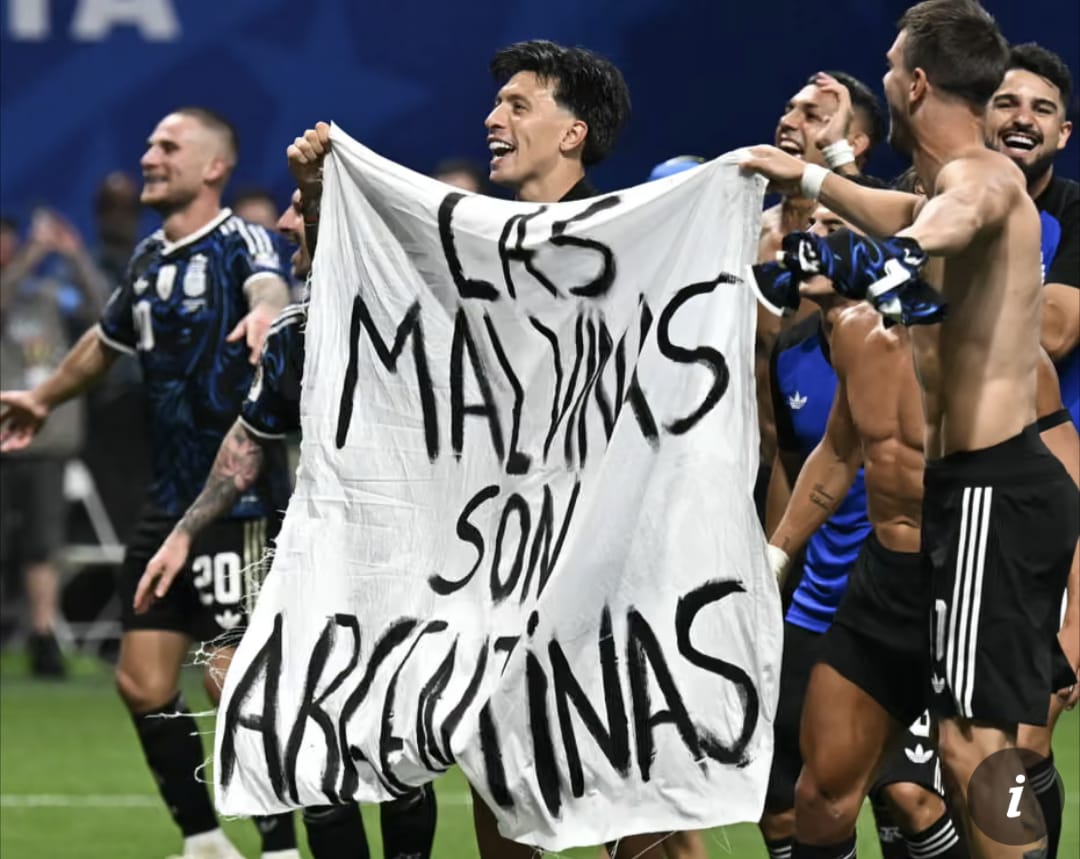
(Lanka-e-News -2026.July.17, 9.30 PM) When the Argentine players celebrated their World Cup victory over England, they raised a banner reading "Las Malvinas son Argentinas" ("The Malvinas Islands belong to Argentina"). It was a clear political message recalling the 1982 Falklands (Malvinas) War. The banner revived the long-standing territorial dispute over the islands, known as the Falkland Islands in Britain and the Islas Malvinas in Argentina. The disagreement over sovereignty led to a 74-day war forty-four years ago, during which more than 900 people lost their lives.
Argentine players Lisandro Martínez and Giovani Lo Celso were seen holding the banner, smiling, and waving to the Argentine supporters. After defeating Switzerland, the Argentine national team celebrated in their dressing room by singing their unofficial World Cup anthem, "The Fourth Star." During the celebration, Lionel Messi and his teammates sang, "For the Malvinas, for Diego." Here, "Diego" refers to Argentine football legend Diego Maradona. Through these celebrations, Argentina's political hostility toward England was made very clear. This was not simply sporting rivalry; it was a clear example of unnecessarily mixing politics with football.
According to FIFA's Stadium Code of Conduct, the display of "banners, flags, flyers, apparel and other paraphernalia that are of a political, offensive, and/or discriminatory nature" inside a stadium is strictly prohibited.
Commenting on the incident, UK Business Secretary Peter Kyle described the display of the banner as "completely inappropriate." He told Agence France-Presse (AFP):
"Politics should be kept separate from football. In fact, one of the fundamental principles of the World Cup is to keep politics and football apart. This is now a matter that FIFA should investigate. I hope FIFA will carry out a full and proper investigation into this incident."
During the 2012 Summer Olympics, South Korean footballer Park Jong-woo held up a sign reading "Dokdo is our territory" after the bronze medal match. (The photograph is attached at the end of the article.) It was a political statement relating to the territorial dispute between South Korea and Japan over the Dokdo/Takeshima Islands. Following the incident, FIFA imposed a two-match international suspension on Park Jong-woo. The British government has now officially lodged a complaint with FIFA over the incident in which Argentine players displayed the "Las Malvinas son Argentinas" banner and has expressed its strong objection. If FIFA is to act consistently and fairly, it should immediately impose match suspensions on the Argentine players involved in the incident. However, considering what we believe has been FIFA's extraordinary favoritism toward Messi and the Argentine team throughout this World Cup, we believe the chances of such a swift decision are extremely limited.
There are many islands around the world whose sovereignty is disputed. However, in recent history, no country has gone to war over such small islands. Although Britain has administered the Falkland Islands since 1833, Argentina has long claimed them as part of its territory. In 1982, Argentina was under the rule of an authoritarian military dictatorship and was facing a deep economic crisis and growing public unrest. The regime sought to strengthen public support by stirring nationalist sentiment through reclaiming the Falkland Islands. On 2 April 1982, Argentina's military junta ordered the invasion of the Falkland Islands. In response, Britain dispatched a large naval and military task force to retake the islands.
On 14 June 1982, ten weeks later, Britain regained control of the Falkland Islands after the Argentine forces surrendered. During the war, 649 Argentine military personnel, 255 British military personnel, and three Falkland Islands civilians lost their lives. The invasion proved to be a disastrous miscalculation by Argentina's military junta. At the same time, it became an unexpected political windfall for the then British Prime Minister Margaret Thatcher. Facing significant public dissatisfaction before the conflict, Thatcher regained popular support through the war. Two weeks after Argentina's surrender, she dissolved Parliament and called a general election, in which she significantly increased her parliamentary majority.
To this day, the Falkland Islands remain under British administration, while Argentina continues to assert its claim of sovereignty over the islands. The dispute remains unresolved at the diplomatic level.
In the 2022 FIFA World Cup final, France and Argentina finished level at 3–3, and the winner was decided by a penalty shootout. After winning the trophy, Argentine players were seen singing songs that contained racist insults directed at France's Black players. It has also become increasingly common for some Argentine football supporters to publicly insult Black people by calling them "monkeys." This is a deeply unfortunate situation. These racist and offensive behaviors have political and social roots. Argentina is a country in South America, where the populations of most countries are of Latin American (Latino) origin. However, many Argentines maintain that they do not belong to that heritage.
"The Brazilians come from the jungle, the Mexicans come from the Indians, but we Argentines come from the boats."
This is a well-known expression used by some Argentines to describe their origins. By saying "we came from the boats," they refer to their descent from European immigrants, particularly Spaniards, who settled in Argentina. The implication is that, although Argentina is geographically located in South America, Argentines see themselves not as part of the region's Latino heritage but as a people directly descended from Europe—a distinct and predominantly White nation. This narrative resembles Adolf Hitler's concept of the Aryan race. Historians and anthropologists, however, reject this interpretation of Argentine identity.
Argentina was under the rule of the Spanish Empire from the 16th century until the early 19th century. It gained independence from Spain on 9 July 1816. At that time, around 15 percent of Argentina's population consisted of Black people descended from enslaved Africans. There was also a significant Indigenous population.
However, during the late 19th century and early 20th century, Argentina sought to present itself as a "White European nation." As a result, the contributions of people of African descent were often overlooked in school textbooks, official historical records, and government narratives. Afro-Argentines frequently faced discrimination in employment, education, and public life, making social and economic advancement more difficult.
For example, there are currently no Black players on Argentina's national football team. The last Black player to represent Argentina at senior international level was Héctor Enrique in 1986, nearly four decades ago. In Argentina, he was commonly known as "Negro" Enrique.
Some historians argue that changes in racial classification methods over time caused Afro-Argentines to gradually disappear from official statistics, effectively rendering them an "invisible" or "disappeared" population in official records. According to this view, Argentina's Indigenous peoples experienced a similar fate.
Argentina was a country that was sympathetic to Adolf Hitler's fascist Nazi ideology. The Nazi vision of building a "pure White race" and Argentina's effort to construct a national identity as a "White European nation" shared important ideological similarities. After the Second World War, thousands of Nazi officials and their collaborators fled Europe and arrived in Argentina. The government of then-President Juan Perón allowed many of them to enter the country. Among the most notorious Nazi war criminals who lived in Argentina were Adolf Eichmann and Josef Mengele. It is widely acknowledged that they received protection, assistance, and ideological sympathy from Perón's government. According to historians' estimates, Argentina accepted thousands of people who had fled Nazi Germany. As a result, Argentina became one of the principal destinations and safe havens for Nazi fugitives after the Second World War.
The current President of Argentina, Javier Milei, is a far-right, racist, and fascist leader. Milei publicly praises the pro-Nazi policies of Juan Perón and other Argentine military rulers, including their practices of forcibly disappearing and killing political opponents.
Given Argentina's long-standing national myth of being a "White European nation," it should not be surprising that some Argentine football supporters insult Black people by calling them "monkeys" or throw water bottles and beer cups at supporters from countries that are not perceived as "White." These supporters celebrate an Argentine football team, including Lionel Messi, that has been accused of singing songs containing racist insults toward Black people.
When the priest himself defiles the temple, there is little left to say about the behavior of the worshippers.
---------------------------
by (2026-07-17 16:13:13)



 Read 37212 Times
Leave a Reply
 0 discussion on this news