
-By Gerard Adams
(Lanka-e-News -2026.July.29, 11.30 PM) “In moments of transition, the greatest danger is not the old order’s violence, but the hesitation of those who must replace it.” -A Gramscian reflection on historical rupture
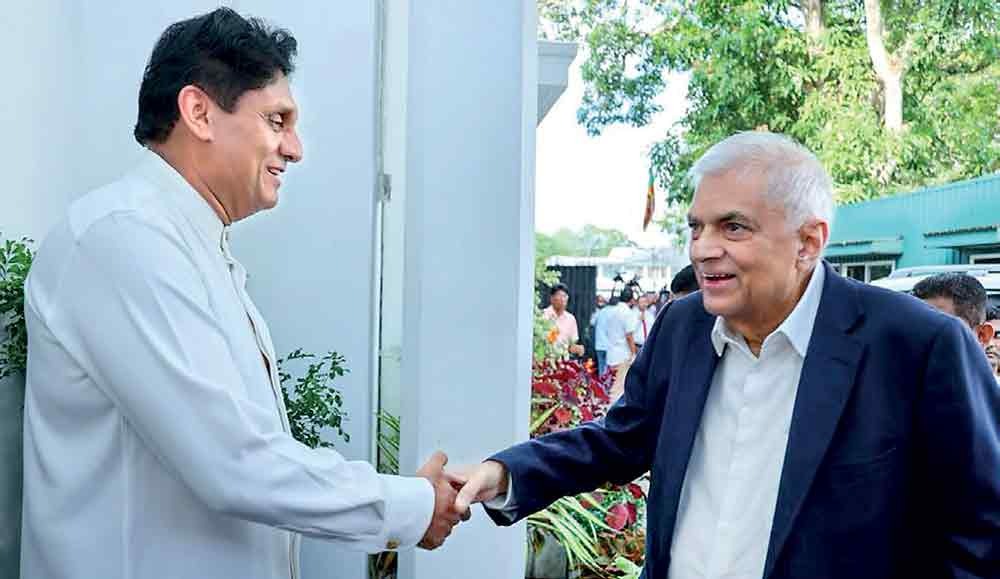
On a sweltering night at 30 Marcus Fernando Street, the official residence of the Leader of the Opposition, the mask slipped. What took place there was not a policy discussion — it was a war council. Ranil Wickremesinghe, the undying custodian of Sri Lanka’s rotten elite order, huddled with Sajith Premadasa and the rest of the opposition brass to plot resistance against a single, simple bill: raising the judicial retirement age. Make no mistake — this was never about judicial reform. It was a desperate rearguard action to protect the Flower Road Plan, the gerontocratic deep state’s scheme to strip Chief Justice Surasena of the years he needs to finish the job — and in doing so, to keep the machinery of judicial laundering and elite impunity running at full throttle.
That meeting exposed, in one sordid tableau, the real battle line running through Sri Lankan politics: the Flower Road Plan — the old elite’s malevolent democracy — against the Pelawatta Plan B — the NPP’s possible turn toward a benevolent autocracy. Forget Parliament. The real battlefield is Hulftsdorf, the citadel of judicial power, and the war for it has already begun.
To understand how a nation arrived at this precipice, we need Marx, Gramsci, and elite theory — because Sri Lanka’s deep state is not a paranoid fantasy. It is a structural fact, built brick by brick out of decades of impunity, and it is now staring down a government that captured the ballot box but not the machinery of the state.
Marx saw it coming: “the executive of the modern state is but a committee for managing the common affairs of the whole bourgeoisie.” Substitute “bourgeoisie” for Sri Lanka’s ruling caste and the picture snaps into focus. This is not just moneyed business interests — it is an interlocking fraternity of political dynasties, legal grandees, career bureaucrats, religious authorities, and old-boy professional networks that has run the state’s superstructure for generations, and has no intention of letting go.
Gramsci sharpens the blade further: behind political society and civil society lies a hidden network of fortresses and earthworks, built to withstand siege. In Sri Lanka, those fortresses are the Bar Association, the Attorney General’s Department, the judiciary, the Buddhist clergy, the media houses, the business chambers, the senior bureaucracy, the intelligence services, the police command. These are not neutral institutions. They are the walls that manufacture consent for elite rule and crush any government reckless enough to challenge it.
Elite theory names the disease: gerontocracy. Sri Lanka’s power bloc is run by an aging cartel — Ranil Wickremesinghe, Mahinda Rajapaksa, Basil Rajapaksa, Gotabaya Rajapaksa, Wijedasa Rajapaksa, Anura Yapa — propped up by legal fixers like GL Peiris, Marapana, Romesh de Silva, bureaucratic enforcers like PB Dissanayake, Gamini Senarath, Saman Ekanayake, and religious cover provided by figures such as Elle Gunawansa and Bengamuwe Nalaka. Their agenda has never been complicated: guard impunity at any cost, and make sure no outsider ever wields real power.
This deep state was not born overnight. It was forged in blood and silence: the ethnic pogroms of 1983, the extrajudicial killing fields of 1988–89, the war-time impunity of the 1990s and 2000s, the white-van abductions of 2010–15, the institutional failures behind the Easter bombing, and the toxic fusion of the drug underworld with police and political networks. Each atrocity, each cover-up, added another brick to an architecture built for one purpose: protecting the ruling bloc from consequence.
This isn’t a purely political phenomenon — it is legal, bureaucratic, religious, and cultural, woven into the judiciary, the AG’s Department, the police, the intelligence apparatus, and the clergy, and shielded by professional bodies like BASL that exist, in practice, to defend elite interests. Every crisis — 1983, 1988–89, the war, the white-van years, Easter Sunday — added a new layer of secrecy, a new circle of loyalists, a new legal alibi. What emerged is a gerontocratic guardianship: a caste of elders who see themselves as custodians of the state even as they are, demonstrably, the architects of its ruin.
The 2022 Aragalaya tore the mask off political legitimacy. The 2024 election handed the NPP a genuine democratic mandate. And still — the deep state didn’t blink. Yes, the NPP now controls the Colombo commercial elite, the finance sector, the Ministry of Finance, the Central Bank, and — as Dr. Newton Gunasinghe long argued it would — a military that follows the sovereign parliamentary mandate, along with major departments like health and education, and influence over unions such as the GMOA and the teachers’ unions.
But look at what it does not control: the AG’s Department, the judiciary, BASL, the AGA network, the religious establishment, the senior bureaucracy. The Judicial Service Association meeting — where a resolution was rammed through without quorum — laid bare just how exposed the lower courts remain, and how deep the deep state’s capture really runs.
This is the chasm between government and state. The NPP won the election. The old guard still owns the machinery.
The Flower Road Plan is nothing less than a blueprint for preserving malevolent democracy — a system where votes are cast and counted, but impunity is untouchable. Its method: stall the cases, postpone the trials, protect the well-connected, and wait for the NPP to choke on economic and bureaucratic sabotage.
Its nightmare has a name: Chief Justice Surasena. His independence, his willingness to rule against the powerful, his digitalisation reforms, his purge of compromised judges — all of it makes him the single greatest existential threat the gerontocratic bloc has ever faced.
The gathering at 30 Marcus Fernando Street, with Ranil Wickremesinghe at the table, was a calculated move to strangle the judicial age-limit bill in its crib. The entire Flower Road Plan hinges on denying Surasena the extra years he needs.
This is not just a political manoeuvre — it is a philosophy. It is the conviction that democracy must stay malevolent: a system where the people vote, and the elite rule regardless.
Pelawatta — the NPP’s administrative heartland — offers a different vision, and a more honest one: raise the judicial retirement age, expand court capacity, cut the delays, shield CJ Surasena, install an independent prosecutor, abolish the executive presidency, and fortify democratic institutions. This is the road to genuine renewal.
Plan A is the NPP’s attempt to build a benevolent democracy — institutions that finally serve the people instead of the patrons.
But there is a second Pelawatta strategy waiting in reserve — Plan B, a silent drift toward benevolent autocracy. This is no revolution. It is a constitutional shortcut, built on the bones of the 1972–78 republican constitution, a Westminster-style legislature, a Paris–Washington-style executive, and a Singapore-style judiciary.
Plan B means keeping the AG’s Department intact, preserving its pipeline to the Supreme Court, consolidating executive power, and building a seductive narrative of benevolent autocracy — deploying media and clergy to amplify AKD’s charisma, branding the old order as corrupted malevolent democracy, and using courtroom battles to harden public sentiment.
Here is the trigger nobody wants to say out loud: if Flower Road gains the upper hand, the NPP will not fight back in the open. It will pivot, quietly, to Plan B. Plan B isn’t activated by NPP ambition — it’s activated by Flower Road’s aggression.
Plan B rests on a seductive and dangerous belief: that autocracy can be benevolent, that stability can be engineered from above, that the deep state can be captured rather than dismantled.
Harshana Nanayakkara is the chief architect of the NPP’s elite integration strategy. His elite pedigree, his intimate command of AG history, his knack for cultivating professional associations, his years building military–police–professional alliances since 2018, and his outreach to left-wing minorities make him the single most important bridge between the NPP and the old networks. His presence doesn’t just make Plan A workable — it makes Plan B dangerously, seductively viable.
Harshana is something new: a technocratic operator who understands, with total clarity, that power is never merely electoral. It is institutional, or it is nothing.
Ranil and the gerontocracy bet everything on collapse: IMF conditionalities, unpayable debt, strangled logistics, customs paralysis, coal supply failures — economic sabotage layered on top of bureaucratic sabotage from a deep state that never wanted the NPP to succeed. Past governments met that sabotage with punishment and patronage. The NPP, being outsiders to the elite game, chose not to fight the bureaucracy on its own turf.
And still — it survived. That survival rattled the gerontocracy to its core. It proved, unmistakably, that the people’s mandate was stronger than elite sabotage.
Strip away the euphemisms and the opposition’s strategy is simple: launder the judiciary. Delay the cases. Postpone the trials. Wait for the NPP to fall. Reclaim power. Protect impunity forever. Their obsession is Surasena. Their weapon is the judicial age-limit bill, wielded through Sajith Premadasa, through BASL, through coordinated Flower Road pressure — all engineered to keep Surasena from staying a day longer than they can help.
Judicial laundering isn’t a side tactic — it is the philosophical core of malevolent democracy: the belief that justice itself must be delayed indefinitely so that power can be preserved forever.
Hulftsdorf is the citadel of judicial power. Full stop.
The fight over Surasena’s tenure is nothing less than the fight for the soul of the state.
If Flower Road wins: judicial laundering continues, impunity survives, gerontocracy tightens its grip, malevolent democracy limps on — but the NPP does not collapse, and Pelawatta pivots to Plan B.
If Pelawatta Plan A wins: judicial independence is fortified, age limits rise, delays shrink, lower-court capture weakens, an independent prosecutor emerges, the executive presidency falls, and democracy is renewed. If Plan B wins instead: benevolent autocracy is born.
Hulftsdorf is not a courthouse. It is the philosophical front line between justice and impunity.
XI. A Blunt Message to Sajith, Champika, and the Liberal Opposition: Eliminate Gerontocracy or Be Eliminated by It...
If Sri Lanka’s liberal opposition — Sajith Premadasa, Champika Ranawaka, and the SJB — wants to survive the next decade, it needs to face an uncomfortable truth: the gerontocratic power bloc is not merely the NPP’s enemy. It is the opposition’s executioner-in-waiting.
The gerontocracy has never tolerated outsiders rising through the ranks, and it never will. The SJB is not part of the old club. It does not sit inside the Flower Road circle. It has no seat at the legal-religious-bureaucratic patronage table. So the gerontocracy will destabilize SJB leadership, sabotage any attempt by Sajith or Champika to consolidate power, weaponize judicial laundering against them, and block, permanently, any non-elite figure from ever reaching the presidency or the premiership.
The opposition umbrella was never built for the people. It was built to shelter crime, protect impunity, and preserve elite privilege. It offers no real alternative to a country desperate for one. The NPP’s dominance in the polls isn’t purely its own achievement — it is the mirror image of an opposition collapsing under the weight of its own alliance with the gerontocratic deep state.
If the opposition wants room to breathe, it has exactly one option: tear down gerontocratic control. It cannot beat the NPP until it first beats the gerontocracy. Refuse that fight, and the gerontocracy will finish the opposition itself.
Here is the paradox at the heart of Sri Lanka’s transition: if Sajith, Champika, and the SJB want to survive, they must step aside and let the NPP dismantle the gerontocratic power bloc. The NPP is the only force with the strength to take on the gerontocracy head-on. The opposition cannot do it alone — it lacks the mandate, the legitimacy, the public trust, and the institutional reach.
Protect the gerontocracy, and the opposition destroys itself. Let the NPP eliminate it, and the opposition finally gets breathing room — the chance to rebuild, to offer a genuine liberal alternative, a professional leadership model, a new socio-political program, to challenge the NPP on policy, win back youth and minority voters, rebuild patronage networks on honest terms, and become a credible government again.
Sajith Premadasa — you are standing at a fork in the road, and you need to see it clearly. Cosying up to Ranil Wickremesinghe and the gerontocratic deep state will not lift you toward the presidency. It will erase you. The public will not forgive a leader who shields impunity. Keep walking the Flower Road path and the presidency will remain permanently out of reach. Break from the gerontocracy — do not serve it. Your entire political future depends on letting the NPP tear down the old order so that you have something worth rebuilding.
Champika Ranawaka — you are the most credible non-elite challenger AKD has. But credibility is fragile, and it shatters fast. Sitting at the table at 30 Marcus Fernando Street with the gerontocratic bloc does not enhance your standing — it torches the political identity you’ve spent years building. Become another custodian of the old order, and you lose the one thing that makes you valuable: the perception that you represent something new. Align with Flower Road, and you forfeit the very constituency that believes in you as the future.
Both of you need to understand this in your bones: the gerontocracy is not your ally — it is your cage. Help dismantle it, or it will dismantle you.
Sri Lanka stands on a tectonic fault line. This is not a moment for careful arithmetic — it demands calculus, dynamic thinking about forces in motion. The opposition must accept a hard truth: the gerontocracy is the enemy of democracy, the enemy of the opposition, the enemy of the people, and the enemy of justice itself. If the opposition wants a future, it must let the NPP eliminate the gerontocratic power bloc — no half-measures, no protective hedging.
Only then can the opposition rebuild. Only then can it offer a genuine liberal alternative. Only then can it challenge the NPP on the merits of policy. Only then can it reclaim political space. Only then can it become a government worth electing.
Sri Lanka stands at the crossroads. Plan A is democratic reform, honestly pursued. Plan B is benevolent autocracy, quietly engineered. The Flower Road Plan is malevolent democracy, stubbornly defended. And the battle over Chief Justice Surasena’s tenure is nothing less than the battle for the soul of the state.
The deep state is not a conspiracy theory. It is a structural fact, built over generations and defended to the last.
And the final battle will be fought where it has always been fought — at the citadel: Hulftsdorf.
Collection of articles written by Gerard Adams
https://www.lankaenews.com/category/22
---------------------------
by (2026-07-29 18:31:49)


 Read 70608 Times
Leave a Reply
 0 discussion on this news