
By Gerard Adams
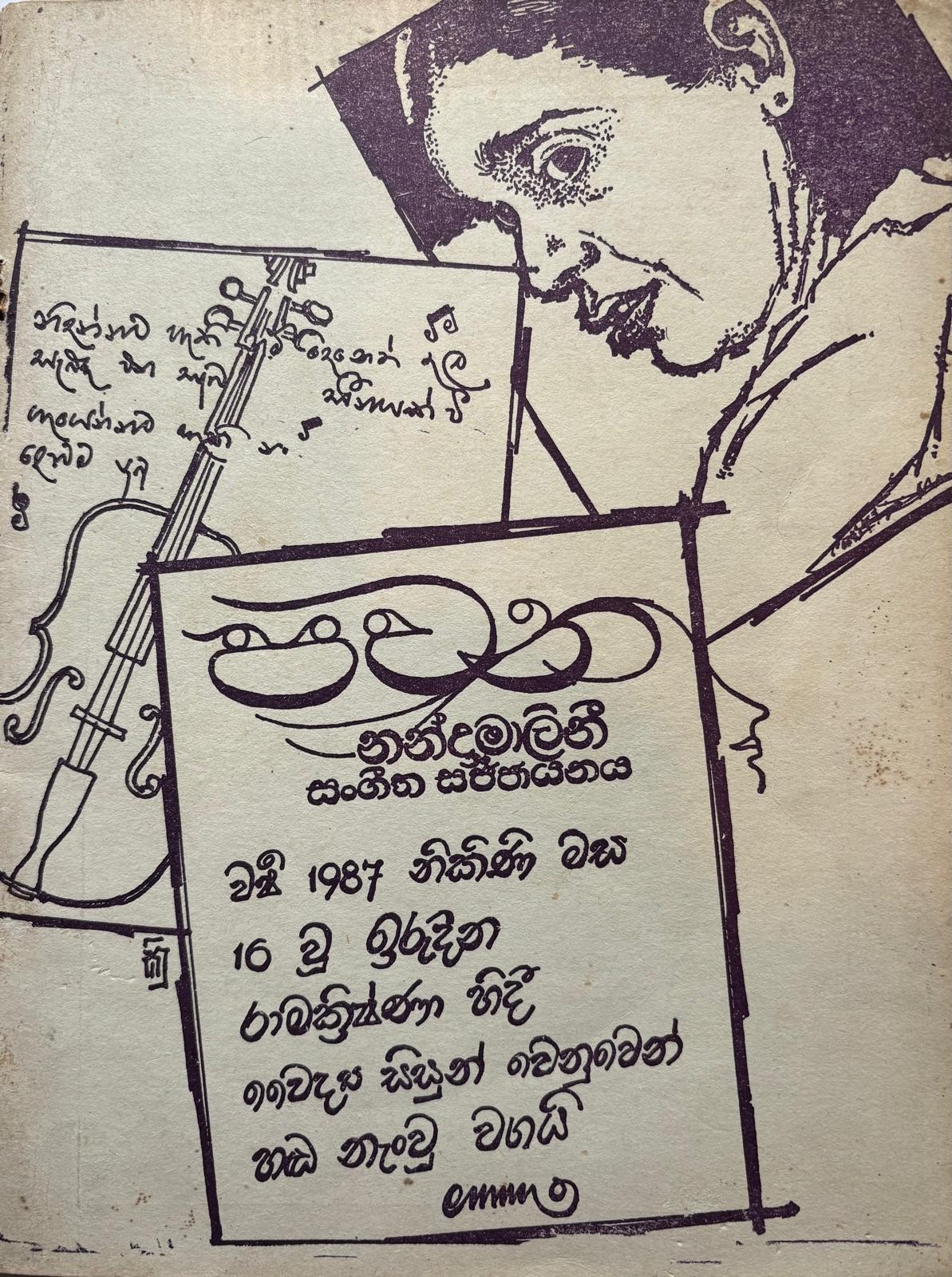
(Lanka-e-News -24.Aug.2026, 3.00 PM) When the family of Dr. Nanda Malini and her lifetime artistic collaborator, Prof. Sunil Ariyaratne, announced that in accordance with her last will, there would be no public funeral, no state honors, and strictly no eulogies, it sent a quiet shockwave through Sri Lanka's cultural landscape. In a nation habituated to post-mortem state pageantry and opportunistic political speeches, her final request felt like a profound, intentional ideological statement.
Yet for those who understood her path, the reason was never a mystery. Nanda Malini's eulogy did not need to be written at her passing in 2026 — it had already been written forty-five years prior, in the blood, fire, and tear gas of the late 1980s, carved into the outlawed cassette tapes passed secretly between university students and soldiers, and sealed forever in the final, damning line of her banned anthem, Yadamin Benda Vilangu La:
"කුමට එරට අධිකරණය, නීතිය සහ විනිසුරන්"
("What use is the court, the law, and the judges of that country?")
Her refusal of a deathbed eulogy was her final act of refusal against a political class that sought to claim in death what it could never tame, bend, or buy in life.
To understand why her rejection of a eulogy is itself a political act, consider a simple historical pattern: from Pericles' Funeral Oration in ancient Athens to the modern state funeral, the eulogy has rarely belonged to the dead. It belongs to the state — used to co-opt the deceased and absorb their legacy into the ruling ideology.
For Nanda Malini — a voice that spent half a century exposing the rot of the state apparatus — allowing politicians or institutional functionaries to stand over her casket and speak would have betrayed her life's work. She understood that the very institutions which silenced her in 1989 would gladly use her eulogy in 2026 to sanitize her memory. By forbidding it, she denied the state its final photo-opportunity and left her legacy in the hands of the ordinary people who had carried her songs in their hearts long before any minister dared applaud them.
A persistent falsehood, propagated by partisan commentators even before her death, held that Nanda Malini belonged to a specific political line. The historical record demolishes this claim.
Her artistic career unfolded across the full spectrum of Sri Lanka's socio-political history, yet she never belonged to any mainstream political party. She entered Radio Ceylon in 1959 under Karunaratne Abeysekera's mentorship. Through the 1960s, her craft matured alongside titans such as Amaradeva, Mahagama Sekara, and Premasiri Khemadasa. By the 1970s, her appeal had widened into nursery rhymes, devotional music, and romantic ballads that entered nearly every Sinhala household. The year 1979 marked a turning point with the Shrawana Aaradhana concert series, and the 1980s brought radicalisation through her collaboration with the Nirmana Sanvada Kulakaya. Between 1987 and 1989, she reached the peak of resistance through the Pawana concerts and the state suppression that followed. In 1989, went into self-imposed exile in India for protection, and in 1990 she refused state awards outright.
Across these decades, she was nurtured by governments of both the Sri Lanka Freedom Party and the United National Party, receiving awards from every administration in her early years. Her true consciousness, however, was forged not in patronage but in refusal. Her defining moment arrived in 1990, when she rejected state awards after surviving the Bheeshana Samaya of 1988 to 1989. When surveillance and death threats followed 250 performances of her radical Pawana series, she fled to India — not out of cowardice, but a conscious preservation of her voice as an uncompromised weapon against authoritarianism.
Unlike contemporaries who traded cultural prestige for political appointments, diplomatic postings, or campaign stage appearances, Nanda Malini never performed for any political party or electoral campaign. Former President Chandrika Bandaranaike Kumaratunga herself noted the moments in which Nanda Malini stood firm against state abuse without aligning with party machinery: against J.R. Jayewardene's disenfranchisement of Sirimavo Bandaranaike, against the assassination of Vijaya Kumaratunga, against the unconstitutional impeachment of Chief Justice Shirani Bandaranayake, and, decades later, alongside the victims of the 2019 Easter Sunday attacks, demanding justice at their memorial events.
She was not the asset of any regime. She was its conscience.
To fully appreciate her evolution, trace how her voice transformed from an instrument of mainstream Sinhala-Buddhist cultural dominance into a universal cry for the oppressed.
Her early collaborations with Pandit W.D. Amaradeva, Mahagama Sekara, and Master Premasiri Khemadasa produced works that defined the dominant Sinhala-Buddhist cultural ethos of the era, songs such as Udangu Liyan (උඩඟු ලියන්) and Me Sinhala Apage Rathai (මේ සිංහල අපගේ රටයි). At the same time, her repertoire embraced a gentler, universal tenderness: devotional transcendence in Buddhanubhavena (බුද්ධානු භාවේන) and Budu Karuna Dasa Temi (බුදු කරුණා දෑස තෙමි); the nursery rhymes of Handa Hami (හඳහාමී), which raised generations of Sri Lankan children; and lovelorn elegies such as Kadamandiye (කඩමංඩියේ) and Mage Sada Oba (මගේ සඳ ඔබ).
By the late 1970s, she had become a household icon for every Sinhala-Buddhist family, from young children to the elderly. But she chose not to remain a comfortable museum piece of national heritage. She risked her prestige, her safety, and her career to become the strength of the powerless.
The turning point came in 1979, with the historic concert series Shrawana Aaradhana (ශ්රවණ ආරාධනා), performed alongside Pandit W.D. Amaradeva. As documented by figures such as Dr. Lionel Bopage, this series marked the initial acoustic shift toward radical political expression.
During this era, her musical consciousness intersected directly with underground youth movements. She anonymously composed and recorded music for revolutionary youth groups — the Vimukthi Gee — including the poignant track Sathi Pooja Dara Saye (සති පූජා දර සෑයේ), proof that her commitment to the struggle was not a commercial gimmick but a deep-seated philosophical stance.
While Shrawana Aaradhana lit the spark, it was her intellectual engagement with the Nirmana Sanvada Kulakaya (නිර්මාණ සංවාද කුලකය — Creative Dialogue Collective) in the mid-1980s that supplied the ideological engine for her most radical era.
Formed by radical youth, university students, and critical intellectuals who gathered around the Colombo Public Library, Nirmana Sanvada Kulakaya emerged when the Janatha Vimukthi Peramuna (JVP) was banned and the state violently closed formal political spaces. The group sought to re-engineer Sri Lankan art away from ethnic chauvinism and toward national harmony — "Demala Uwath...", embracing the Tamil struggle as part of a unified anti-tyranny front.
This period saw the rise of an artistic triad that would define a generation: Dr. Nanda Malini, Prof. Sunil Ariyaratne, and Dr. Rohana Weerasinghe — picking up the mantle held by Amaradeva, Khemadasa, and Mahagama Sekara, but directing it explicitly toward the liberation of the oppressed.
The Nirmana Sanvada Kulakaya forums at the Colombo Public Library Auditorium became the epicenter of a historic debate within Marxist aesthetics in Sri Lanka. On one side stood the Stalinist and Maoist line, or Janathavadi Kalawa, which argued art must serve as direct propaganda — agitprop — for party cadres. On the other stood the classical Trotskyist line, spearheaded by literary scholar Prof. Sucharitha Gamlath, who insisted art must retain aesthetic rigor, psychological truth, and creative freedom rather than devolve into slogans.
Yet Gamlath's defense of artistic freedom did not translate into uncritical praise of Nanda Malini herself. He was sharply, publicly critical of the nationalist strain that ran through some of her own earlier repertoire — work that, amid the escalating ethnic war, echoed a Sinhala-Buddhist chauvinism he regarded as a betrayal of art's higher responsibility. This criticism pushed her further toward the universalist, anti-chauvinist politics that would come to define her Nirmana Sanvada Kulakaya years. Her radicalism was not handed to her; it was argued into her, in rooms where even her admirers refused to spare her.
Nirmana Sanvada Kulakaya navigated this landscape. Students from the Inter University Students' Federation (IUSF, or Anthare) were active participants in these library seminars — among them Camilas Silva, who served both as an IUSF leader and as a Nirmana Sanvada Kulakaya organizer, and who became the first of the collective's own to be forcibly disappeared by the state, in late 1986.
During this terrifying period, Nanda Malini's home off Navala Road in Nugegoda became a safe haven, sheltering young organizers and providing a sanctuary where cultural resistance could be forged. When police eventually banned Nirmana Sanvada Kulakaya's public seminars at the Colombo Public Library Auditorium, the dialogue did not die — it converted directly into the explosive musical tour known as Pawana.
The alliance between Nanda Malini and university students during Pawana was written in shared trauma and physical danger. Pawana was not performed in safe, air-conditioned theatres for high-society elites; it was performed in packed university grounds, rural halls, and provincial centres under constant threat of armed raids.
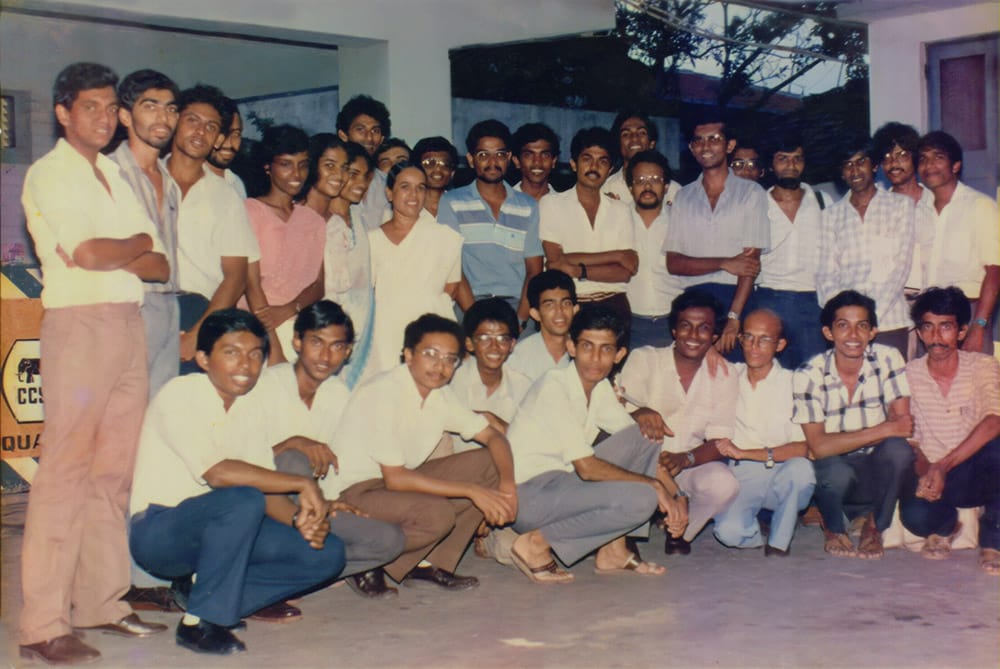
Her connection with the medical students of the Colombo Medical Faculty remains legendary. IUSF student leaders who helped coordinate her concerts — among them Waruna Edirisinghe and Athula Senaratne — were hunted down and extrajudicially murdered by state death squads at the height of the terror. According to Specialist Dr. Ajith Amarasighe, others who survived those same halls went on to become some of Sri Lanka's most respected medical specialists today.
Those years, 1987 to 1989, are remembered as the Bheeshana Samaya: state and paramilitary suppression through extrajudicial killings, disappearances, media censorship, and banned seminars, met by cultural resistance through the Pawana tour, secret tape distribution, and — most hauntingly — lullabies sung in detention centres.
When police and security forces moved to ban Pawana shows across the island, a remarkable phenomenon occurred: officers of the Army, Navy, Air Force, and Police were secretly buying cassette tapes of Pawana to listen to in their own barracks. More poignantly, in the dark, illegal detention centres and torture camps across the island, captured students sang Pawana songs to one another in the dead of night — to ease the pain of torture, and to bid a quiet goodnight to a comrade who would be executed before dawn.
Decades later, when the Aragalaya uprising erupted in 2022 at Galle Face Green, it was not modern pop tracks that echoed through the loudspeakers — it was, once again, Nanda Malini's voice, specifically her immortal Yadamin Benda Vilangu La, providing the moral backbone for a new generation rising against economic ruin and political corruption.
The song Yadamin Benda Vilangu La (යදමින් බැඳ විලංගු ලා) — banned by the Ranasinghe Premadasa administration — concludes with a line of devastating institutional indictment:
"කුමට එරට අධිකරණය, නීතිය සහ විනිසුරන්"
("What use is the court, the law, and the judges of that country?")
When Nanda Malini sang those words in the late 1980s, Sri Lanka was experiencing the collapse of the rule of law. Human rights activists and law students such as Gemunu Yasas Seneviratne were abducted and disappeared, while the state carried out extrajudicial executions and institutional authorities looked away. Figures who would later become Attorney Generals and Supreme Court Justices — including former Chief Justice Preethi Padman Surasena and Justice Yasantha Kodagoda — were themselves law students navigating that same broken system.
When Nanda Malini hurled that question at the state in 1979 and 1980, and throughout the Pawana tour that followed, she was not merely critiquing a single president or a single party. She was issuing a timeless, standing indictment of the entire Sri Lankan institutional architecture — a critique that remains as painfully urgent today as it was forty-five years ago.
Today, as the executive, the opposition, and the Bar Association remain locked in ongoing battles over judicial independence and the integrity of the bench, her forty-five-year-old question continues to ring over the nation like a warning bell.
She did not need a politician to stand beside her casket in 2026 to explain what her life meant, nor an academic to compose a tribute, nor an institution to confer a posthumous award. She had already delivered her own judgment, decades before anyone thought to ask for it. By demanding no eulogy, no state funeral, and no political speeches, she ensured that the last word on her life remained the one she had spoken herself — entering memory not as a tool of the state, but as she had always lived: unbound, unbought, and forever the voice of the voiceless.
There is a peculiar cruelty in how states mourn the very people they once hunted. The uniform that signs the condolence book is often, structurally if not literally, the same uniform that signed the arrest warrant. A eulogy, however eloquent, cannot undo that arithmetic — it can only launder it, dressing suppression in the language of tribute so the next generation forgets there was ever a difference between the two.
Nanda Malini gave her own verdict on the court, the law, and the judges long before any of us thought to ask her for one. Her version was not a legal opinion; it was a question flung at an entire architecture of power — kumata erata adhikaranaya, nithiya saha vinisuran — what use is a court, a law, a judiciary, if they exist only to be used? Forty-five years on, that question has not aged into irrelevance. It has aged into indictment. The judiciary meant to protect the powerless still, too often, fails to deliver justice to them. Law and order, meant to restrain power, is still routinely bent to suppress the very people who have none. And judges — entrusted with the conscience of a nation — are still asked, quietly, again and again, whether they will guard that conscience or simply administer its silence.
That is the real question Nanda Malini leaves behind, and it is not rhetorical. It is a test, renewed with every delayed case, every powerful man who walks free, and every powerless one who does not. Her silence at the end was not surrender to that failure — it was refusal to let anyone pretend the question had been answered.
A nation that still cannot say, honestly, that its courts serve the weak rather than the strong has no right to eulogize the woman who asked why.
It only has the right to finally answer her.
Collection of articles written by Gerard Adams
https://www.lankaenews.com/category/22
---------------------------
by (2026-08-24 09:55:33)


 Read 75462 Times
Leave a Reply
 0 discussion on this news