
By Ruwan Weerakoon
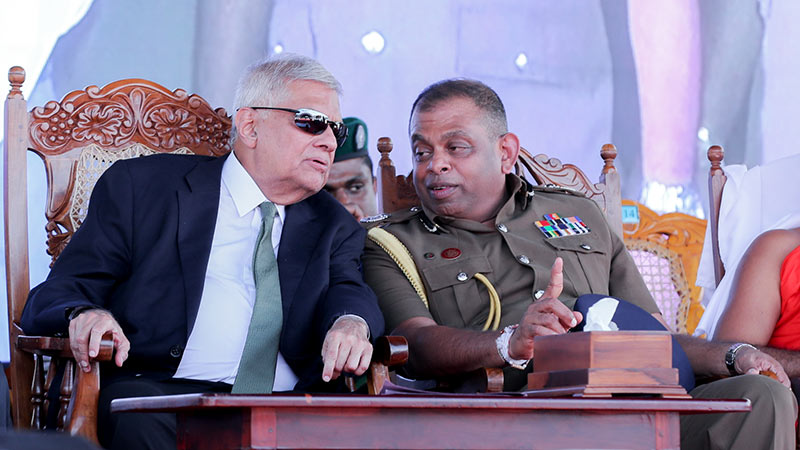
(Lanka-e-News -16.Sep.2026,6.00 AM) Sri Lanka has removed a sitting Inspector General of Police only once in its history. That distinction belongs to Deshabandu Tennakoon, whose appointment was contested from day one and whose removal, when it came, was near-unanimous. The more instructive question is not how he fell, but how he rose — and who lifted him.
Tennakoon was appointed the 36th Inspector General of Police on 26 February 2024 by President Ranil Wickremesinghe, having served as Acting IGP since November 2023.
The appointment proceeded over sustained objection. The Constitutional Council declined to endorse it. Lanka e-News and other outlets had by then published a sustained body of reporting alleging corruption, dealings with narcotics traffickers, and the extraction of money from businessmen — allegations Tennakoon has denied and which remain untested in any criminal court.
Two figures are widely understood to have carried his case to the President: Vajira Abeywardena, the UNP politician who signed as a witness at Tennakoon's wedding, and Presidential Advisor Sagala Ratnayake. Both were among Wickremesinghe's closest confidants.
Nine Fundamental Rights petitions were filed in the Supreme Court challenging the appointment.
5 August 2025. Parliament took up a resolution to remove Tennakoon under the Removal of Officers (Procedure) Act No. 5 of 2002. It passed with 177 members voting in favour and none against.
7 August 2025. President Anura Kumara Dissanayake signed the resolution, formally terminating his tenure.
No Sri Lankan police chief had previously been ousted by parliamentary impeachment.
Three separate judgments have now held Tennakoon personally liable for violating fundamental rights. Each concerns a different period of his career, and each concerns the same underlying conduct: the use of police power against people the state found inconvenient.
The Supreme Court found that Tennakoon had violated the fundamental rights of a suspect through participation in illegal detention and torture in 2010. He was ordered to pay LKR 500,000 in compensation from his own funds.
In March 2022, at the height of the economic collapse, social media activist Anuruddha Bandara — who ran the "GotaGoHome" Facebook page — was taken into custody and detained without proper legal procedure.
The Supreme Court held that Tennakoon, then Senior DIG for the Western Province, and one other officer had violated Bandara's rights to freedom from arbitrary arrest and illegal detention. The court found that Tennakoon had a direct role in ordering and executing the arrest, and that its purpose was the suppression of peaceful dissent.
The most consequential judgment concerns the use of a criminal investigation as an instrument against two of the country's most senior detectives.
The background. DIG Palitha Siriwardena lodged a complaint with the Criminal Investigation Department alleging that former Senior DIG Ravi Seneviratne and former CID Director Shani Abeysekara had failed to act on prior intelligence to prevent the 2019 Easter Sunday attacks. Seneviratne and Abeysekara petitioned the Supreme Court, arguing that the resulting CID investigation — opened under Tennakoon's leadership — was political victimisation designed to arrest and discredit them.
The finding. The Court held three officers accountable: former IGP Deshabandu Tennakoon, DIG Palitha Siriwardena, and SSP Induka Silva.
The Court ruled that the investigation lacked legitimate legal justification and was driven by political agendas rather than law enforcement protocol. It found violations of Article 12(1) — equality and equal protection of the law — and Article 14(1)(g), the right to engage in a lawful occupation. All three respondents were directed to pay compensation personally to both petitioners.
The ruling establishes, in judicial language, what had long been asserted in print: that the state's investigative machinery was turned against the officers who had pursued political corruption and human rights abuse.
Ranil Wickremesinghe has spent much of his public life, at home and abroad, arguing that Sri Lanka and the wider world must safeguard human rights. His record as an appointing authority sits awkwardly beside that argument.
He elevated to the head of the police service a man already found liable for torture, and against whom further petitions were pending. The Batalanda Commission report — concerning detention and interrogation facilities operating during Wickremesinghe's earlier political career — has been under study at the Attorney General's Department for many months without public outcome. Wickremesinghe has consistently denied wrongdoing in relation to Batalanda.
There is older history. During a previous UNP administration, the Supreme Court convicted Chief Inspector Priyankara and ASP Premadasa Udugampola in two assault cases, those of Vivian Gunawardena and Hettiarachchi Chandrasena. Days afterwards, the underworld figures Gonawala Sunil and Kalu Lucky — both of whom later received presidential pardons — led a group to the residences of Supreme Court judges, where they jeered and threw stones. The police did not intervene.
The pattern is not one of isolated lapses. It is one of consistent preference for the enforcer over the court.
Tennakoon, long regarded as loyal to the Rajapaksa camp, is reported to have held extended discussions about entering politics through the Sri Lanka Podujana Peramuna. The arrangement under discussion would place him as an organiser or sub-organiser in Nikaweratiya.
Two things make him attractive to the party. The first is money. The second is that the party has never regarded findings of rights violations as disqualifying.
On the question of funds, sources allege that the resources are not held in his own name but through a trusted relative, and that a Dubai-based underworld figure has channelled further money towards him. These claims are unverified and are reported here as allegations.
For the Pohottuwa, the calculation is simple enough. A man held liable three times over for violating fundamental rights is not a liability to a party whose own record on the subject is what it is.
---------------------------
by (2026-09-16 01:10:43)


 Read 26376 Times
Leave a Reply
 0 discussion on this news