If a Government Cannot Control Its Own Black State, Can The World Afford a Luxury Escape of The Most Dangerous Terrorist Suspect ??
By Gerard Adams
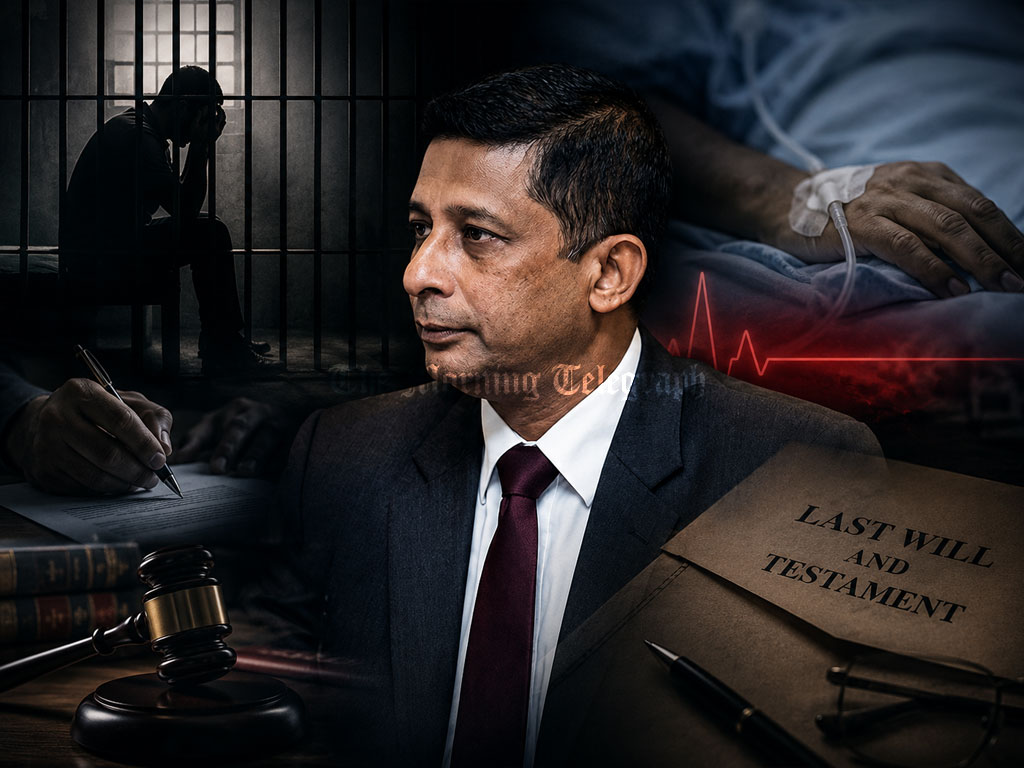
(Lanka-e-News -16.Sep.2026,3.30PM) Investigating Institutional Impunity, Deep-State Collusion, and the Global Price of Looking Away in Post-War Sri Lanka
SPECIAL EDITORIAL INVESTIGATION · SEPTEMBER 2026
Covenants, without the sword, are but words, and of no strength to secure a man at all. — Thomas Hobbes, Leviathan
Sunlight is said to be the best of disinfectants; electric light the most efficient policeman. — Louis D. Brandeis
A state that cannot enforce its own covenants is not a state. It is a stage set. And for one hundred days, Sri Lanka has been performing sovereignty from behind a hospital curtain while the men who may hold the truth about the worst terrorist massacre in its modern history rest on clean sheets, out of reach.
A HOSPITAL WARD BUILT LIKE A FORTRESS
The 100-day safehouse and the judiciary that blinked
Strip away the euphemisms and look at what actually happened. A retired Major General accused of ties to the 2019 Easter Sunday massacre — an atrocity that murdered 269 people and wounded hundreds more — did not sit in a cell while investigators worked. He checked into the National Hospital of Sri Lanka on June 7, staged a hunger strike, produced a diagnosis of PTSD, depression, and anxiety, and simply stayed. One hundred days. Not a hospital stay. A siege — of the truth, by the truth's chief suspect.
On September 15, Additional Solicitor General Dileepa Peiris finally said in open court what half the country had been whispering for weeks: this was not medicine; it was strategy. He called it, without softening, a premeditated medical conspiracy — an operation engineered to dodge interrogation, run out the clock, and protect whoever else needs protecting.
Notice the language prosecutors reached for. Not "delay." Not "irregularity." "Conspiracy." That word, spoken by the state's own Additional Solicitor General about the state's own hospital system, should have been the headline in every newsroom on the island. Instead, it barely dented the news cycle — which tells you something about how normalized this manoeuvre has become.
And here is the detail that should embarrass every institution attached to it: a court-ordered, five-member medical board was supposed to determine whether inpatient care was ever genuinely necessary. It never delivered its findings. Not late. Absent. The Magistrate had to summon the Director of the National Hospital himself, under formal notice, to explain why the state's own machinery would not answer the state's own question.
When a hospital outranks a courtroom, ask yourself who is actually governing the country.
THE PLAYBOOK: HOW SRI LANKA'S ELITE CONVERT ILLNESS INTO IMMUNITY
Salley is not an anomaly. He is a repeat performance.
What makes the Salley case dangerous is not that it is unprecedented — it is that it is routine. Sri Lanka has built, quietly and over decades, a functioning conversion mechanism: criminal jeopardy goes in one end, a medical diagnosis comes out the other, and the law simply stops applying.
Duminda Silva, convicted and sentenced to death for the murder of Bharatha Lakshman Premachandra, spent years cycling through prison medical wards and the Colombo National Hospital. Each time the legal net tightened, a compliant medical board discovered a new ailment urgent enough to require his removal from custody. A death sentence, softened by paperwork.
Ranil Wickremesinghe, facing remand over allegations of state fund misuse, was moved into an Intensive Care Unit rather than a holding cell — and then appeared in court by video link, engaging the justice system from the comfort of a hospital bed before securing bail. No perp walk. No remand cell. Just a screen, a gown, and a lawyer.
Look at the mechanics, and the pattern is unmistakable:
• a sympathetic physician willing to sign the diagnosis,
• a legal establishment willing to weaponize procedure,
• and a warden or hospital administrator willing to look away.
Three professions, one function — laundering criminal exposure into clinical sympathy.
This is not corruption at the margins. It is a parallel justice system, reserved exclusively for people who already hold institutional power.
Think of it as an insurance policy that the powerful quietly underwrite for one another. When political patrons and intelligence chiefs share decades of secrets — counter-insurgency operations, civil-war-era black budgets, covert programs that were never meant to survive contact with daylight — the machinery of the state does not need to be ordered to protect them. It simply does, reflexively, the way an immune system protects a body it has learned to recognize as its own. Medical reports become legal shields. Hospital beds become safehouses. Prosecutions are not killed outright; they are simply starved, one missing medical-board report at a time, until the public loses interest and the file quietly grows cold. The result is a dual-track legal system operating in plain sight: swift and unforgiving for the ordinary citizen who cannot produce a diagnosis on demand, and endlessly patient, endlessly accommodating, for the official who can.
What should alarm observers most is how legal each step appears. No single doctor is obviously lying. No single judge is obviously corrupt. No single administrator is obviously breaking a rule. That is precisely the design. Institutional capture rarely announces itself with a bribe in an envelope; it operates through the accumulation of small, defensible, professionally justifiable delays that add up to total obstruction. A hundred days is not one decision. It is dozens of small ones, each easy to defend in isolation, each catastrophic in aggregate.
HOW THE REST OF THE WORLD HANDLES ITS MONSTERS
No hospital beds. No medical boards. No mercy for the architects of mass murder.
Set Salley's hundred days of clean linen against how functioning states have actually handled the men responsible for history's worst terrorist atrocities, and the contrast stops being uncomfortable and starts being damning.
Ramzi Yousef detonated the bomb beneath the World Trade Centre in 1993, killing six and injuring over a thousand, then fled the country. He was hunted to Islamabad, extradited, and prosecuted — no hospital interlude, no psychiatric reprieve. He received two consecutive life sentences plus 240 years, and lives out that sentence in the total isolation of ADX Florence.
The men behind the 1998 U.S. Embassy bombings in Kenya and Tanzania — 224 dead, more than 4,000 wounded — were tracked across borders, extradited to New York, and convicted by federal juries in 2001 on counts of mass murder and conspiracy. Multiple life terms, no parole.
When Osama bin Laden himself was finally located in Abbottabad in 2011, no medical board was convened, and no hospital wing was offered. A Navy SEAL team ended the manhunt in one night.
Indonesia's response to the 2002 Bali bombings — 202 dead, 88 of them Australian — was equally uncompromising. Amrozi bin Nurhasyim, Imam Samudra, and Ali Ghufron were captured, held in maximum security, tried in public, convicted, and executed by firing squad in 2008.
When the fugitive commander Zulkarnaen surfaced in 2020 after nearly twenty years underground, Indonesia did not offer him a hospital bed either — it gave him fifteen years in prison.
Even the delays in Guantánamo Bay, for 9/11 architects like Khalid Sheikh Mohammed, were fights over torture and CIA black-site legality — not a suspect's ability to fake a panic attack his way into a ward with room service. Compare that record to Colombo's, and Sri Lanka is not merely an outlier. It is an embarrassment to every nation that ever extradited, prosecuted, or buried a terrorist.
FANATIC VS. FUNCTIONARY: TWO WAYS TO DEFY JUSTICE
One shouted his crimes. The other filed paperwork.
There is something almost clarifying in comparing how the Bali bombers resisted justice against how Salley has resisted it. Mukhlas and Amrozi did not hide behind medical charts. They used the courtroom as a pulpit — shouting slogans, boasting of motive, daring the state to make an example of them. Repulsive, but at least honest about what they were.
Salley's resistance is quieter and, in a sense, more corrosive. He has not defended an ideology. He has weaponized a diagnosis. Where the ideologue seeks martyrdom, the intelligence operative seeks attrition — buying time until political winds shift, memories fade, and evidence chains rust. Religious extremism is loud and, eventually, easy for a court to crush with a verdict. Institutional capture is silent, patient, and far harder to prosecute, because it does not look like a crime. It looks like a medical chart.
"THERE CANNOT BE TWO STATES" — EXCEPT THERE ALREADY IS
AKD's black-state admission and the 45 foreign nationals still waiting for answers
President Anura Kumara Dissanayake has said, publicly and more than once, that "in this country, there cannot be two states."
It is a striking thing for a sitting head of state to have to say out loud — because it implicitly concedes the second state already exists: a parallel structure of intelligence syndicates, protected political dynasties, and institutional gatekeepers operating beyond the reach of the elected government's writ.
A president does not warn against a black state that isn't there.
This is not an abstract governance debate. The 2019 Easter Sunday bombings killed 45 foreign nationals — 11 from India, 8 from the United Kingdom, 6 from China, 4 from Switzerland, three each from the Netherlands, Denmark, and the United States, and citizens of Australia, Saudi Arabia, Spain, Turkey, Bangladesh, Japan, and Portugal. Every one of them trusted Sri Lanka enough to be there. According to the prosecution's own submissions, the network responsible was, historically, nurtured and shielded by intelligence structures operating under exactly the kind of purview Salley held.
A hundred days in a hospital bed is not a medical footnote to that history. It is a continuation of it.
THE DIPLOMATIC SILENCE NOBODY WANTS TO EXPLAIN
Forty-five dead foreigners, and not one summoned ambassador
Here is the part of this story that ought to be a scandal in fourteen foreign ministries simultaneously, and somehow is not: when a nation's citizens are murdered on foreign soil by a terrorist network, and credible prosecutorial submissions allege that network was nurtured under the purview of officials now sheltering in hospital wards, silence from the victims' home governments is not neutrality. It is a policy choice. Every additional day that passes without a formal diplomatic inquiry into the hospitalization of a central Easter Sunday suspect is a day in which Delhi, London, Beijing, Bern, The Hague, Copenhagen, Washington, Canberra, Riyadh, Madrid, Ankara, Dhaka, Tokyo, and Lisbon each quietly accept that their dead are worth less scrutiny than a domestic corruption case would be if it happened at home.
This is where the comparison to global counter-terrorism practice cuts deepest. Extradition treaties, joint task forces, and multinational manhunts exist precisely because sovereign borders are not supposed to double as immunity borders. When Washington and Islamabad hunted Ramzi Yousef, or when Jakarta refused to let its own legal process be treated as optional for the Bali plotters, the message sent was unambiguous: a victim's nationality creates an obligation that outlives the news cycle. A hospital admission form in Colombo should not be sufficient to dissolve that obligation. Yet, functionally, it already has.
CONCLUSION: WHOSE IMPUNITY ARE WE ACTUALLY PROTECTING?
Barbaric criminals who seek to obliterate human life, and decent people of all religions who seek to protect it. — Donald Trump
You are either with us, or you are with the terrorists. — George W. Bush, address to Congress, 2001
So here is the question that should be sitting uncomfortably with every diplomat, every human-rights office, and every foreign ministry with a citizen among the 45 dead: if a government cannot control its own black state, why should the world go on pretending its justice system is sovereign at all?
Suresh Salley is not a rogue exception. He is the demonstration model — proof that in Sri Lanka, the deep state does not merely survive scrutiny; it outranks it. A man tied to the deadliest terrorist attack in the country's modern history has spent a hundred days in clinical comfort while the men who built the case against him wait for a medical board that will not report, in a court that cannot compel the one hospital that could end the standoff in a single afternoon.
The world has not been squeamish about pursuing terrorism's architects when it mattered enough. It has authorized renditions, military tribunals, and black sites — extraordinary, often ethically fraught measures — specifically because mass-casualty impunity was considered intolerable.
So explain the silence now.
Explain why a hospital bed in Colombo is treated as a private, internal matter when a hospital bed in any other country accused of sheltering a terror suspect would be treated as a diplomatic incident.
If global powers and human-rights institutions stay quiet while intelligence elites trade prison cells for private wards, they are not staying neutral — they are ratifying the trade.
They are telling every future security official, in every fragile democracy, exactly how to convert a body count into a diagnosis. The precedent being set in Colombo is not a local embarrassment. It is an instruction manual.
No terror suspect — general, minister, or intelligence chief — should be permitted to purchase freedom with a hospital admission form. Sri Lanka's black state has already told the world what it thinks its own citizens are worth. The open question, the one that should not be allowed to go quiet, is what the rest of the world thinks the 45 foreign dead were worth — and whether it is willing to look away from a hospital door to avoid finding out.
History does not remember institutions for the crimes they failed to prevent alone; it remembers them for the excuses they accepted afterward. A five-member medical board that never reports. A hospital director summoned like a recalcitrant witness. A hundred days recast as a footnote instead of a scandal. Each of these, taken individually, will be filed away as procedural friction — the ordinary grit of a functioning bureaucracy. Taken together, they are something else entirely: a verdict, quietly rendered, on whose lives the system was actually built to protect.
The Colombo Fort Magistrate Court now holds more than a case file. It holds a choice.
Either the judiciary compels the hospital, the medical board, and the security establishment to answer for one hundred days of manufactured delay — or it confirms, for anyone still watching, that in Sri Lanka the deepest state office is not held by anyone the public elected.
Gerard Adams
Collection of articles written by Gerard Adams
---------------------------
by (2026-09-16 12:56:55)
We are unable to continue LeN without your kind donation.


 Read 8406 Times
Leave a Reply


 0 discussion on this news