
By Anubhavananada
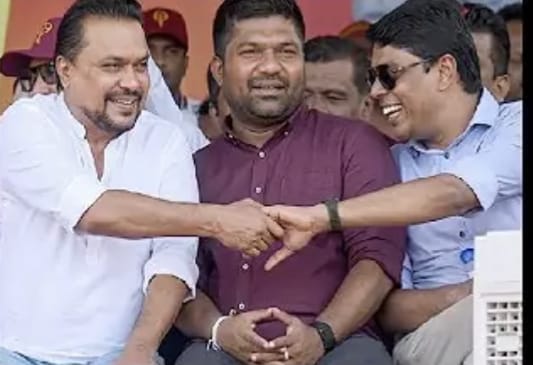
(Lanka-e-News -05 Oct 2026,4.00 P.M.) Dissanayake Mudiyanselage Sumanaveera Banda Dissanayake, better known as S. B. Dissanayake, was once one of the brightest stars in Sri Lankan politics. A key figure in the defeat of the UNP's 17-year rule, S. B. Dissanayake was once one of President Chandrika Bandaranaike Kumaratunga’s closest political allies. With her backing, he rose above several senior politicians to become even the General Secretary of the Sri Lanka Freedom Party (SLFP).
At one point, he appeared destined to become Prime Minister in a future People’s Alliance government. Many called S. B. Dissanayake the People’s Alliance’s “vote machine.” His political rise was rapid, and he was known for pursuing positions of power with considerable ambition. There is a familiar saying that “speed kills,” in politics as in ordinary life. S. B. Dissanayake would go on to prove it once again.
Although he had been regarded as President Chandrika Bandaranaike Kumaratunga’s “right-hand man,” S. B. Dissanayake began falling out with her around 2001. What began as personal disagreements eventually developed into political conflicts. Claiming that he wanted to “teach Chandrika a lesson,” S. B. Dissanayake left the People’s Alliance government and joined the UNP along with several others, including Professor G. L. Peiris, Mahinda Wijesekera and Bandula Gunawardena.
The move contributed to the UNP’s victory at the December 2001 general election, which brought Ranil Wickremesinghe to the premiership. S. B. Dissanayake became a prominent figure in the new government, and UNP leader Ranil Wickremesinghe decided to appoint him as the party’s National Organiser.
From the outset, tensions developed between the executive, represented by President Chandrika Bandaranaike Kumaratunga, and the legislature led by Prime Minister Ranil Wickremesinghe. Wickremesinghe entered into a ceasefire agreement with the LTTE without obtaining the prior consent of the Executive President. This led to disputes over which side held constitutional authority over national security.
In October 2003, a serious constitutional confrontation developed between President Chandrika Bandaranaike Kumaratunga and the government led by Prime Minister Ranil Wickremesinghe over executive authority relating to the Ministry of Defence.
President Kumaratunga sought the opinion of the Supreme Court on her decision to take the Ministry of Defence under her control from the government headed by Wickremesinghe. The Supreme Court expressed the view that, under the Constitution, the portfolio of Defence should remain with the President.
On November 3, 2003, at a Vap Magul ceremony in Habaraduwa, S. B. Dissanayake criticised the Supreme Court’s decision. Dissanayake, who was then Minister of Agriculture, reportedly declared at the ceremony:
“I will not accept any damn judgment delivered by the courts.”
Following the statement, two residents of the Habaraduwa area petitioned the Supreme Court, alleging that his remarks amounted to contempt of court.
The petitions were heard under Article 105(3) of the Constitution of Sri Lanka, which provides the courts with the power to punish for contempt of court.
During the proceedings, S. B. Dissanayake apologised to the court, while his lawyers argued that he had not intended to insult or disrespect the judges through his remarks.
Nevertheless, on December 7, 2004, a five-member bench of the Supreme Court, headed by Chief Justice Sarath N. Silva, found him guilty and sentenced him to two years’ rigorous imprisonment.
He did not spend even a week in prison. Until President Mahinda Rajapaksa granted him a presidential pardon in February 2006, he spent his time in the prison hospital and the National Hospital.
On December 7, 2009, he resigned from all positions he held in the UNP and went on to “strengthen the hands” of Mahinda Rajapaksa.
His conviction and imprisonment for contempt of court marked the beginning of the decline of S. B. Dissanayake’s political stature. Although he attempted to portray himself as a “political prisoner,” he did not receive a favourable response from the public.
He came to be seen by sections of society as a political operator who had even used his political influence to spend his prison sentence in hospital wards.
The man who had once appeared destined for the premiership of a People’s Alliance government eventually found himself reduced to serving as State Minister of Lands and Land Development under the Gotabaya Rajapaksa government in 2022.
Against this backdrop, the statement made by Wimal Weerawansa at a Sri Lanka Podujana Peramuna gathering in Anuradhapura on September 12, criticising the court order remanding Namal Rajapaksa, is far more serious than S. B. Dissanayake’s declaration that he would not accept “any damn judgment” delivered by the courts.
We will not reproduce Weerawansa’s statement here because of the gravity of its content.
Colombo Chief Magistrate Asanga S. Bodaragama has reportedly directed the Inspector General of Police to investigate whether Wimal Weerawansa’s remarks amounted to contempt of court.
The matter appears to have been treated not merely as an issue concerning the personal dignity of a particular judge, but as one affecting the authority of the judiciary as a whole.
The Criminal Investigation Department’s Central Crime Investigation Bureau commenced an investigation into the matter on September 22. On September 29, Deputy Solicitor General Janaka Bandara informed the court that television channels were in the process of handing over unedited video footage of the meeting to the Central Crime Investigation Bureau.
The court has also ordered that a copy of the remand order concerning Namal Rajapaksa be provided to the Central Crime Investigation Bureau for the purposes of the investigation.
The Anuradhapura incident is the second occasion on which Wimal Weerawansa has faced allegations relating to contempt of court.
Earlier, following statements made during protests against the arrest of Suresh Salley, allegations of contempt of court were levelled against Wimal Weerawansa, Udaya Gammanpila, Dilith Jayaweera, Mahinda Pathirana and several others. On September 14, the Court of Appeal appointed a three-member bench to examine the matter.
Contempt of court is not a game.
Article 105(3) of the Constitution gives the courts the power to punish contempt of court.
In 2017, statements made by Ranjan Ramanayake about Supreme Court judges during a television programme led to proceedings concerning contempt of court under Article 105(3). A three-member bench of the Supreme Court subsequently found him guilty and, on January 12, 2021, sentenced him to four years’ rigorous imprisonment.
What was significant in that case was that the Supreme Court considered the manner in which his remarks affected the independence of judges and the credibility of the judiciary.
Unlike S. B. Dissanayake, who spent his sentence in hospital wards, Ranjan Ramanayake served his prison sentence. He, too, was subsequently granted a presidential pardon, as S. B. Dissanayake had been.
Retired Major and lawyer Ajith Prasanna was charged with contempt of court over statements he made during a YouTube interview in January 2020. A staunch supporter of the Rajapaksa family, he had also served as a member of the Southern Provincial Council.
On January 24, 2023, the Supreme Court, by a majority decision, found him guilty and sentenced him to four years’ rigorous imprisonment and a fine of Rs. 300,000.
Galagoda Aththe Gnanasara, the leader of the “Sangha underworld” in this country, stormed into the Homagama Magistrate’s Court on January 25, 2016, while proceedings were underway in the case concerning the disappearance of journalist Prageeth Eknaligoda.
He faced serious allegations of interfering with judicial proceedings, behaving in a threatening manner inside the courtroom, and acting in a manner that placed pressure on the judge and lawyers.
On August 8, 2018, the Court of Appeal found him guilty on four charges and imposed an aggregate sentence of 19 years’ rigorous imprisonment. However, because the sentences were ordered to run concurrently, the effective prison term was limited to six years.
In 2019, President Maithripala Sirisena granted Gnanasara a presidential pardon.
However, on September 10 this year, the Supreme Court delivered a landmark judgment declaring that the pardon granted to Gnanasara by former President Maithripala Sirisena in 2019 was unconstitutional and arbitrary.
The judgment followed the hearing of fundamental-rights petitions filed by a group including Sandhya Eknaligoda, the wife of journalist Prageeth Eknaligoda.
Following the judgment, Gnanasara now faces the prospect of being returned to prison to serve the remaining portion of his six-year sentence imposed for contempt of court.
The “Sangha underworld” has now launched a new campaign to prevent his imprisonment by seeking another presidential pardon from President Anura Kumara Dissanayake.
The campaign is being led by Thiththagalle Anandasiri of what may be described as the “Rajapaksa faction,” who has claimed that he would stand up for Namal Rajapaksa regardless of the crime he had committed.
What is particularly notable about this campaign is that the attempt to secure another presidential pardon for Gnanasara is being pursued through threats, intimidation and accusations directed at President Anura Kumara Dissanayake and the NPP government at media conferences organised by Thiththagalle Anandasiri and his associates.
Under Sri Lankan law, criticising a judicial decision and committing contempt of court are two distinct matters.
The principal difference lies in the content of the criticism, its purpose, and the manner in which it affects the functioning of the judiciary.
A person may legitimately criticise a judicial decision by arguing, for example, that “the judge’s interpretation of the law is incorrect,” that “the decision is inconsistent with provisions of the Constitution,” or that “the court failed to give sufficient consideration to this evidence.”
The ability to examine and criticise judicial decisions publicly is an important part of legal discourse. Such criticism does not, by itself, amount to contempt of court.
However, interfering with the administration of justice, deliberately disobeying court orders, or making statements intended to undermine the authority of the judiciary may constitute contempt of court under Article 105(3) of the Constitution.
Given that Wimal Weerawansa is already facing allegations relating to contempt of court in the Suresh Salley case, it is difficult to believe that he was unaware of the seriousness of the statement he made in Anuradhapura.
Wimal Weerawansa is not politically innocent. He is a highly experienced and politically calculating operator.
Why, then, does Wimal Weerawansa appear to attack the judiciary without fear or hesitation?
Because, at this moment, it is part of the opposition’s principal political strategy — what I call the “Bail-and-Suspicion” strategy.
Their objective is to undermine public confidence in the entire judicial system and persuade people that the judiciary does not operate independently.
Through this, they seek to convince the public that they are innocent of allegations involving bribery, corruption, illicit accumulation of wealth, and other offences.
To create such a public narrative, they need to attack judicial proceedings with insults, accusations, mudslinging and baseless allegations.
If future judgments against them are to be dismissed in advance as “political victimisation,” they first need to undermine public confidence in the independence of the judiciary.
If they eventually return to power, creating a public perception that such judicial decisions were politically motivated would also provide the foundation for seeking to overturn those decisions or obtain pardons.
This is the political strategy being pursued in Parliament by opposition figures including Chamara Sampath Dasanayake, Jeyasiri Jayasekara and Rohini Kavirathne.
Extremely low-level personal attacks were also directed at Chief Justice Surasena and members of his family, allegedly under the cover of parliamentary privilege.
These days, the lawyers representing Namal Rajapaksa, who is currently in remand custody, can be seen publicly criticising judicial decisions outside the court premises over the refusal to grant him bail.
What genuine lawyers should do is seek appropriate legal remedies against the Magistrate’s decision, including approaching the Court of Appeal for an appropriate writ or other relief.
Instead, they too appear to be part of this political campaign, attempting to create the impression that the judiciary is biased.
While figures such as Wimal Weerawansa, Udaya Gammanpila and Mahinda Pathirana attack the judiciary from outside Parliament, and another group within the opposition attacks the Chief Justice, other judges and the judiciary from inside Parliament, the Bar Association of Sri Lanka remains conspicuously silent.
The reason, it appears, is that the BASL and the “Bail-and-Suspicion” opposition are standing on the same side of the political divide.
The BASL has so far not uttered a word about the alleged contemptuous remarks made by Wimal Weerawansa at the Anuradhapura rally.
The BASL President, Rajiv Amarasuriya, appears to have been rendered speechless.
The “Bail-and-Suspicion” opposition previously warned that the 22nd Amendment to the Constitution would destroy judicial independence and fought against it with extraordinary intensity. Yet, to this day, they have failed to explain precisely how the amendment would undermine the independence of the judiciary.
In reality, it is the “Bail-and-Suspicion” opposition and organisations such as the BASL that support them that are undermining judicial independence.
Through mudslinging, baseless allegations, and attacks on judges and the judiciary, they are ultimately eroding public confidence in, and respect for, the judicial system.
For the sake of their narrow political interests and objectives, they are destroying what should be regarded as the conscience of the nation — the judicial system itself.
---------------------------
by (2026-10-05 10:18:30)


 Read 31698 Times
Leave a Reply
 0 discussion on this news