By Ruwan Weerakoon, Lanka e-News Investigations Unit
(Lanka-e-News -26 Oct 2026,5.00 P.M.) Sri Lanka has learned at great cost that religious violence seldom begins with a crowd. It begins with a rumour, a doctored image, or a speech that arrives at exactly the right moment. A Lanka e-News investigation has found that a campaign of this kind is allegedly being prepared, and that its primary aim is political, not religious: to pressure the President into releasing Galagoda Aththe Gnanasara Thero.
These allegations are serious and unproven. No one named in this report has been charged with any offence in this regard, and everyone is entitled to the presumption of innocence. But the pattern described to this writer by several sources, including one inside military intelligence, should reach the public before events overtake it.
According to the sources, a network of retired military intelligence officers, nationalist politicians and a former senior police officer is preparing a coordinated campaign to create religious and ethnic unrest. Its immediate goal, the sources say, is to build public pressure for Gnanasara Thero's release, and through that to restore political space to those behind him.
The backdrop is legal. On September 10, 2026, the Supreme Court voided the presidential pardon granted to the Thero in 2019, and his sentence has since taken effect. According to the sources, any campaign that recasts that court outcome as an attack on Buddhism would benefit those who want him freed.
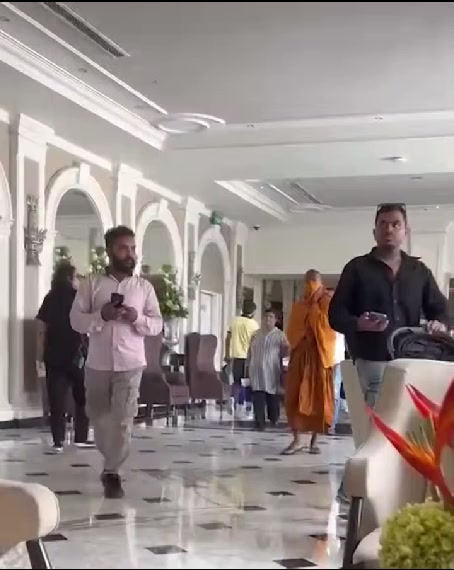
According to information received by this writer, the visit to Colombo's Kingsbury Hotel by a prominent monk, Balngoda Kassapa, who led the Viharamahadevi Park protest on the 23rd, drew the attention of hotel staff. The sources identified two rooms, 918 and 2810, as places used for "operational meetings", including discussions about distributing money.
A member of hotel staff, questioned by this writer, said that Udaya Gammanpila, Wimal Weerawansa, Sarath Weerasekera and Chandra Wakista have visited the hotel from time to time for meetings and strategy discussions. He did not describe what was discussed.
When this writer asked Sarath Weerasekera, he said the monk had a fever and went to the hotel for that reason. When asked why a patient with a fever would go to a five-star hotel rather than see a doctor, he disconnected the call. Footage of the monk, his face covered by his robe, later leaked onto social media.
The explanation given has not been independently verified. Nothing in this report suggests that a hotel stay, a meeting or a monk's visit is unlawful in itself. Whatever significance it has lies in what the sources say those meetings were for.
Who Is Allegedly Behind It?
The strategic tier. According to the sources, the operation is directed by retired Major General Kapila Hendavitharana, a former head of national intelligence. He allegedly uses assets trained under earlier covert programmes. Up to eight former military intelligence officers are said to be involved, some reportedly still on good terms with serving officers, and the sources say this is how the network gets information and a degree of protection.
The financial and political tier. The sources say the campaign depends on nationalist politicians and businessmen. Dilith Jayaweera is alleged to be funding the entire operation. Others named by the sources include Sarath Weerasekera, an unnamed former senior police officer, National Buddhist Congress chairman Chandra Wakista, and former IGP Deshabandu Tennakoon. The sources also allege that Gotabaya Rajapaksa is in regular contact with Hendavitharana and Jayaweera.
This writer's sources say there are more names, and that more details will be published once they can be verified.
The sources described a four-stage plan.
Fake digital infrastructure. Email addresses would be created through VPNs and used to open Facebook accounts, which would then post graphics and articles.
A dual narrative. The material would claim the government is anti-Buddhist because it is led by "godless" communists, while also claiming it favours Christians or Catholics.
Staged incidents. According to the sources, to give the narrative a real event on which to build religious tension, the same group would organise an attack on a temple or a Buddhist monk.
AI-generated videos. IT specialists loyal to the Sri Lanka Podujana Peramuna are allegedly preparing AI videos in which the President, the Prime Minister and key ministers criticise the Mahanayake theras and prominent monks.
The sources also allege that the footage would first be shown from abroad, to raise the question inside Sri Lanka: "Could this happen here?" Two television channels are said to have agreed to obtain the overseas footage and to give extended airtime to the Gnanasara Thero issue and to opposition voices on Buddhism. One source said the campaign could present Gnanasara Thero as a modern-day Anagarika Dharmapala. Harassment of monks is also said to be part of the plan.
The analysis offered by the sources, and by observers who reviewed these claims, comes down to one question: who benefits?
Members of the Rajapaksa family face a growing list of legal difficulties. These include court proceedings involving Namal Rajapaksa, Yoshitha Rajapaksa and Shiranthi Rajapaksa, and the reported Red Notice and extradition efforts concerning Basil Rajapaksa. The sources also say a Criminal Investigation Department probe involving Gotabaya Rajapaksa is nearing its final stage. In their reading, the group around him sees Gnanasara Thero's release as a way to change the political climate and win public sympathy.
That is the sources' interpretation. The claim that these cases are the motive behind any campaign remains unproven, and each case must be judged on its own evidence.
Researchers who study ethnic and religious conflict describe several recurring mechanisms, seen in many countries, that underlie allegations like these.
Polarisation through rhetoric. Presenting the religion or heritage of the majority community as "under threat" creates a fearful and receptive audience.
Alliances with hardline groups. When politicians amplify extremist demands over contested sites, land, or practices, local disputes can escalate into wider conflict.
Exploiting political crises. After scandals, economic collapse, or legal setbacks, attention can be redirected to cultural and religious grievances.
Selective enforcement of the law. Where police action is slow or politically influenced, agitators act without fear of punishment.
Sri Lanka adds a new element: the low cost of digital tools. Fake accounts, VPN emails and AI videos allow a small group to imitate a mass movement, and to spread a convincing lie within hours, long before police or journalists can verify it. The most dangerous element of the alleged plan is the staged incidents, because whoever carries them out, a single real attack could be enough to turn a fabricated narrative into a real crisis.
Forces also work against such a campaign. Researchers point to swift, impartial action by the police and military; the influence of interfaith leaders and local peace networks; and the public's focus, since the 2022 economic collapse, on economic accountability rather than nationalist agendas. A large-scale riot would normally require all of these to fail at once.
Regional experience shows the risk. During periods of ethnic and religious tension in Myanmar, monks who opposed military rule, and members of nationalist movements as well, were detained, intimidated, or drawn into the conflicts. The lesson analysts draw is that once religious symbols are politicised, those who wear them become targets as well as instruments.
The test of these allegations is evidence, not rhetoric. The sources point to specific rooms, a specific plan, and specific individuals, all of which can be checked. The authorities can examine hotel records and CCTV, trace the creation of coordinated accounts, and inform the Mahanayake Theras and interfaith leaders. Platforms can be asked to act against coordinated fake behaviour. The public, for its part, can refuse to forward unverified videos, an "attack" with no source, or an outraged post that arrives at a suspicious speed.
If the allegations are false, a swift and open investigation will say so. If they are true, the cost of silence will be measured in far more than politics.
Lanka e-News will publish further details once they are verified.
Send confidential investigative tips to: [email protected]
Public notice: Readers are asked not to share unverified religious content, videos, or social media posts, and to report suspicious material to the authorities.
---------------------------
by (2026-10-26 11:50:46)


 Read 14688 Times
Leave a Reply
 0 discussion on this news