
- By Michael Joachim
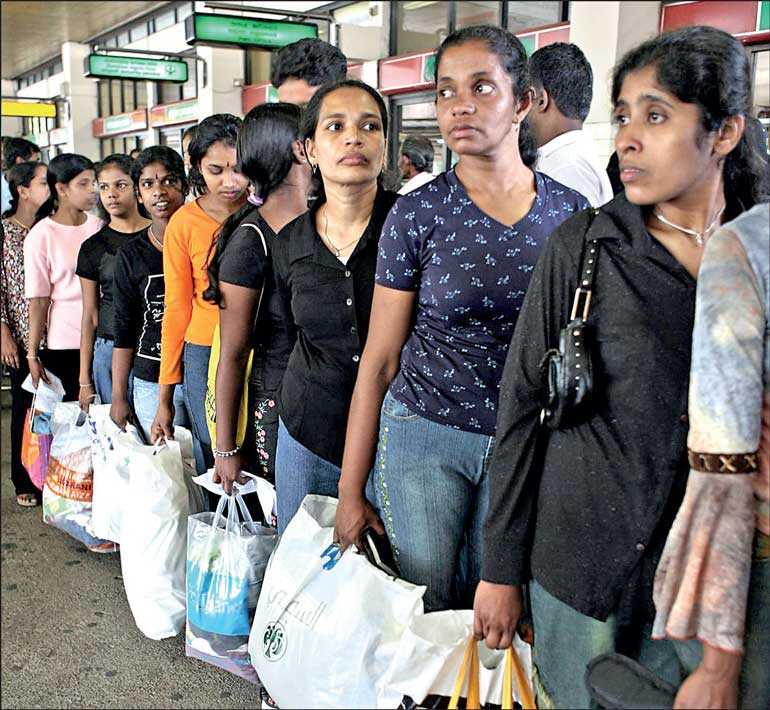
(Lanka-e-News -27.April.2026, 2.12 PM) Every year, hundreds of thousands of Sri Lankans leave their homes to work in unfamiliar, often risky environments abroad. Their remittances are not a side note in the economy; they are its backbone—consistently propping up foreign reserves, stabilizing the rupee, and cushioning the country during times of crisis. Yet when those same workers face war, exploitation, sudden job loss, or death, the system that depends on them responds too slowly, too weakly, or not at all.
This is not just a policy gap. It is a moral failure.
The world in which Sri Lankan migrants work has changed dramatically. The Middle East—our largest labour market—is increasingly volatile. Conflicts flare without warning. Economic downturns trigger mass layoffs. Immigration policies shift overnight. In such a landscape, migration is no longer just a pathway to income; it is a high-risk undertaking that demands a robust system of protection.
But Sri Lanka’s migration governance framework remains stuck in another era—one focused on sending workers, not safeguarding them.
The Sri Lanka Bureau of Foreign Employment, the primary state institution responsible for migrant welfare, continues to operate largely as an administrative body rather than a proactive protector. Crisis responses are often reactive and underfunded. Families are left scrambling when emergencies strike. Repatriations are delayed. Legal assistance is limited. And psychosocial support—critical in times of trauma—is almost entirely absent from the state system.
Until recently, some of these gaps were quietly filled by international donor-funded programmes. But with the withdrawal of agencies such as USAID and others, many of these support structures have simply disappeared. What remains are migrant societies—grassroots groups formed within communities—that now stand as the only line of support for affected families. Yet these groups operate without formal recognition, funding, or institutional backing.
This is the reality: Sri Lanka’s migrant economy is being sustained from below, by communities that are themselves struggling to cope.
If the 2027 national budget continues on its current path, it will fail to address this structural imbalance. What is needed is not another incremental adjustment, but a fundamental shift in how the state views and supports labour migration.
First, Sri Lanka must establish a National Migrant Protection and Resilience Fund—a dedicated, ring-fenced financing mechanism to respond swiftly to crises affecting migrant workers and their families. This fund should cover emergency evacuations, temporary shelter, legal aid, and direct financial assistance to families. It should not depend on ad hoc decisions made in moments of crisis. It should be permanent, predictable, and adequately resourced.
Second, the country must finally recognize the invisible toll migration takes on families left behind. When a migrant worker is caught in a war zone or detained abroad, it is their spouse, children, and elderly parents who bear the psychological burden. Anxiety, depression, school dropouts, and social instability are not abstract risks—they are daily realities in migrant households. A national psychosocial support system, anchored at the district level and linked to schools and community networks, is no longer effectively optional especially when dealing with labor migrant families living in rural and plantation areas. It is essential.
Third, migrant societies must be brought into the formal policy framework. These are not informal gatherings; they are functioning community institutions with deep local knowledge and trust. They are often the first responders during crises, the first to identify vulnerable families, and the only consistent advocates for migrant rights at the grassroots level. Voice of Migrants network (VOM ) became a reality as a collective of local Migrant societies. Supporting Migrant Societies, through modest funding and capacity-building is one of the most cost-effective investments the government can and should make.
Fourth, access to justice for migrant workers must be strengthened. Too many Sri Lankans endure wage theft, abuse, and contract violations with no realistic path to redress. A dedicated legal protection fund—supporting legal aid both in Sri Lanka and in destination countries—would send a clear message: exploitation of Sri Lankan workers will not go unanswered.
Fifth, reintegration must be treated as a core component of migration policy, not an afterthought. Returnees often come back with skills, experience, and aspirations—but without support, many fall into unemployment or debt. Investing in skills recognition, job placement, and small enterprise support can transform return migration into a driver of economic growth. The Government and the SLBFE needs to seriously review as to whether the “Recognition of Previous Learning (RPL) system is effectively supporting the Migrant returnees and prospective Migrants.
All of this requires money. But the question is not whether Sri Lanka can afford to invest in migrant protection. It is whether it can afford not to.
A practical and fair solution is to allocate a small, fixed percentage—just 1 to 2 percent—of annual remittance inflows to a dedicated migrant protection fund. This is not a burden on the economy; it is a reinvestment into the very system that sustains it.
The argument here is not about charity. It is about economic logic and national responsibility. Migrant workers are not temporary actors in Sri Lanka’s development story; they are central to it. Ignoring their welfare is not only unjust—it is economically short-sighted.
Budget 2027 presents an opportunity to correct this imbalance. It is a chance to move from a system that extracts value from migrants to one that protects and empowers them. It is a moment to recognize that resilience in the migration sector is not built at airports or embassies alone, but in the homes and communities that migrants leave behind.
Sri Lanka owes its migrant workers more than gratitude. It owes them protection, dignity, and a system that stands with them when it matters most.
Anything less is indefensible.
“A just economy is not built on remittances alone, but on recognition, protection, and respect.”
Executive Director -Voice of Migrants.
---------------------------
by (2026-04-27 08:53:18)


 Read 9096 Times
Leave a Reply
 0 discussion on this news