
Investigative Journalism by Ruwan Weerakoon
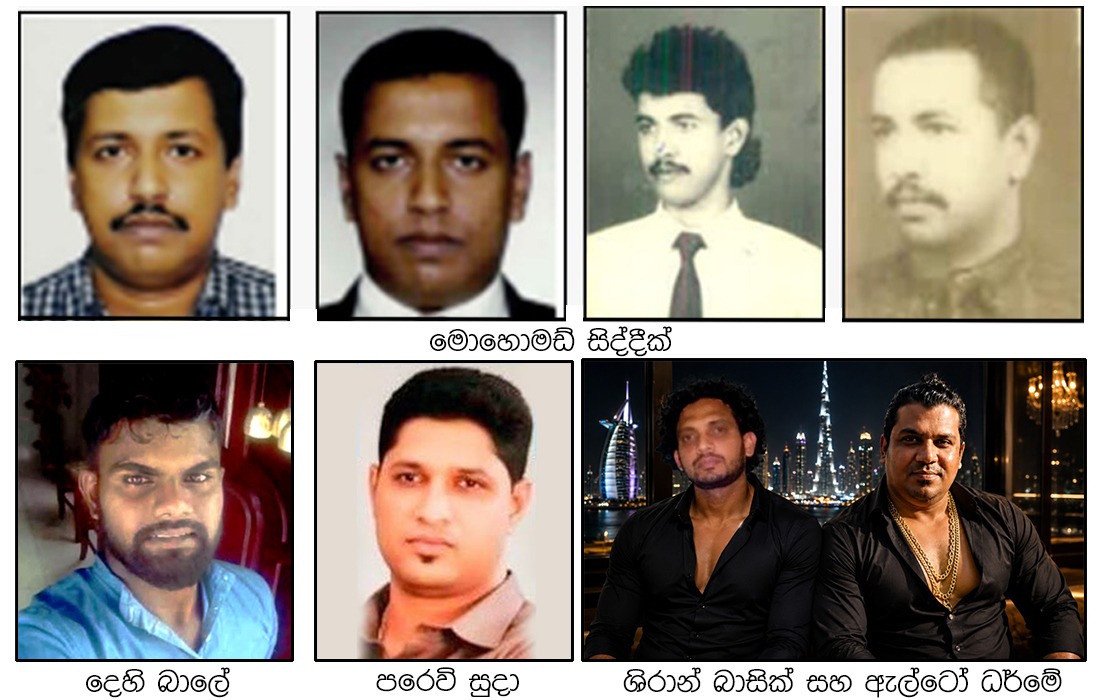
(Lanka-e-News -02 June.2026, 11.30 PM) When Dubai's security forces moved in on Shiran Basik, the Sri Lankan drug lord who had spent years hiding behind a businessman's smile and a string of jewellery stores, they may not have anticipated what would happen next. Within days, according to sources with direct knowledge of the situation, a plane touched down in Dubai carrying Mohamed Siddique, the man many in Sri Lanka's criminal underworld call the Godfather. He did not come alone. Three Arab associates reportedly accompanied him. And he came with a purpose: to retain Dubai lawyers and prevent Basik's deportation to Sri Lanka. If true, it is an audacious move. It is also a familiar one.
Siddique has been performing variations of this act for two decades, escaping, surviving, resurfacing, and protecting his network while Sri Lanka's institutions have repeatedly failed to hold him accountable. The Dubai rescue attempt may be the most brazen chapter yet. But to understand why it matters, you have to understand what Siddique has built.
Mohamed Siddique — also known as Mahmud Siddik, Mohammad Siddeek, and various other transliterations has constructed a criminal identity as slippery as his legal record.
His documented history with Sri Lankan law enforcement stretches back to 2003, when the Western Province North Crime Division arrested him and four others while transporting heroin in a jeep through Boralasgamuwa. It should have ended there. It did not.
After a protracted remand period, he was granted bail. He then fled first to India, where he had already cultivated connections near the border with Nepal, then onward. Tamil Nadu police, who had arrested him years earlier in a separate matter, watched his associates carry out a brazen armed ambush of a police escort to free him from custody, one of the more cinematic episodes in the long and sordid history of Sri Lanka's drug trade.
He eventually surfaced in Pakistan, where he married the sister of a man sources describe as a powerful Afghan-Pakistani heroin supplier. This was not simply a personal relationship. It was a business merger.
The marriage gave Siddique access to supply chains running from Afghanistan's poppy fields through Pakistan's port cities and onto vessels destined for Sri Lanka, Thailand, Malaysia, and Vietnam. Crucially, sources say, he abandoned conventional shipping agents and cultivated direct relationships with ship captains and chief engineers, the men who control what happens in the hold when no one is watching.
In March 2015, Pakistan handed him over. A CID team flew to collect him. He was brought before the Colombo Magistrate's Court, remanded, and investigated under the Prevention of Money Laundering Act, accused of accumulating over Rs. 510 million through the heroin trade.
In September 2018, the Colombo High Court acquitted him. The reason: severe contradictions in police evidence. He was re-bailed in 2019 with a cash bond of Rs. 1 million, barred from leaving the country, and required to report to the CID twice monthly. He is no longer doing any of those things.
What Siddique built after his second escape from Sri Lanka is, by any measure, a substantial criminal enterprise. Sources who have tracked his movements describe a pivot from heroin distribution to crystal methamphetamine manufacturing. Working with his Afghan brother-in-law and contacts in Kandahar province, Siddique is alleged to have helped establish ICE production facilities in Afghanistan, including one site approximately 17 kilometres from Kandahar city. A second facility, reportedly set up in partnership with Shiran Basik, added a direct Sri Lankan dimension to the manufacturing operation.
These are not rudimentary operations. Sources describe on-site quality testing laboratories, strict security protocols, and staffing drawn exclusively from Afghan and Pakistani nationals, compartmentalisation designed to limit exposure if any one element of the network is compromised.
In Dubai, Siddique reportedly operates a legitimate-facing front: gold shops and two restaurants, staffed predominantly by Pakistanis. His relatives, sources claim, continue to invest on his behalf in the Colombo Stock Exchange, a detail that, if confirmed, would raise serious questions about the effectiveness of Sri Lanka's anti-money laundering enforcement.
He travels on a Pakistani passport. He is described as fluent in Urdu and Dari, highly personable, and skilled at cultivating relationships with officials in multiple jurisdictions. Sources allege that these relationships are maintained, in part, through bribes.
There is also a weapons dimension. Siddique is said to deal primarily in 9mm pistols and T-56 rifles, with weapons and drugs frequently moving in the same shipments, a detail that elevates the threat his network poses beyond narcotics.
Siddique does not operate alone in the Gulf. Dubai has become, for Sri Lanka's drug elite, a city of second lives. Three major figures, all reportedly holding false passports, all watching Sri Lankan news closely from their Gulf residences, form the operational core of the supply network feeding narcotics back to Sri Lanka.
Shiran Basik (also rendered as Shan Basik or Sharn Basik) is the most prominent. His full name is Mohammed Shiran Basik. He built his distribution network across Dehiwala, Mavanella, and central Colombo over more than a decade. He was arrested near Kirulapana in 2011 with heroin. In 2024, the Colombo High Court acquitted him again, citing contradictions in police testimony. With his Sri Lankan record clean, he left the country without restriction and reinvented himself in Dubai as a businessman. Reports indicate he owned several jewellery stores.
Then came the UAE's broader crackdown on Iran-linked financial networks. A confrontation at a Dubai hotel brought him to the attention of authorities already watching him. He is now in Dubai custody, reportedly held alongside two Iranian nationals, and the question of extradition hangs over everything.
Dehibala operates in Dubai's real estate and money-lending markets, often in partnership with Arab counterparts, a profile that suggests sophisticated financial integration into the local economy.
Paravi Suda runs a rent-a-car operation, also with Arab partners. Legitimate businesses, serviced by illicit money.
These three, sources say, are rivals. They do not speak. But they share a common logistics architecture — and Siddique sits at its centre, coordinating supply from Afghanistan and Pakistan regardless of which Sri Lankan operation is placing the order.
The supply chain described by sources is methodical and multi-layered. Heroin and crystal methamphetamine move from Afghanistan into Pakistan overland, with border officials reportedly receiving payments from Siddique's team. Near Pakistan's port cities, the narcotics are held in safe houses until a vessel is ready. Direct handovers are then made to ship captains. Those captains coordinate via satellite phone with Sri Lankan trawler operators who meet the vessel at sea, an offshore handoff that largely bypasses port inspection.
Once onshore in Sri Lanka, distribution is handled through local networks, with activity concentrated in Wattala and Battaramulla. Financial settlement runs through the hawala system known locally as undiyal, leaving minimal formal financial trace.
The architecture is designed to be resilient. Arrest any single node, and the rest of the network continues.
Against this backdrop, Siddique's reported arrival in Dubai following Basik's arrest makes tactical sense. Basik is not simply a subordinate. He is a co-investor in at least one ICE manufacturing facility. He holds knowledge of supply routes, financial flows, hawala networks, ship captain contacts, and the identities of Sri Lankan officials allegedly on the payroll. His extradition to Sri Lanka or worse, cooperation with US authorities who are reportedly seeking him over Iran-linked trafficking connections, would represent an existential threat to the network.
Sources say Siddique and his three Arab associates have already scheduled meetings with Dubai lawyers, with the explicit objective of preventing Basik's deportation.
This is, legally speaking, not inherently criminal. Lawyers are entitled to clients. But the speed and directness of the intervention, a senior figure in an alleged criminal network personally flying in to manage the legal response to a key associate's arrest, speaks to how much is at stake.
Sri Lanka's institutions have a pattern when it comes to these cases. Arrests are made abroad. Press statements are issued. Extradition is promised. And then slowly, quietly, the momentum dissipates.
Makandure Madush, arrested at a Dubai party in 2019 after being set up by rivals, including associates of Siddique himself, was eventually brought back. But the broader network he was part of was never dismantled. The lords of Dubai regrouped. The Basik arrest is different in at least one significant respect: the US interest. If American agencies DEA, have a file on Basik in connection with Iranian drug trafficking networks, that introduces an external pressure that Sri Lankan authorities cannot manage through delay. US interest in a suspect changes the diplomatic calculus entirely. Several questions now demand urgent answers from Colombo:
Has Sri Lanka's Interpol unit formally engaged the Attorney General's office on extradition procedures? Not a press conference, a formal legal filing.
Has the CID submitted a comprehensive dossier to the UAE authorities on Basik's criminal history and the network he belongs to? The UAE's strict narcotics laws work in Sri Lanka's favour, but only if Sri Lanka puts its evidence on the table. Has Sri Lanka issued or renewed Interpol Red Notices for Dehibala and Paravi Suda, the two remaining figures from the Dubai trio who are, at this writing, still at large?
What is Mohamed Siddique's current legal status? He was arrested in Oman in August 2023, travelling on a fake Indian passport. By October 2025, credible reports placed him living freely in Europe. If he is now in Dubai outside any active custody, Sri Lanka must explain how that happened, and whether there is an active international warrant against him.
Who, in Sri Lanka, is his domestic infrastructure? His relatives reportedly continue to invest in the Colombo Stock Exchange. His hawala networks in Wattala and Battaramulla continue to function. These are not operations that run themselves. The people enabling them domestically are not in Dubai; they are here.
There is one thread in this story that deserves its own investigation. Both Mohamed Siddique and Shiran Basik were arrested in Sri Lanka with evidence of narcotics activity. Both were prosecuted. Both were acquitted by the Colombo High Court. In both cases, the stated reason was the same: severe contradictions in police evidence.
This is either a systemic failure of Sri Lanka's drug enforcement evidence-gathering, or it is something else. Either possibility is alarming. A pattern of acquittals on identical grounds, in cases involving the country's most significant alleged traffickers, is not a coincidence to be accepted without scrutiny.
If Sri Lanka's law enforcement agencies cannot produce evidence that survives court scrutiny against the country's most wanted drug suspects, the question must be asked: why not? And who benefits from that failure?
Dubai has, for now, done what Sri Lanka's institutions could not. It has placed Shiran Basik behind bars. The extradition framework between Sri Lanka and the UAE is imperfect. Wealthy defendants with resources and connections have exploited it before. Mohamed Siddique's reported presence in Dubai hiring lawyers, scheduling meetings, working his network, is a live attempt to exploit it again.
Sri Lanka has a narrow window. The UAE's aggression toward Iran-linked criminal networks, US intelligence interest in Basik, not only back and the potential testimony of the dozen or more individuals arrested alongside him creates a convergence of pressure that may not last.
What Colombo does with that window will reveal, more clearly than any press statement, whether the political will to break this network actually exists or whether, once again, the big fish will find a way to slip the net. We expect further exposés on this network, including documentary evidence, to follow.
---------------------------
by (2026-06-02 19:51:56)


 Read 50460 Times
Leave a Reply
 0 discussion on this news