
-By Gerard Adams
(Lanka-e-News -2026.June.13, 11.30AM) "But I'm not guilty," said K. "There's been a mistake. How is it even possible for someone to be guilty? We're all human beings here, one like the other." "That is true," said the priest, "but that is how the guilty speak."
- Franz Kafka, The Trial
Among the 273 people murdered on Easter Sunday, 21 April 2019 — across three churches and three hotels in the space of a single morning — stands one name that carries a particular weight: Manik Suriaaratchi. She held postgraduate degrees in both business law and aeronautical engineering. She had built a life in Australia, the kind of life that measured sacrifice in air miles and calendar gaps. She came back to Sri Lanka for the oldest reason there is: to care for her mother. She brought her ten-year-old daughter Alexandria home with her. They came together out of love. They were killed together.
A mother and her child. That is what 273 deaths look like when you look at two of them directly. Alexandria had not yet lived a decade. She will not live another. The men responsible for the failures that made that morning possible are alive, lawyered, and in court. Alexandria is not.
The Easter Sunday bombings were not the work of spontaneous fanaticism. With a confirmed death toll of 273, injuries exceeding 500, and coordinated simultaneous strikes executed with clinical precision across Colombo, Negombo, and Batticaloa, they represent the most sophisticated act of mass violence in Sri Lanka's post-war history. The attacks required intelligence, logistics, and — the question that has never been satisfactorily answered — a degree of institutional negligence, or something far worse, that allowed them to proceed despite credible advance warnings received by the state's own security services.
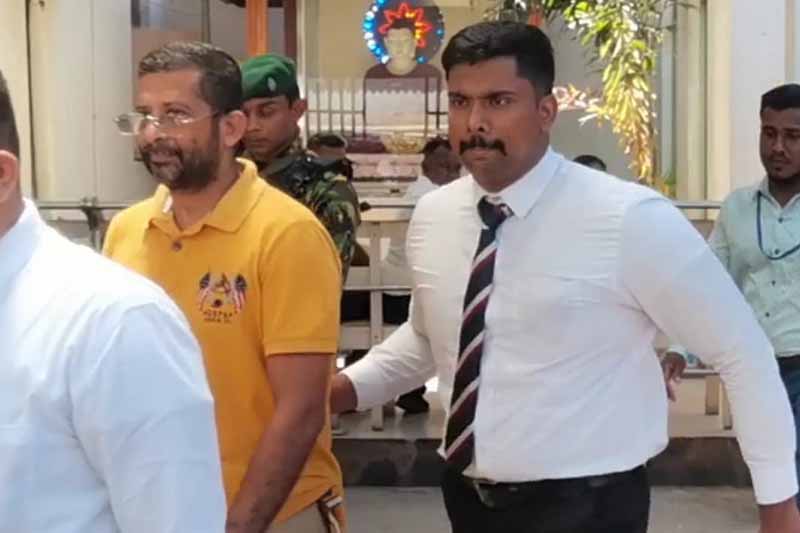
The man named in open court as connected to those intelligence failures is Major General (Rtd.) Suresh Salley. He has, by every observable measure, become the luckiest man named in connection with the deadliest attack in Sri Lanka's modern history. The instrument of his luck? The Prevention of Terrorism Act — the very law his network never repealed when it had the power to do so. And the deep state.
The Prevention of Terrorism Act has been, for four decades, Sri Lanka's most efficient instrument of institutional cruelty. Under its provisions, Vijaya Kumaratunga — film star, democrat, dissident — was detained on a Naxalite charge so absurd it would have been comic were it not designed to destroy him. Field Marshal Sarath Fonseka, the man who won the war, was summoned to a court martial in uniform, stripped of rank, imprisoned. The JVP was banned. Wasantha Mudalige, the face of the 2022 Aragalaya, the student leader who helped bring down a presidency, was detained under the PTA for the crime of speaking truth in public. And when Major Salley's apparatus forced the detention of Hejaaz Hizbullah — a Muslim human rights lawyer whose offence was defending the vulnerable — Kafka's priest nodded and said nothing. That is how the system works. That is how the guilty speak, said the priest, of every person the state chose to designate.
And in Welikade Prison in 1983, when Tamil detainees held under the PTA — Kuttimani and dozens of others, approximately 53 prisoners massacred by mobs allowed through the gates — were killed, the priest did not weep. The priest said: they were guilty. They deserved it.
The writer of these pages has one demand: repeal the Prevention of Terrorism Act. Unconditionally. Completely. Now.
But here is the irony that should be recorded in every law school in this country. The networks that used the PTA as a weapon of political terror — that detained lawyers, students, dissidents, and minorities under its provisions — never repealed it when they governed. They had the power. They had the parliamentary majority. They had the executive presidency. They chose to keep the weapon loaded because they intended to keep using it. They did not foresee that one day, they would stand on the other side of the barrel.
The PTA, unchanged, now holds the agents of the deep state accountable. This is not justice. It is geometry. What goes around, as the geometry of power always insists, comes around. The writer does not celebrate this. The writer demands better. But the deep state's lawyers should not be surprised by the architecture of the cage. They built it.
The global architecture of counterterrorism since September 11, 2001, has been built not on the rule of law but on the logic of annihilation. Osama bin Laden was killed without trial in Abbottabad in 2011 — celebrated as justice. The CIA operated black sites across at least eight countries, where the United States Senate Intelligence Committee confirmed: sleep deprivation up to 180 hours, waterboarding, confinement in boxes. Guantánamo Bay held detainees for decades without charge. Extraordinary rendition became standard state policy.
Sri Lanka required no lessons. Rohana Wijeweera was shot dead in custody in 1989. Balachandran Prabhakaran, fourteen years old, was executed at Mullivaikkal in May 2009. Boosa, the 4th Floor, Joseph Camp, Batalanda — these are not allegations. They are findings of commissions, human rights bodies, and courts. Not one LTTE or JVP leader received a fair trial. They were killed, disappeared, or broken.
Against this backdrop, Suresh Salley lives. He has lawyers. He has hearings. His rights are intact. That is what justice requires. It is also a measure of how selectively this state has always decided who deserves it.
Sri Lanka's anti-torture jurisprudence was built by judges of uncommon courage. Justice Mark Fernando gave the voiceless a constitutional forum. Justice Prasanna Jayawardena refined and extended it. Justice Mahinda Samayawardana named, without euphemism, what the evidence showed: that state torture in Sri Lanka operated on class lines. It was the poor, the Tamil, the Muslim, the politically marginal who were broken in detention. Never the generals. Never the intelligence elite.
The devastating irony is that these protections — built for the oppressed — now shield precisely the class those judges were most worried about. The armour forged for the vulnerable now fits the powerful with remarkable comfort.
The presumption of innocence is among the oldest and most fundamental principles in the legal traditions of both the common law and civil law worlds. It appears in Roman legal maxims, was articulated by Sir John Fortescue in the fifteenth century, and was given its most enduring formulation by William Blackstone in 1769: it is better that ten guilty persons escape than that one innocent suffer. The principle migrated into modern human rights law through Article 11 of the Universal Declaration of Human Rights and Article 14 of the International Covenant on Civil and Political Rights, both of which Sri Lanka has ratified.
The philosopher and legal theorist Boris Krigger, writing in 2026, has argued that in politically saturated criminal proceedings, the presumption of innocence undergoes a systematic inversion: the accused enters the courtroom already designated, already narrated, already convicted in the public imagination, such that even acquittal cannot restore what the process has consumed. The trial becomes not a search for truth but a performance of justice — and in that performance, designation precedes verdict.
In Sri Lanka's Easter Sunday proceedings, this inversion is not theoretical. Suresh Salley and Gotabaya Rajapaksa were named in open judicial proceedings, linked to intelligence-related allegations, and subjected to travel restrictions. These are acts of the state, not of public opinion. The moral and legal presumption of innocence was not eroded by press reporting or social media — it was eroded, if not extinguished, by the state's own conduct within its own institutions. Whether those named are ultimately found guilty or innocent, they have already been deprived of the most fundamental protection the law affords: the right to enter proceedings untainted by prior designation.
And yet — this is where the argument turns — the presiding judge has refused to abandon that principle even under this weight. Following the 2023 reforms to the PTA, standing in the tradition of Fernando, Jayawardena, and Samayawardana, the court ordered independent expert medical panels to ensure the accused is held under judicial supervision, not institutional convenience. The presumption of innocence is being applied — with more rigour and humanity than the PTA was ever applied to Kuttimani, to Hizbullah, to Wasantha Mudalige, to any of the people the same networks once designated without scruple. The Catholic Church, which buried its dead from those Easter pews, has acknowledged this. They have placed their hope in a fair trial. They accept the presumption of innocence. They ask only that the process be real.
Three categories of terrorism fill the standard literature. Private political terrorism: non-state actors seeking to compel political change. Religious terrorism: violence mandated by theological conviction. State terrorism: governments turning violence on their own people.
The Easter Sunday attacks demand a fourth category: deep-state terrorism. Violence not in service of a cause, but in service of an outcome — an election, a transition, a political realignment. Engineered or permitted by factions embedded within intelligence networks and military establishments, using extremist proxies as instruments of domestic power. The target is not an enemy. The target is the electorate's fear.
Deep-state terrorism is the most durable form because it wears the face of the state while operating behind it. It survives elections. It survives transitions. It survives reform. It has no ideology except power, no endgame except survival. The Easter attacks — timed four weeks before a presidential election, striking symbolically devastating targets, producing political consequences of almost mechanical predictability — fit this pattern with a coherence no serious investigator has yet been permitted to pursue to its conclusion. That evasion is itself part of the pattern.
Luck, in this kind of terrorism, may not be luck at all. It may be strategy. But this writer argues without qualification: there must be no space for impunity. Not strategic impunity. Not institutional impunity. Not the impunity of the well-connected, the well-lawyered, or the well-prayed-for. None.
Impunity is not a stable condition. It accumulates until it collapses. Decades of unprosecuted crimes created a class that had genuinely stopped believing in consequences. The Chief Justice was impeached through parliamentary theatre in 2013. The Attorney General's independence was traded. DIG Shani Abeysekara was prosecuted for investigating the wrong people. Journalists were threatened. Witnesses forgot. The machine maintained itself through the continuous suppression of its own exposure.
But the machine miscalculated. The Aragalaya of 2022 happened. The NPP won. And now something has shifted that the machine did not model: a public that no longer believes the performance.
Watch the panic. Mrs. Salley is organised to visit the Mahanayake of the Malwathu chapter — a visit to the highest prelate of Theravada Buddhism, deployed as a character reference for a detained general. Politicians who ran torture camps deny they exist, on camera, in public, in plain sight. Lawyers mock the judiciary that is protecting their client's rights with more care than that client ever showed anyone else. That is not confidence. That is the behaviour of people who have lost the script and are improvising badly.
Kafka's priest had a phrase for this. The writer does not need to repeat it. It is self-explanatory.
When the Chief Justice was summoned before a legislature sitting as a court — a parliament stripped of judicial authority performing the theatre of impeachment — Kafka's priest did not object. That is how the guilty speak, said the priest, of the Chief Justice.
When Field Marshal Sarath Fonseka was hauled before a court martial in the uniform he had worn to victory, Kafka's priest said: that is how the guilty speak.
When Vijaya Kumaratunga was detained as a Naxalite, when the JVP was banned, when Wasantha Mudalige was held under the PTA for leading students into the street, when Hejaaz Hizbullah was detained for defending Muslims — each time, the priest found a way to say it. That is how the guilty speak.
In Welikade, in 1983, when Kuttimani and approximately 53 Tamil PTA detainees were massacred by mobs let through the gates, the priest said they deserved it. They were guilty. The law had said so.
Now the same law holds Major General Suresh Salley. The judge applies the presumption of innocence with more humanity than the PTA has ever been applied before. And the networks that built and kept and wielded that law are in panic.
The new Kafka's priest does not need to speak. After the Aragalaya, after the NPP, after the collapse of the old performance, the panic is its own testimony. The lawyers who mock the court, the politicians who deny the camps, the wife's pilgrimage to the Mahanayake — these are not the acts of the innocent. They are the acts of people who know what the evidence contains.
That is how the guilty speak. The priest has left the room. The text reads itself.
Manik came home from Australia to care for her mother. She brought Alexandria with her. They did not come home to die in a church. A daughter did not lose her life beside her mother so that the men responsible for the failures that made that morning possible could hide behind the very law they refused to repeal.
The dead cannot speak in court. But their absence speaks in the panic of those who fear a reckoning. Their souls make the guilty more afraid, not less. Their God — in whom the Catholic Church that buried them still places its faith — does not demand vengeance. He demands truth. He asks for a fair trial, a real verdict, and the permanent end of impunity. He gives energy to the loved ones left behind — the grandmother who lost both daughter and granddaughter, the family who flew home from Australia to bury them — to never give up.
To those who loved Manik and Alexandria: do not give up. The truth does not expire. The evidence does not disappear. The system, for perhaps the first time, is being asked to work — and a judge, in the tradition of the great anti-torture jurists of this country, is trying to make it work.
Let them rest in peace in heaven. Let the living find no rest until justice is done.
The truth is not for sale. We will not forget. We will not give up.
Note on Sources: Factual claims draw from the Final Report of the Presidential Commission of Inquiry on the Easter Sunday Attacks (2021); open-court proceedings before the High Court of Colombo; the US Senate Select Committee on Intelligence report on CIA detention and interrogation (2014); Amnesty International, Human Rights Watch, and UN Special Rapporteur findings; Sri Lankan Supreme Court fundamental rights judgments; and documented accounts of the 1983 Welikade prison massacre. The number of Tamil prisoners killed at Welikade in July 1983 is recorded at approximately 53 in the most cited accounts, though some human rights documentation places the figure higher. The interpretive and philosophical framework is the author's own.
---------------------------
by (2026-06-21 13:11:51)


 Suresh Salley; The Luckiest Trial for the Most Dangerous Terrorism..! When Deep-State Actors Lost the Presumption of Innocence..!!)


 Read 106512 Times
Leave a Reply
 0 discussion on this news