
-By Gerard Adams
(Lanka-e-News -2026.June.21, 7.00 PM) "Will all great Neptune's ocean wash this blood clean from my hand? No — this my hand will rather the multitudinous seas incarnadine, making the green one red."
— Macbeth, Act II
"The more a man is a thief, the more he protests his honesty."
— Crime and Punishment, Dostoevsky
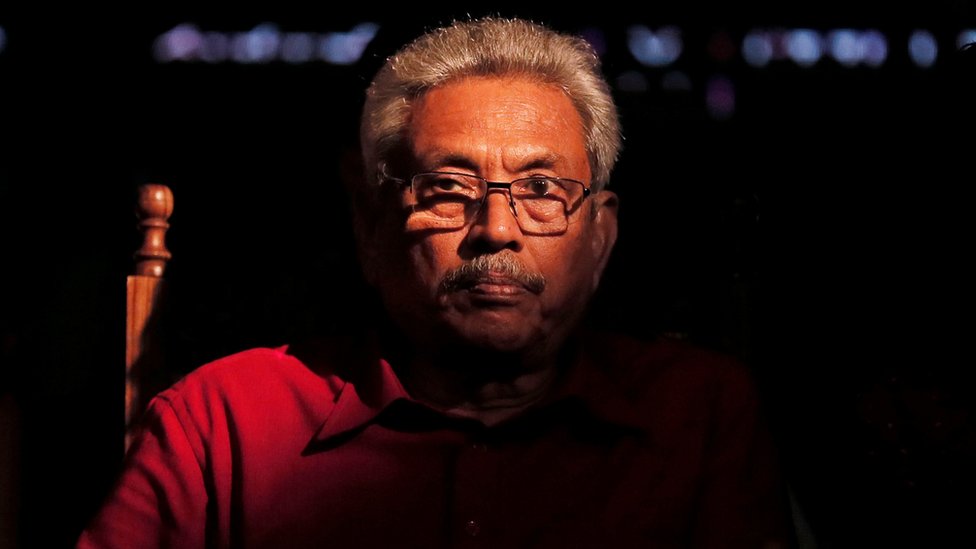
On Easter Sunday, April 21, 2019, 269 men, women, and children were massacred in churches and hotels across Sri Lanka. Their blood soaked the floors of St. Anthony's Shrine, St. Sebastian's Church, and the Shangri-La Hotel. Seven years later, the man who was the primary political beneficiary of those bombs has filed a petition before the Court of Appeal — not to answer for those deaths, but to prevent himself from being questioned about them.
This single fact must never be buried under procedural language: Gotabaya Rajapaksa did not merely benefit politically from Easter Sunday — he won the presidency because of it. The massacre collapsed the Sirisena-Wickremesinghe government, shattered public confidence in the existing order, and delivered the presidency to Gotabaya on a tide of national fear and grief. The bombs were the campaign. The 269 dead were the margin of victory.
The petition, filed through Attorney-at-Law Sanath Wijewardena, names the Inspector General of Police, CID Director Shani Abeysekara, and CID Officer Madhawa Gunawardena as respondents. The legal basis invoked is the Prevention of Terrorism Act — the same instrument his government wielded against political opponents, Tamil civilians, and honest investigators. The man who built the cage now fears being placed inside it.
Any honest analysis of Easter Sunday impunity must place Maithripala Sirisena precisely where he belongs: not as a peripheral figure, but as the central structural pillar of both the original failure and the subsequent cover-up machinery.
Sirisena was the sitting President on April 21, 2019. He held supreme executive authority over national security. Intelligence warnings had been received, circulated, and ignored. The attacks proceeded. In the aftermath, rather than leading accountability, Sirisena did two things that define the entire impunity architecture:
First, he appointed the Presidential Commission of Inquiry (PCoI) — under his own presidential authority, while he was the president constitutionally accountable for the intelligence failure. This is the same PCoI that Gotabaya's petition now cites as primary exculpatory evidence. The commission investigating the failure of Sirisena's presidency was appointed by Sirisena himself.
Second, Sirisena became the political ally and coalition president who delivered Gotabaya to power — the man whose presidency bore responsibility for Easter Sunday facilitating the political ascent of the man who then controlled all subsequent investigation.
This is not coincidence. This is architecture. The cover-up did not begin when Gotabaya took office. It began the moment Sirisena appointed a commission to investigate his own failure, then partnered with the political beneficiary of that failure to transfer power.
Hannah Arendt described this as the totalitarian inversion — where the state actors responsible for catastrophe capture the apparatus meant to investigate it. Sirisena's PCoI is Neptune's ocean drawn from the most contaminated well imaginable: appointed by the president whose watch the attacks occurred under, to investigate the attacks that occurred on his watch.
The petition constructs an elaborate architecture of exoneration by citing every layer of institutional authority available — critically, authority held not only by Gotabaya but by his political allies and predecessors:
The Presidential Commission of Inquiry (PCoI), appointed by Sirisena — Gotabaya's coalition partner and the president during the attacks — is now the cornerstone of Gotabaya's legal defence. The man who benefited from Easter Sunday cites the findings of a commission appointed by the man on whose watch Easter Sunday occurred. Two actors, one machine, one alibi.
The Parliamentary Select Committee (PSC) operated under a legislature shaped by the same political alignment. FBI reports are cited selectively, only where favorable. The Channel 4 Inquiry Committee was formed specifically to counter Channel 4's journalism on Sri Lanka. Supreme Court extracts serve as procedural armor. CID files are selectively cited — state investigation turned backward against itself.
Foucault was precise: power defines what counts as evidence. The petition asks the Court of Appeal to treat politically contaminated institutional findings as neutral authority. This is the impunity machine presenting its own internal documents as independent verification.
At the last hearing, the Jayaki Alwis report was placed before the court as a significant pillar of the petition's defence. This document — associated with investigative files, testimonies referencing figures like Asad Moulana, and materials connected to the Channel 4 inquiry proceedings — was presented as evidence undermining the basis for any PTA arrest.
The Catholic Church's response was immediate and unambiguous: the Church rejected the report.
This rejection carries a moral weight that no affidavit can match. Cardinal Malcolm Ranjith and the Easter Sunday families are not rejecting a procedural document. They are declaring, before the court and the nation, that this report does not represent truth — that it serves the machine rather than the dead.
This is Miranda Fricker's epistemic injustice made visible in real time. The Jayaki Alwis report appears authoritative — structured, referenced, formally presented. It launders contested claims through the formality of official documentation. The Church's rejection strips that laundering bare. An institution that buried 269 of its faithful, that has waited seven years, that cannot be transferred or prosecuted or classified — that institution looked at the report and said: no.
Dostoevsky understood this moment. Raskolnikov produced elaborate, internally consistent intellectual justifications for his crime. Porfiry listened. Then he watched what the hands did when the argument stopped. The Jayaki Alwis report is Raskolnikov's argument. The Church's rejection is Porfiry watching the hands.
Shani Abeysekara was arrested under Gotabaya's government. He was prosecuted on charges widely regarded as politically fabricated. He was imprisoned while serving as a senior investigator — targeted precisely because honest investigation threatened the machine. He survived. He now heads the CID. He is now named as a respondent — framed as someone with malicious intent to arrest the former president.
When Claudius stormed out of Shakespeare's Mousetrap — the theatrical re-enactment of his own crime — he did not confess. He fled, crying for light. The petition naming Abeysekara as an aggressor is the identical movement: the guilty party cannot endure the continued existence of the one honest investigator who survived everything thrown at him. Naming him as a threat is not a legal argument. It is panic dressed in legal robes.
Porfiry needed no physical evidence. He watched the quality of the denial. The ferocity with which Abeysekara is targeted in this petition tells its own story — louder than any affidavit.
This is the impunity machine's most elegant structural manoeuvre and deserves to be stated with full clarity:
The Presidential Commission of Inquiry was appointed by Maithripala Sirisena — the president constitutionally responsible for national security on the day 269 people were killed. Its findings are now the primary evidentiary shield of Gotabaya Rajapaksa — the man who was the political beneficiary of those killings and who subsequently became Sirisena's coalition partner.
John Rawls established that legitimate institutions require decisions made behind a veil of ignorance. A commission appointed by the president whose government failed on Easter Sunday, investigating that failure, cannot satisfy this condition. Its findings cannot be neutral. They were structurally incapable of being neutral from the moment of appointment.
Yet these findings travel from Sirisena's commission to Gotabaya's petition as if laundered clean by the formality of the process. This is what Agamben meant by the lasting exception — emergency arrangements made during a period of power that permanently alter the institutional landscape even after those who made them lose office.
The blood does not wash. Neptune's ocean — in this case, drawn from Sirisena's presidential well — turns the sea red rather than the hand clean.
Shakespeare gave us Lady Macbeth — performing composure before the court doctor while her hands compulsively scrubbed invisible blood: "Out, damned spot. Here's the smell of the blood still. All the perfumes of Arabia will not sweeten this little hand."
The sympathetic public appearances, the family drama staged for media consumption, the projection of a wronged former leader simply seeking legal protection — these are performances in the same theatrical tradition. What appears as personal suffering is structurally a political communication strategy. The tears serve the machine. Their function is calculated: humanize the accused, reframe accountability as persecution, generate emotional counter-pressure on investigators and the judiciary.
Sri Lanka's deep-state-aligned media performs Claudius's flight from the Mousetrap at industrial scale. Investigators become aggressors. The accused becomes the persecuted. Justice-seeking becomes vendetta. Cardinal Ranjith and the victim families are treated as political actors rather than moral witnesses. The 269 dead are rendered unworthy of the front page. The former president's legal jeopardy is rendered worthy of prime time.
Chomsky and Herman documented this in Manufacturing Consent: media systems aligned with power produce worthy and unworthy victims. The media circus is the deep state attacking the play it cannot endure watching performed.
Previous regimes made judicial appointments strategically — placing loyalists at every level during their period of dominance. The mechanism operates on a time-delay: appointments made during power; judges serving long terms; regime losing power; appointments remaining; accountability investigations beginning; appointed judges adjudicating them. The deep state does not need to interfere now. The interference was done years ago.
When the political arm of the old regime attacks the current Chief Justice and works to delegitimize independent judicial appointments, Dostoevsky's law operates at full institutional scale: the more a man is a thief, the more he protests his honesty. Those who appointed compromised judges for years; who prosecuted Abeysekara on fabricated charges; who weaponized the Attorney General's department; who controlled the Judicial Service Commission — are now the loudest voices about judicial independence and proper process.
The attack on the Chief Justice is not principled constitutional concern. It is a threatened machine attempting to discredit the only institution it no longer fully controls. Montesquieu warned that when the executive controls the judiciary, civilized governance collapses. What the deep state calls interference is simply the restoration of the separation of powers it spent years dismantling.
Edgar Allan Poe's murderer could silence everything except the heartbeat beneath the floorboards — growing louder and louder, not because it was real, but because guilt amplifies what conscience cannot suppress.
Cardinal Ranjith and the Easter Sunday families are the institutional Tell-Tale Heart of this case. They cannot be transferred, prosecuted, classified, or discredited. The Church rejected the Jayaki Alwis report not as a legal manoeuvre but as a moral declaration: we know what these documents are for, and we will not pretend otherwise.
Simone Weil described affliction as suffering so total and unacknowledged by power that it becomes invisible to institutions. The Church makes that affliction institutionally visible — permanently, repeatedly, in every courtroom where these proceedings occur. It is the one element the impunity machine was never designed to absorb. Every commission it dismisses, every report it rejects, every hearing it attends is the heartbeat growing louder beneath the floorboards.
Easter Sunday, April 2019. 269 killed. Intelligence warnings ignored. Sirisena is President.
Sirisena appoints the PCoI — a commission investigating his own government's failure, under his own presidential authority.
November 2019. Gotabaya wins the presidency — carried there on the fear and grief of a nation. He now controls all further investigation. Sirisena becomes his coalition partner — the president during the attacks allied with the political beneficiary of the attacks.
Honest investigators targeted. Shani Abeysekara arrested and prosecuted. Investigation systematically dismantled from within.
July 2022. Aragalaya uprising. Gotabaya flees. Returns 2023. Abeysekara rehabilitated. Heads CID. Real investigation resumes.
PTA arrest becomes imminent. Deep state activates: Court of Appeal petition filed. Jayaki Alwis report submitted. Catholic Church rejects the report. Media circus deployed. Chief Justice attacked. Political arm of old regime mobilises lawyers, aligned institutions, and public commentary.
Court of Appeal asked to freeze accountability — using Sirisena's PCoI as its primary evidence, submitted in Gotabaya's petition.
269 victims and the Catholic Church wait. The machine waits to see whether the court will become its newest instrument.
Dostoevsky's most psychologically precise observation is Raskolnikov's compulsive return to the crime scene. He cannot stay away. Guilt draws the criminal back toward the evidence of what they have done.
This petition returns obsessively to Easter Sunday. It cites document after document about the attacks. It engages exhaustively with the very investigation it claims has no legitimate basis. An innocent man says simply: I have nothing to answer for. This petition marshals every commission, every committee, every report available — Raskolnikov explaining at considerable length why he had no reason to be near the pawnbroker's apartment.
Porfiry watched. He did not need physical evidence. The quality of the denial was sufficient.
The petition is legally sophisticated. It may succeed on procedural grounds. And that is precisely the point. It does not need to prove innocence. It needs only to delay, obstruct, exhaust, and outlast. The Court of Appeal petition is the window-closing mechanism — the machine's attempt to seal accountability behind procedure before truth can reach verdict.
Every institution deployed in this laundering adds another wave. Sirisena's PCoI. The PSC. The Jayaki Alwis report. The selective FBI citations. The Channel 4 committee. The media circus. The attacks on the Chief Justice. The political arm's performances. Neptune's ocean summoned across two presidencies, two political eras, one unbroken machine.
But the Church stood at the last hearing and rejected the report placed before the court. That rejection — from an institution that cannot be transferred, prosecuted, or classified — echoes louder than any affidavit submitted in that courtroom.
Sirisena appointed the commission that investigated his own failure. Gotabaya benefited from the bombs and then controlled the investigation into them. Abeysekara was jailed for pursuing truth and returned to continue. The Church buried 269 faithful and has rejected every document designed to bury accountability alongside them.
When the accused summons every ocean — drawn from his ally's contaminated well — to wash his hand, and the Church stands at the court steps saying the hand is still red — what does the court see?
The victims of Easter Sunday are waiting for that answer.
They have been waiting seven years.
The green is red. The sea is red. The hand is still red.
Philosophical Sources: Hannah Arendt · Giorgio Agamben · Michel Foucault · John Rawls · Miranda Fricker · Noam Chomsky & Edward Herman · Simone Weil · Ruti Teitel · Steven Levitsky
Literary Sources: Shakespeare — Macbeth & Hamlet · Fyodor Dostoevsky — Crime and Punishment · Edgar Allan Poe — The Tell-Tale Heart
Collection of articles written by Gerard Adams
https://www.lankaenews.com/category/22
---------------------------
by (2026-06-21 13:26:29)


 Read 93708 Times
Leave a Reply
 0 discussion on this news