
By Gerard Adams
(Lanka-e-News -2026.June.30, 3.40 PM) "When the king shares the sin of the criminal he shelters, the kingdom does not merely decay — it becomes the criminal's throne." — Manusmriti, paraphrased
"The state is not a neutral instrument. It is always somebody's weapon. The only question is whose blood it is designed to shed."
— Political Realism, Anonymous
"Truth is not a fragile thing that can be killed with a bullet or buried under a body. Truth is geological. It does not negotiate its eruption."
— Reflection on Sri Lanka's Deep State, 2025
"Every survivor the death machine fails to eliminate becomes a testament — an archive it cannot burn, a witness it cannot silence, a verdict it cannot appeal."
— On the Philosophy of Impunity's Collapse
"A nation that allows its criminals to wear its uniform, speak from its rostrum, and collect its salary has not merely been corrupted — it has been replaced."
— Moisés Naím, adapted from The End of Power
There is a truth so ancient it has been spoken in every language that has ever grappled with power: a state that shelters criminals does not merely tolerate evil — it becomes evil's architecture. This is not an accusation. It is political physics. It is what happens when the sovereign becomes the shield.
Kautilya warned in the Arthashastra that when punishment becomes selective — when the guilty walk free while the innocent bleed — the king destroys himself. Not metaphorically. Structurally. The Manusmriti sharpened the blade: a ruler who fails to punish shares the sin. The Mahābhārata drew the final line — a king who shelters the wicked ruins his kingdom. And the Buddha, in the Cakkavatti Sutta, offered the most devastating prophecy: from the king's neglect, thieves arise.
These are not moral fables. They are structural diagnoses written in the blood of fallen kingdoms — describing what happens when the architecture of power is colonised by the architecture of crime. They describe what Moisés Naím calls the mafia state: a political order in which the ruling elite and the criminal underworld cease to be distinguishable, because they have already merged.
Sri Lanka did not merely approach this threshold. It crossed it. It lived through taskara-rājya — the kingdom of thieves. It lived through adharma-rājya — the kingdom of unrighteousness. And then, in 2025, the consequences of four decades of engineered decay erupted into full volcanic visibility. The illusion of impunity — that elegant, murderous fiction — shattered around a single unlikely figure: a drug lord who survived his own execution.
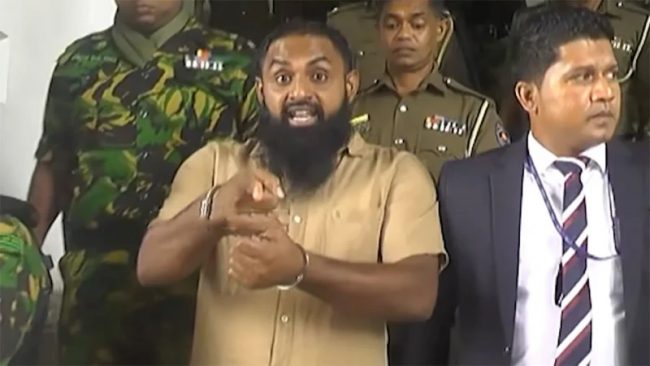
Nadun Chinthaka — known as Harak Kata, the Lucky Survivor — is not a story of criminal genius. He is something far more philosophically significant: the story of a system. A system that allowed him to exist. That protected him when he was useful. That tried to kill him when he became inconvenient. And that failed — catastrophically — in that final ambition.
The script was familiar. Arrest, transfer, "show us the hidden weapons," and death. Makandure Madush — killed in 2020 in an operation described as self-defence despite eyewitness accounts suggesting execution. Kosgoda Tharaka — eliminated through the same choreography. The Crow Island suspects. The Kotahena gunmen. Human rights organisations and the Bar Association of Sri Lanka condemned this pattern as systematic extrajudicial execution. Let us call it with philosophical precision: MOP — Murder of Process. Not merely killing a man. Killing the truth he carries.
But Harak Kata did not die. His survival was not merely biological. It was an epistemological rupture. When he speaks, he does not speak like a criminal confessing. He speaks like a ledger read aloud in open court — a database that refused deletion. He names the lawyers, the politicians, the intelligence officers, the bureaucrats, the money flows, the offices — even the Presidential Secretariat.
His testimony triggered the arrests of Rakitha Rajapaksa, son of former Justice Minister Wijeyadasa Rajapakshe, and Varushahannadige Arun Sri Chaturanga, a key operational node. Investigators allege millions of rupees in drug money funnelled through lawyers into political channels, routed through shell accounts and property transactions. These arrests exposed the vertical integration of the deep state's mafia branch: drug money flowing upward through lawyers, politicians, senior officials, into the protective apparatus of the state — a criminal supply chain hidden inside the formal architecture of governance.
And then came the implication of Wijeyadasa Rajapakshe himself — former BASL President, former Justice Minister, potential presidential candidate — and Charith Abeysinghe, cinema personality turned opposition media architect. The scandal did not merely expose corruption. It exposed the myth at the heart of Sri Lanka's political identity.
The criminal deep state was cultivated over four decades through a patient pedagogy of impunity. Each era taught the state a new lesson.
1977 — Legislature Laundering. Post-election violence erased by parliamentary decree. The state learned it could write impunity into statute.
1983 — The Pogrom and the Pardon. Three thousand Tamil civilians killed in organised massacres. Then Gonawala Sunil — a convicted criminal — was pardoned and made a Justice of the Peace. The state learned the distance between underworld and state was not a wall but a revolving door.
1988–89 — The Vigilante Fusion. Underworld figures embedded into counterinsurgency operations. Mass graves later discovered at Suriyakanda. The state learned it could outsource killing to the mafia — and the mafia, having tasted state sanction, would never fully return to private crime.
1990s — The Erasure of Witnesses. Richard de Zoysa, journalist and human rights activist, abducted and murdered. His mother identified a senior police officer as responsible. No conviction followed. The state learned it could erase threats biologically and the judiciary would not look too closely.
2000s — Criminal Muscle in the Presidential Ring. Baddegana Sanjeewa, Julampitiye Amare, Kajja — convicted criminals embedded within presidential security. Political power and criminal muscle merged until the distinction became incoherent.
2010s — The Burning of the Archive. Lasantha Wickrematunge murdered on 8 January 2009. Prageeth Eknaligoda disappeared in January 2010. Court archives destroyed in targeted fires. The state learned history was a territory to be violently administered.
2020–2024 — The Perfection of MOP. Madush. Tharaka. Crow Island. Kotahena. Kill the suspect, eliminate the evidence, close the file, write the press release.
2024–2025 — The Mafia Branch Inside the State. Drug money flowing through legal fees, political donations, property purchases, brokered appointments. The mafia branch had become a circulatory system. And then Harak Kata survived, and the system began to haemorrhage truth.
To understand why this eruption is happening now, we must place it within the larger frame that Professor Jayadeva Uyangoda — Sri Lanka's most rigorous political scientist — has provided.
Uyangoda argued, in the aftermath of the Aragalaya, that Sri Lankan society is undergoing a tectonic transformation — not merely a change of government, but a seismic shift in the plates of social consciousness upon which Sri Lankan governance has rested for seven decades. The Aragalaya was the visible eruption of a subterranean shift long accumulating: the collapse of ethno-nationalist governance as a credible framework, and the emergence of a civic consciousness that refused to organise itself along the ethnic and clientelist fault lines the deep state had always exploited.
What makes this transformation tectonic is its irreversibility. The social substrate the deep state depended upon — deference to authority, ethnic solidarity over civic accountability, fear of the white van — has cracked. The plates have moved. The Harak Kata eruption is not an isolated scandal. It is a symptom of a civilisational reckoning that the Aragalaya began and the 2024 elections confirmed.
Three structural pillars of the deep state's violent apparatus fractured simultaneously.
First, the judiciary began to reclaim independence. The Supreme Court's 2022 ruling that former President Gotabaya Rajapaksa and his cabinet violated the fundamental rights of citizens was unprecedented — signalling the courtroom could no longer be assumed a passive instrument of executive will.
Second, the police-underworld nexus was disrupted. Deshabandu Tennakoon — whose appointment as Inspector General of Police had itself been challenged in the Supreme Court — was removed. The institutional architecture protecting the extrajudicial killing programme broke. The chain of command shattered.
Third, intelligence impunity collapsed. Suresh Sallay — Director of the State Intelligence Service, whose name appeared in connection with political surveillance, electoral interference, and underworld coordination — was arrested. The arrest was not merely legal. It was ontological. It announced that no one, regardless of proximity to state violence, stood beyond accountability's reach.
Extrajudicial MOP is no longer structurally possible. The old choreography is broken. And so the deep state did what dying systems always do: it pivoted to its final refuge.
When the violent arm collapses, power retreats into the courts. When you can no longer kill the witness, you attempt to kill the process through procedural suffocation.
What unfolded at the Rakitha Rajapaksa hearing was not advocacy. It was theatre engineered as intimidation. Over one hundred lawyers flooded the courtroom. The Bar Association of Sri Lanka — whose former president stands implicated in the very scandal being adjudicated — intervened to demand exceptional treatment. The atmosphere became hostile to the presiding judge. The hearing transformed from legal proceeding into a performance of power: demonstrating that certain individuals remain beyond ordinary law even when physically standing before it.
This is judicial laundering at its most naked. If you cannot kill the suspect, kill the process. If you cannot destroy the evidence, bury it in procedural delay. If you cannot silence the witness, drown his testimony in appeals and adjournments.
But judicial laundering is failing. The judiciary is no longer fully captured. The public — forged through the Aragalaya's fire — no longer accepts the theatre as reality. And in the age of digital communication, what one survivor says in a courtroom is heard by millions before the session ends.
The involvement of Wijeyadasa Rajapakshe is not merely a legal development. It is a civilisational rupture. He was a figure of maximum moral credibility: former BASL President, former Justice Minister, Sinhala-Buddhist intellectual heavyweight who delivered lectures on constitutional propriety and wrote on Buddhist jurisprudence. He was discussed as a potential unifying presidential candidate as recently as 2023.
His fall is not the fall of a man. It is the fall of a myth — the myth that the Sinhala-Buddhist political elite was morally insulated from the criminal underworld. The scandal annihilates this myth. It reveals that the separation was always a performance — a costume drama staged for public consumption while the real transactions occurred in other rooms.
The involvement of Charith Abeysinghe is equally revealing. A cinema personality elevated into political organiser and opposition media architect, his fall reveals how completely the mafia branch penetrated not merely the institutional apparatus of state but the cultural infrastructure through which political alternatives are manufactured and marketed.
Together they represent the full civilian face of the deep state — the legal-intellectual wing and the cultural-entertainment wing — exposed simultaneously in a single drug-money-to-political-protection scandal. This is structural revelation: proof that the mafia branch did not merely infiltrate politics. It saturated it.
Kautilya warned that distorted punishment destroys sovereignty from within. Buddhism taught that neglect of justice accumulates into structural consequence that cannot be indefinitely deferred. Naím argued that the mafia state hollows itself until the shell can no longer sustain its own pretensions. And Uyangoda identified the deeper civilisational movement beneath these structural failures: a tectonic shift in which the ethnic and religious mobilisations the deep state used to divide and pacify the citizenry are losing their power, permanently and irrevocably.
Sri Lanka's deep state believed it had mastered permanent concealment — that it could bury truth under bodies, burn archives, intimidate judges, launder criminals through law, and hide behind the apparatus of state as though the apparatus itself were moral invisibility.
But every project of permanent suppression contains a fatal miscalculation. It mistakes power for permanence. It mistakes silence for truth's absence. It mistakes a buried thing for a dead thing. It forgets the most fundamental lesson that geology teaches politics: what is buried beneath sufficient pressure does not disappear. It transforms. It accumulates energy. It waits. And then it erupts.
Truth is not soil. It does not stay where you bury it. Truth is not ash. It does not disappear in fire. Truth is not paper. It does not burn with the archive. Truth is not a body. It does not die with the witness.
Truth is a geological force — a fault line accumulating pressure across decades of injustice, a tectonic plate moving slowly, invisibly, irresistibly beneath the apparent stillness of a stable surface. And when the pressure exceeds the capacity of the structure above to contain it, truth does not merely emerge. It erupts.
It erupted in 2022 during the Aragalaya — when a citizenry told for decades that its suffering was inevitable stood up and said: no more. It erupted in 2024, when the NPP — dismissed by the entire architecture of the old order as unelectable — won the presidency and then parliament in a democratic revolution the deep state's machinery failed to predict, because it had never learned to read a citizenry it had only ever managed. And it erupts now, in 2025 — in every courtroom, every confession, every digital leak, every survivor who opens his mouth and refuses to be silent.
Harak Kata lived. And because he lived, he speaks. Midigama Ruwan lives. Kehelbedara Padme lives. The Manamperi brothers live. Suresh Sallay speaks. Shani Abeysekara remembers. These are the living archives of a system that believed it had learned to destroy all its evidence — one body at a time. They are the unsilenceable witnesses: those whose survival constitutes, by itself, a verdict.
When the survivors speak, the deep state cannot survive. Not because the survivors are powerful. But because truth, once spoken by those meant to die before they could speak it, acquires a moral authority that no institutional apparatus can fully suppress. The momentum of tectonic transformation does not reverse. The plates do not return. The landscape is permanently, irreversibly altered.
The deep state is over. Its crime branch is finished. Its laundering has failed. Its silence has broken. Its truth has erupted.
The blood of evidence can be buried in the dunes of power for decades. Mountains of influence can stand over it. Armies of lawyers can surround it. Politicians can speak over it in the polished language of constitutional propriety and Sinhala-Buddhist nationalism.
But truth moves beneath all of them. Truth shakes beneath all of them. Truth rises beneath all of them. And when it rises, it does not whisper. It does not negotiate. It does not ask permission.
It erupts. It erupts like a volcano. It erupts like an earthquake. It erupts like a tectonic transformation that no one who built their palace on the old ground can stop, reverse, or survive.
And nothing — not the deep state, not its mafia branch, not its judicial laundering, not its media theatre, not its hundred lawyers in a courtroom, not its intelligence officers in the shadows, not its politicians draped in the flags of nationalism and religion — can bury it again.
The transformation Professor Uyangoda named is not coming. It is here. It is underway. And it is, by its geological nature, irreversible.
Collection of articles written by Gerard Adams
https://www.lankaenews.com/category/22
---------------------------
by (2026-06-30 10:12:52)


 Read 4284 Times
Leave a Reply
 0 discussion on this news