
-By Gerard Adams
(Lanka-e-News -2026.July.21, 6.30 AM)
"When a political order collapses, it does not fall from the top — it falls from the conscience of the people." — Hannah Arendt
"Not everything that is faced can be changed, but nothing can be changed until it is faced." — James Baldwin
Every empire believes it will be the exception. Every ruling class believes its rot is invisible, that the people beneath it are too tired, too divided, or too afraid to notice that the arithmetic of power no longer adds up. Sri Lanka's over-80 UNTOUCHABLE political class believed this for half a century. Then, in 2026, the belief died — not with a bullet fired at the state, but with numbers, and then with a body.
No manifesto did this. No revolution, no coup, no constitutional amendment. A poll did it. A suicide did it. Between them, they delivered something more binding than an election and more damning than a courtroom verdict: a verdict of conscience.
Consider what conscience means in politics. It is not sentiment. It is the quiet, cumulative refusal of ordinary people to keep pretending that a broken arrangement is still working. Sri Lanka's arrangement — the kankani system of patronage, favour, and dependency that has run the island for generations — worked for exactly as long as people agreed to believe in it. In February 2026, that belief cracked. Verité Research found the government's approval sitting at 65%, satisfaction with the country's direction at 59%, and economic optimism at 64%. These are not decimal points. They are a population telling itself a new story: that suffering endured for a coherent moral purpose is bearable, and suffering endured for nothing is not.
But numbers alone rarely move a nation's soul. It took a death to do that.
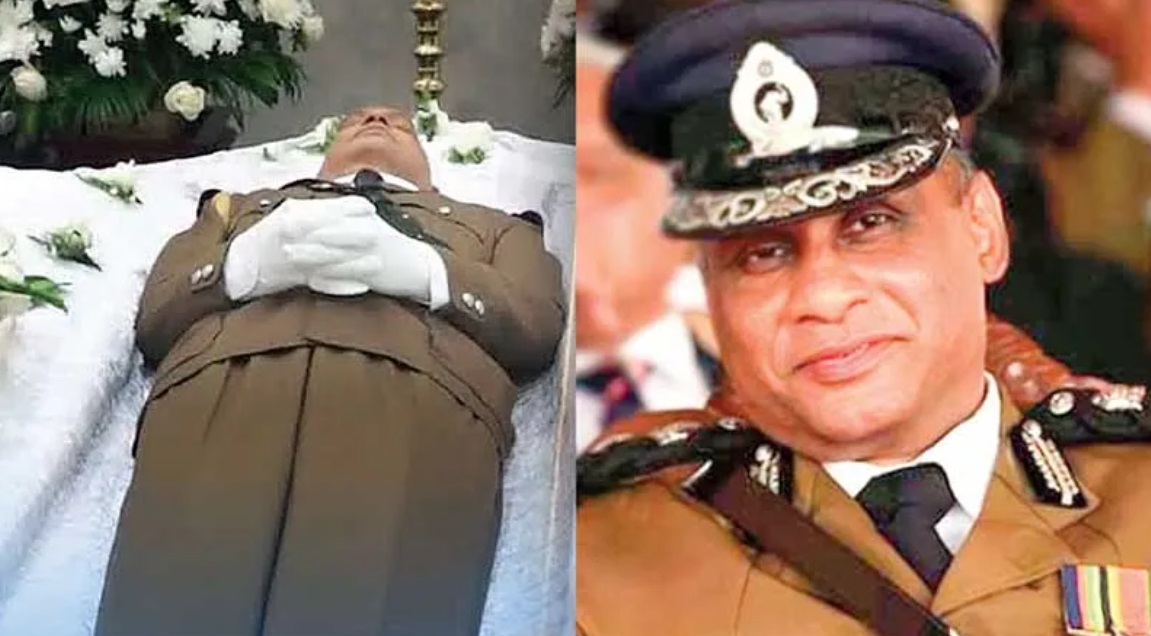
C. D. Wickramaratne was no minor official. As Inspector General of Police, he did something almost no one in his position ever does. He told the truth about his own institution while still inside it. During the Aragalaya uprising, he admitted publicly that politicians routinely dictated who ran police stations — not for competence, but for loyalty. He confirmed, in effect, that the law in Sri Lanka had a second employer.
That confession should have been a turning point. Instead it became a slow sentence. His name kept surfacing — in the Easter Sunday files, in narcotics investigations, in the endless grey zone where political power and criminal justice trade favours. Whether the whispers about him were fair or not is almost beside the point. What matters is that a man who had once told the truth about the machine ended up crushed inside it.
His death was not private. A suicide inside a collapsing political order is never only personal — it is a message written in the only language power sometimes leaves people: the body. It echoed an earlier one. Kapila Chandrasena, the former SriLankan Airlines chief tangled in the Airbus scandal, had already shown the pattern: when the old elite cannot win at the ballot box, it tries to win in the courtroom, and it is ordinary, replaceable men who get destroyed in the attempt.
Then, in July 2026, the Centre for Policy Alternatives released numbers that reframed the tragedy entirely. President Anura Kumara Dissanayake's satisfaction stood at 75.5%. The opposition leader, Sajith Premadasa, stood at 29.4%. Read against that gap, Wickramaratne's death stopped looking like an isolated misfortune. It looked like the first casualty of an elite that had lost the country's trust but not yet surrendered its machinery of impunity.
A question worth sitting with: what does it mean for a democracy when the clearest evidence of a regime's desperation is a body count rather than a ballot count?
We are taught to think of numbers as neutral. They are not. The demographic breakdown of the CPA survey reads less like a poll and more like a philosophical map of who Sri Lanka now trusts and who it has stopped forgiving.
Malaiyaha Tamil satisfaction: 94.4%. Muslim satisfaction: 93.4%. Sinhala satisfaction: 69.9%. Youth satisfaction: 81.6%. Rural satisfaction: 76.4%. Urban satisfaction: 44.3%.
Strip away the percentage signs and what remains is a verdict on decades of minority exclusion, generational neglect, and rural condescension. When minority satisfaction crosses ninety percent, minority political parties are not making an ideological choice when they distance themselves from the opposition — they are doing arithmetic. No coalition survives attaching itself to a leader whose own base trusts him barely three in ten. So the minorities did what the excluded eventually always do: they stopped waiting to be represented and started representing themselves. Call it a small, local instance of an old truth — when the marginalised unite, the centre that depended on their division cannot hold.
The rural-urban gap tells a second story. Sri Lanka's political geography has always been rural in weight and urban in volume — the countryside decides, the city narrates. With rural satisfaction near seventy-six percent against an urban forty-four, the old elite's most reliable weapon — Colombo's newsrooms, chambers, and drawing-room consensus — has been geographically outflanked. The village was always dismissed as the place where politics happens to people. It has become the place where politics is decided by them.
And then youth — eighty-one percent. This is the number that should worry the old order most, because it cannot be reversed by a single election cycle. A seventy-year-old political culture cannot out-argue a future that has already made up its mind. When the young reject not just a party but an entire style of politics — patronage, impunity, constitutional gamesmanship — the old guard's only remaining strategy is not persuasion. It is delay. It is the courtroom instead of the ballot box.
When Ranil Wickremesinghe left government, he did not simply exit. He left behind an architecture — a landscape engineered, consciously or not, to make the next government's failure look inevitable. Call it a philosophy of pre-emptive despair: if you cannot win the argument that you governed well, make sure your successor cannot govern at all.
The traps were specific and calculated. An IMF trap, betting the NPP would tamper with debt sustainability terms and blow up the programme. A debt trap — USD 8 billion due in the new government's first fifteen months, a number engineered to suffocate. A procedural trap, betting the new administration would drown in procurement and compliance failures it didn't understand. A coal mafia trap, betting entrenched corruption networks would swallow reformers the way they swallow everyone. A port trap, with 330 containers left stranded to manufacture logistical paralysis. A prison trap, banking on overcrowding to erupt into riots. A cyber trap, a long-buried vulnerability that eventually surfaced as a 2.5-billion-dollar loss. A cultural trap — the long-suppressed Pallegama Hemarathana child abuse scandal — timed to detonate under religious institutions. Even an institutional trap, goading the new government toward war with the Attorney General's Department.
Then came the traps no human being planted: US tariffs, the Iran war, global commodity shocks — the universe's own indifference added to the pile. And then Ditwah, heatwaves, floods, dengue — nature's audit of a government's competence.
Here is the philosophical question worth asking of any collapse that refuses to happen: what do we call an order that predicted failure and got growth of five percent, a surplus of Rs. 197 billion, seven billion dollars in debt honoured, no asset sales, no default, no riots? We call it, at minimum, evidence. Not proof of virtue — governments are not saints because they survive — but proof that the inevitability the old elite promised was never inevitable. It was a story they needed to be true.
There is a fitting, almost comic standard to hold them to now: before the architects of that minefield lecture anyone on economic management again, let them run a small betel shop on a street corner for a year — no theft, no asset sales, a modest profit at the end of it. If they cannot manage a shop, the country owes them nothing on the subject of managing a state.
Every patronage system depends on one quiet lie: that the people inside it have no alternative. The kankani model that scholars like Jayadeva Uyangoda, Gamini Keerawella, and Pradeep Peiris have long described — the overseer who trades access for loyalty — survives only as long as its subjects believe dependency is the only door available to them.
The 2026 numbers are the sound of that door being kicked down. Minority and rural satisfaction did not simply rise; it rose in a register that reads as autonomy rather than gratitude. People who once needed a patron to reach the state now, in some functional sense, feel they are the state's constituency directly. That is not a small shift. It is the quiet unmaking of a hierarchy that took generations to build and one honest set of numbers to expose.
C. D. Wickramaratne's death sits at the hinge of that unmaking — a grim punctuation mark closing a chapter that ran on precisely the kind of coercion he once confessed to enabling.
The one demographic still resisting this shift — urban, Sinhala-Buddhist, middle-class — is not immune to persuasion; it is simply the last place where the old narrative machinery still functions at full volume. Inflation anxieties, tax-base expansion, and a media ecosystem built for Colombo's comfort keep this segment tethered to the past a little longer. But an island of resistance surrounded by a rising tide is not a stronghold.
It is a delay.
Here is where sympathy for a government must stop and demand must begin. A mandate delivered by the dispossessed is not a blank cheque. It is a debt.
The people who produced these numbers — minorities, the rural majority, the young, the historically unheard — did not hand power to the NPP so it could manage the economy competently and call the transaction complete. Competent management was the minimum. What they actually purchased, at the cost of real hardship endured in hope, was a different relationship between the citizen and the law. And on that account, the ledger is still unpaid.
Convenience is not justice.
Stability is not justice.
GDP growth is not justice.
A surplus in the treasury does not settle a debt owed to a prisoner who has waited eleven years for a trial date.
Martin Luther King Jr. said the arc of the moral universe bends toward justice. He was making a promise about direction, not about speed, and certainly not about automation. Arcs do not bend themselves. Someone has to grab the arc and bend it — a government, a movement, a single stubborn generation that refuses to accept that "later" is an acceptable answer to "when."
Sri Lanka's arc has been left twisted for decades, and the evidence is not rhetorical — it is architectural.
More than 40,000 people occupy prisons designed for 11,000. More than 30,000 sit in remand, which is to say: punished before being tried.
Over 1,131,818 cases remain lodged in the courts — more than a million lives suspended in procedural limbo.
More than 10,000 children face abuse every year, and their cases move through a system too depleted to move quickly.
Drug-related incarceration alone consumes 65.5% of prison capacity. A criminal trial can take a decade.
A child rape case can take five to eight years to reach a verdict. And the country that produces these numbers has just twenty judges for every million citizens.
These are not statistics in the way a GDP figure is a statistic. A GDP figure describes an abstraction. These numbers describe a person, still waiting, right now, for a country to remember them.
A nation does not heal while its courts haemorrhage. A government does not get to claim moral authority on credit while its judiciary suffocates on its own backlog. And a democracy that keeps deferring its conscience is not being patient — it is quietly rehearsing the same abandonment the old order perfected.
Strengthening the judiciary, in this light, is not bureaucratic housekeeping.
It is closer to a form of national repair — the kind you cannot legislate around, only through.
And so to the one reform that keeps being postponed for reasons that dissolve the moment you examine them: raising the retirement age of judges, and with it, rebuilding the capacity of a justice system starved for decades. Not because judges are asking loudly. Not because the Bar Association objects. Not because the Judicial Service Commission is stalling. Not because the Attorney General's Department cannot agree with itself. Every one of those objections is a procedural excuse standing in for a moral failure to act.
The real reason to move is simpler and harder to argue with: the people who delivered this government its mandate was promised a different relationship with the state, and every day of delay quietly breaks that promise a little further.
They dismantled a patronage system that had outlived its usefulness to everyone but its beneficiaries. They rejected a political class that measured legitimacy in decades of incumbency rather than years of service. They endured hardship on the strength of a belief that the direction, not just the destination, had finally become moral. They trusted a government with their patience. That trust was not unconditional, and it does not renew itself automatically.
The old order did not fall because it lost an argument.
It fell because it ran out of people willing to keep pretending the argument had already been won.
That is what a verdict of conscience actually is — not applause, but withdrawal of tolerance.
The numbers spoke first.
The tragedy spoke next.
Now it is the government's turn to answer, and the only honest answer left is action, not another season of explanation.
The people's verdict has already been delivered. The old order has already fallen. What remains open — the only thing still genuinely undecided in this story — is whether justice arrives because a government chose to deliver it, or waits, once again, for the next body to make the case for it.
That is the only question left worth asking.
And it will not stay patient forever.
Collection of articles written by Gerard Adams
https://www.lankaenews.com/category/22
---------------------------
by (2026-07-21 01:11:22)


 Read 26652 Times
Leave a Reply
 0 discussion on this news