
-By Gerard Adams
(Lanka-e-News -12.Aug.2026, 3.10 PM)
"All tremble at violence; all fear death. Comparing oneself with others, one should neither kill nor cause others to kill."
— The Buddha, Dhammapada, verse 129
"It would be very difficult, if not altogether impossible, to establish any principle upon which the justice or expediency of capital punishment could be founded, in a society glorying in its civilization."
— Karl Marx, Capital Punishment, New-York Daily Tribune, 18 February 1853
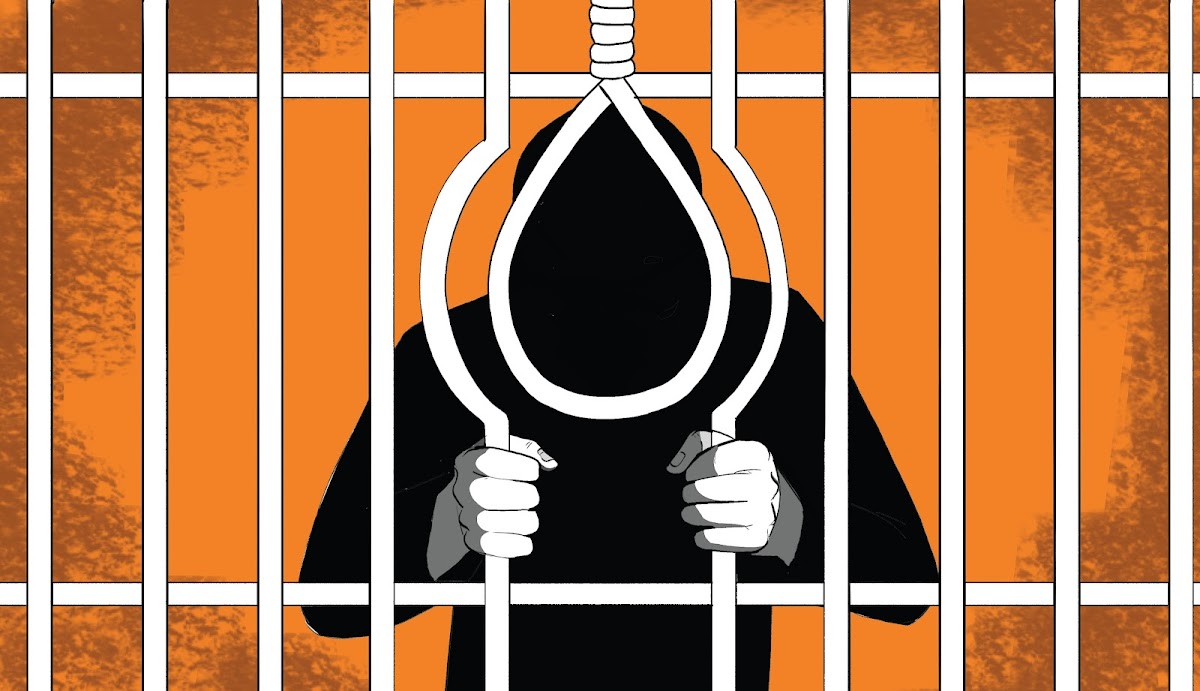
Every state, sooner or later, remembers that it owns a rope. In August 2026, Sri Lanka's National Operations Council, chaired by President Anura Kumara Dissanayake (AKD), placed the death penalty for drug-related offences back on the table, framing the narcotics trade as a threat to the economy, tourism, and the "social and moral fabric" of the nation. It is a familiar reflex: when a society feels its authority slipping, it reaches not for the scalpel of policy but for the axe of spectacle. This essay asks a philosophical question dressed as a policy debate: is the death penalty an instrument of justice, or the state's oldest form of theatre — a performance of power staged upon the body of the powerless?
Punishment did not begin as justice; it began as vengeance formalized. In the earliest legal codes — Hammurabi's Babylon, the Hittite laws, the Mosaic lex talionis — the state's role was to monopolize retaliation so private blood-feuds would not consume the community. "An eye for an eye" was, paradoxically, a limiting principle: it capped revenge rather than encouraging it. Capital punishment sat atop this hierarchy as the ultimate assertion of sovereign power — the right to kill being, as Michel Foucault later argued, the truest signature of pre-modern sovereignty. Foucault's Discipline and Punish traces how execution was once public spectacle, designed not merely to end a life but to reassert the sovereign's wounded authority through the visible suffering of the condemned body. The scaffold was theatre; the crowd was the audience; the state was both director and protagonist.
Punishment later shifted from the spectacle of the body to the discipline of the soul — prisons, surveillance, rehabilitation. Yet the death penalty survives as a fossil of the older paradigm, retained less for its practical effect than its symbolic thunder. It persists not because societies have proven it works, but because it feels like justice — and feeling, in politics, often outweighs evidence.
Sri Lanka's relationship with capital punishment is neither foreign import nor recent invention. Folk memory and chronicle speak of ancient kings — the Mahavamsa records royal justice dispensed with severity, including execution for treason, as an instrument of kingly dharma. Under British rule, the gallows at Welikada became a fixture of penal administration, formalizing execution as bureaucratic procedure rather than royal ritual. Sri Lanka has retained the death penalty in law since independence, yet has observed an unofficial moratorium since 1976, with only a handful of executions before that, notably during 1958-59. The rope has hung, unused, in the nation's legal cupboard for half a century — present in statute, absent in practice, a ghost the state periodically threatens to resurrect.
More striking is the tension between this history and Sri Lanka's dominant religious identity. The island is majority Theravada Buddhist, and Buddhism's first precept — pānātipātā veramaṇī — is abstention from taking life, extended by most schools to killing in all its forms, including judicial killing. Buddhist ethics frames punishment through karuna (compassion) and rehabilitation rather than retribution; the state, in classical Buddhist political theory, is meant to govern through dhamma, not the sword. It is a telling irony that a nation whose civilizational self-image rests on Buddhist compassion should reach, again and again, for the instrument its own religious philosophy identifies as corrosive — not only to the executed, but to the executioner and the society that sanctions the act.
Sri Lanka carries, among its oldest self-descriptions, the title Dhammadeepa — the Island of the Dhamma, sometimes rendered as the Island of Righteousness or, in looser political usage, the Island of Justice. The Mahavamsa records the tradition that the Buddha himself sanctified the island as a future stronghold of his teaching, and successive kings styled themselves protectors of that inheritance, legitimizing rule not through force alone but through fidelity to dhamma — righteous, compassionate governance. It remains a founding myth with real political weight: Sri Lankan leaders routinely invoke Dhammadeepa to claim moral authority, positioning the state as guardian of a civilizational project older than any modern constitution.
But Dhammadeepa is a demanding inheritance, not a decorative one. An island that calls itself the Island of the Dhamma cannot import the prestige of that title while discarding its ethical substance whenever convenience demands severity. If Sri Lanka is truly the island where dhamma was meant to flourish, justice there cannot be measured by the length of a rope but by the depth of its compassion under pressure — precisely the pressure a resurgent drug economy now applies. To invoke Dhammadeepa while building gallows is to keep the myth's crown and discard its conscience; the island of justice was never meant to become simply the island of judgment.
Opposition to capital punishment has a long philosophical lineage.
Cesare Beccaria, in On Crimes and Punishments (1764), delivered the first systematic Enlightenment argument against the death penalty, contending that the state possesses no rightful authority to take a life it did not give, and that the certainty of punishment deters crime far more effectively than its severity.
Albert Camus, in Reflections on the Guillotine, argued that capital punishment is not the mirror of justice but the mirror of the crime itself — a premeditated killing carried out with more cruelty than most murders, since the condemned must live for months anticipating the exact hour of death.
Karl Marx's opposition is less commonly cited but philosophically sharp. Writing for the New-York Tribune in 1853, Marx questioned the entire theoretical basis of capital punishment, arguing that no philosopher — not even Kant, who defended it most rigorously — had furnished a rational justification beyond the abstract formula of retribution. Marx's deeper critique was structural: he saw the death penalty less as a response to individual moral failure than as an instrument that punishes the products of social conditions the state itself manufactures — poverty, desperation, criminalized survival — while leaving the deeper economic violence untouched.
For Marx, the danger of allowing the state to hold the power of legal killing was that it would fall hardest not on the calculating villain of legal theory, but on the poor, the marginal, and the politically inconvenient. The criticism later left and critical theorists have refined into a broader claim: capital punishment does not fall evenly; it falls on those without money for competent defence, on the disenfranchised, on minorities.
The empirical record is unusually unambiguous for a policy question. Decades of comparative criminology find no credible evidence that the death penalty deters crime — including drug offences — more effectively than long-term imprisonment. Comparative studies between abolitionist and retentionist jurisdictions, and before-and-after studies within countries that abolished the death penalty, consistently fail to find a deterrent effect beyond that of severe incarceration alone. Homicide rates in US states without capital punishment have, for decades, tracked at or below rates in states that retain it. Globally, well over two-thirds of the world's nations have abolished the death penalty in law or practice — a slow civilizational drift away from state killing, even as a shrinking cluster of states, disproportionately authoritarian or populist, move to expand its use.
Why do states so often reserve the death penalty specifically for terrorists and drug traffickers rather than, say, corporate fraudsters whose crimes may harm far more people indirectly?
The answer is uncomfortable: these categories are chosen not because the evidence for deterrence is stronger, but because they are narratively convenient — pre-packaged villains, faceless and morally uncomplicated in the public imagination. Executing them requires no reckoning with the state's own complicity in the conditions — poverty, addiction, weak governance, corrupted enforcement — that produced the crime. It is far easier to hang the mule who carried the package than to prosecute the officials who let the shipment through the port.
Sri Lanka does not have to speculate. The Philippines ran the experiment. Under Rodrigo Duterte, the "war on drugs" combined aggressive extrajudicial killing with promises to restore capital punishment formally. The results are a grim ledger: government figures acknowledge around 6,000 deaths, with one internal accomplishment report listing over 20,000, and human rights groups estimating tolls as high as 30,000. Yet crime and drug-related case numbers, after an initial dip, rebounded to near pre-campaign levels within a few years, and researchers found the campaign failed to sustainably reduce drug use. Rehabilitation admissions, which briefly rose under the panic of the crackdown, later fell — suggesting fear drove people underground rather than into treatment. The Philippine experiment stands as the starkest modern demonstration that lethal force does not dismantle a drug economy built on poverty and demand. It merely raises the body count of the addicted, the poor, and the low-level courier.
While the architects of trafficking networks, insulated by wealth and connection, largely persist.
Here the philosophical must meet the cynical. Whatever its moral standing, the death penalty proposal is, for AKD, an almost perfect piece of political architecture. It costs nothing to announce and everything to oppose. It converts a complex, slow-moving governance failure — addiction, weak border enforcement, corrupted policing — into a single, emotionally satisfying image: the noose. It functions as a media deterrent — not necessarily deterring drug crime, but deterring criticism of the government's competence, by redirecting public anger toward traffickers rather than the state's own institutional failures.
It is also a shrewd opposition trap. Sri Lankan political folklore is thick with allegations linking politicians across party lines to protection rackets shielding drug networks. By proposing the ultimate punishment, AKD forces rivals into an impossible position: oppose it and risk being painted as soft on traffickers, or complicit; support it and legitimize a policy inconsistent with decades of Sri Lankan penal restraint. It is populism's favourite move — manufacture a binary where only one answer is politically survivable, regardless of policy merit. Sri Lanka's religious culture tilts toward compassion; but its populist political culture, shaped by decades of conflict and emergency rule, has long rewarded strongman gestures. The proposal borrows the aesthetics of firmness from a culture of war-weariness while borrowing none of the restraint from the Buddhist compassion that supposedly defines the nation.
There is, beneath this, a personal irony worth naming plainly. AKD leads a nominally Buddhist republic that still calls itself Dhammadeepa, and he leads it as head of a political movement rooted in Marxist-Leninist tradition — the JVP was founded on explicit class analysis, and the National People's Power coalition he now fronts carries that inheritance into government. This makes AKD arguably the leader best positioned to know why the death penalty fails on both grounds he stands on. As custodian of a Buddhist island, he inherits a precept against killing that predates his party by two and a half millennia. As inheritor of a Marxist tradition, he inherits Marx's own documented rejection of capital punishment as a policy without rational foundation — one that criminalizes the poor for crimes a broken economic order manufactures. A leader who is simultaneously a Buddhist head of state and a Marxist by political formation does not merely have two reasons to oppose this policy; he belongs to both intellectual traditions that produced history's clearest arguments against it.
To advance the death penalty from that position is a leader arguing against the two ethical inheritances that define him.
The evidence-based alternative is neither exotic nor untested. Portugal's 2001 decriminalization of personal drug possession, paired with investment in treatment, harm reduction, and reintegration, produced sustained declines in problematic drug use, HIV transmission, and drug-related deaths — without a single execution. Switzerland's heroin-assisted treatment programs stabilized a population of chronic users, sharply reducing associated crime. Thailand's recent shift toward treating drug use as a health issue reflects growing regional recognition that punitive-only models fail. These are documented, replicable public health interventions that treat addiction as a medical condition while still pursuing traffickers through conventional, well-resourced law enforcement and financial-crime investigation — unglamorous, institution-building work that produces no dramatic headlines and therefore holds little populist appeal.
Beyond the traffickers and the addicted lies a third victim of capital punishment: the moral character of the society that practices it. Every execution asks ordinary citizens — judges, prison officers, witnesses, voters — to participate, however distantly, in a premeditated killing conducted with the calm the state officially condemns in murderers. It asks a Buddhist-majority nation to hold, simultaneously, the belief that all life is sacred and the practice of scheduling a human being's death on a government calendar. It risks falling disproportionately on the poor and the addicted, while the financiers of trafficking networks remain untouched — and it offers, per the global evidence, no measurable public safety return for this cost. Those who resist the policy are not soft on crime; they are asking whether a society becomes safer or merely crueller when it schedules death as governance.
President Dissanayake came to power on a promise that Sri Lanka's politics could be different — cleaner, more rational, less captured by spectacle. The death penalty for drug offences is spectacle's purest form: cheap to announce, expensive in blood, empty in result, as the Philippines has already shown at a cost of thousands of lives and no lasting victory. There is still time to choose otherwise — to build the treatment infrastructure, the incorruptible enforcement units, and the financial investigations that actually starve trafficking networks, rather than gallows that merely feed the illusion of control.
A nation that calls itself Dhammadeepa should hesitate, at least once, before trading the island of the Dhamma for the island of the noose. And a leader who governs in the name of both the Buddha's compassion and Marx's critique of state violence carries a double obligation to resist this proposal, not a double license to pursue it. AKD should abandon this project — not because mercy is weak, but because, on the evidence of history, philosophy, and every comparable experiment before it, mercy is simply the more competent policy.
Let the island remain, in substance and not merely in name, the Dhammadeepa it claims to be.
Collection of articles written by Gerard Adams
https://www.lankaenews.com/category/22
---------------------------
by (2026-08-12 09:37:55)


 Read 17466 Times
Leave a Reply
 0 discussion on this news