
-By Prof. Desmond Mallikarchchi (rtd)
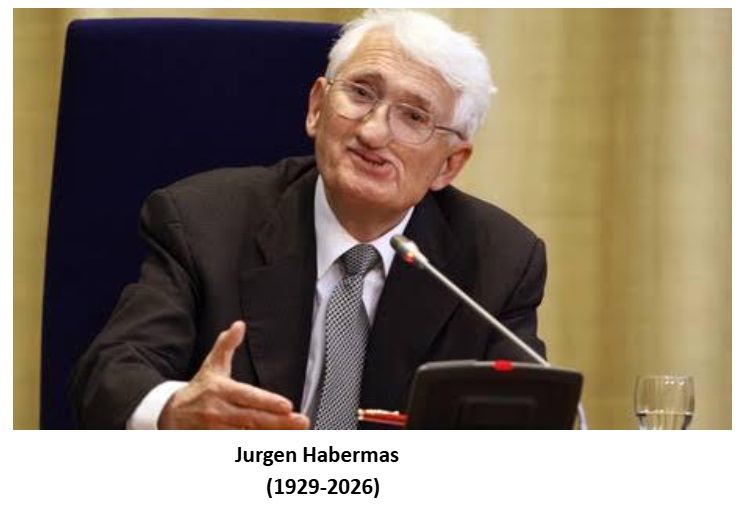
(Lanka-e-News -15.Aug.2026, 3.50 PM) The renowned German philosopher and social thinker Jürgen Habermas passed away on 14 March this year at the age of ninety-six. By a remarkable coincidence, 14 March is also the day on which Karl Marx died in 1883. (Special Note: Habermas’s death on the 14th of March and that of his theoretical mentor, Marx, on the same date is, of course, a coincidence, but it carries symbolic value and brings Habermas an unintended significance and the respect he deserved).
Habermas spent more than sixty years studying, criticizing, and developing many of Marx's ideas in new directions. With his death, the world lost one of the greatest philosophers and social thinkers of the late twentieth and early twenty-first centuries.
When I heard of Habermas's death, I wanted to write an obituary immediately. Unfortunately, my university teaching and other academic responsibilities – alongside my own health circumstances - did not allow me to do so. I have regretted that delay ever since because I owe a great intellectual debt to him. Although I disagree with some of his ideas—such as his rejection of labour as the central concept in understanding human beings, his departure from Marx's theory of history, and some of his views on modernity and democracy—I have always admired the originality and depth of his thinking. His important ideas, especially those on communicative action, the public sphere, and rational discussion, have had a lasting influence on philosophy, sociology, politics, and many other fields.
Around the year 2000, when I designed the Master's course on contemporary German Philosophy at the University of Peradeniya, I included Habermas as one of the prominent theorists in the Frankfurt school. "As early as 1987, I introduced Jürgen Habermas to the Sinhala readership by publishing a comprehensive introductory article on his theory of communicative action, ^zcqqf.ka ynudiaf.a ikaksfõok ls%hd kHdhz iudcõuiqu i`.rdj ^1987& fmardfoKsh õYajõoHd,h& alongside a translation of his seminal essay, 'Modernity: An Incomplete Project.' ^kQ;k;ajh ( wiïmq¾K jHDmD;shla&.Through these early works, I aimed to introduce the Sinhala readership to Jürgen Habermas, who would become recognized as one of the world's most influential contemporary philosophers. For these reasons, I felt a special responsibility to pay tribute to a thinker who greatly influenced my teaching and academic work. Though this tribute comes later than I had hoped, it is offered with sincere respect and gratitude.
Jürgen Habermas (born in 1929) grew up in Germany after the Second World War. Seeing the destruction caused by war and dictatorship made him think deeply about how societies could rebuild themselves through democracy, reason, and open discussion. He studied philosophy, sociology, and history, and later became the best-known thinker of the second generation of the Frankfurt School. He taught at Heidelberg University and later at Frankfurt University, and also served as Director of the Max Planck Institute at Starnberg.
Habermas wrote many important books, including Knowledge and Human Interests, The Theory of Communicative Action, Between Facts and Norms, The Philosophical Discourse of Modernity, and Moral Consciousness and Communicative Action. His central idea was simple but powerful: a healthy society is built not only through work and economic activity but also through honest communication. He believed that people can solve problems and strengthen democracy by talking to one another openly, listening to different opinions, and reaching agreement through reason rather than force or manipulation. These ideas have had a major influence on philosophy, sociology, politics, law, and communication studies throughout the world.
Habermas also became well known through his debates with other leading thinkers. He admired the French philosopher Michel Foucault's studies of power but argued that if all truth is nothing more than a result of power, then we lose any firm basis for saying that oppression is wrong. He disagreed with Jacques Derrida because he believed that endless interpretation of texts could weaken clear communication and democratic discussion. However, despite their disagreements, the two later became friends and worked together in support of democracy in Europe. Habermas also debated Hans-Georg Gadamer, arguing that we should not simply accept traditions because they are old; we must also examine them critically to uncover prejudice and false beliefs. He respected the political philosopher John Rawls but argued that ideas of justice should emerge through open discussion among ordinary citizens rather than from a purely hypothetical thought experiment. Throughout his life, Habermas defended the belief that free discussion, critical thinking, and democracy are the best ways of creating a fair and peaceful society.
I would like to end this tribute with a simple reflection.
With the death of Jürgen Habermas, the world has lost not only a great philosopher but also one of the few public intellectuals of our time. He believed that philosophy should not remain inside universities. It should help people understand society, defend democracy, oppose injustice, and encourage thoughtful public discussion.
People may not agree with all his ideas, and I myself have disagreed with some of them. Yet no one can easily question his vast scholarship, his honesty as a thinker, or his lifelong commitment to democracy, human dignity, and rational discussion. For more than six decades, he remained faithful to these ideals.
Great thinkers like Habermas do not appear very often. His books will continue to be read, discussed, criticized, and appreciated by future generations. "Though his voice—one that always believed people could solve differences through reason and dialogue rather than hatred or violence—has fallen silent, his ideas live on.
This tribute comes later than I intended. But, I offer it with deep respect and gratitude to a philosopher who enriched not only modern philosophy and social thought but also the lives of countless teachers, students, and readers around the world —including myself. May his life and work continue to inspire all those who believe that reason, open dialogue, and critical thinking are essential for a just and humane society.
Department of Philosophy
University of Peradeiniya
---------------------------
by (2026-08-15 10:27:54)


 Read 606 Times
Leave a Reply
 0 discussion on this news