THE MOST DETERMINED PETITION OF THE ULTIMATE VILLAIN - A Final Tribute to Ranil Wickremesinghe
By Gerard Adams
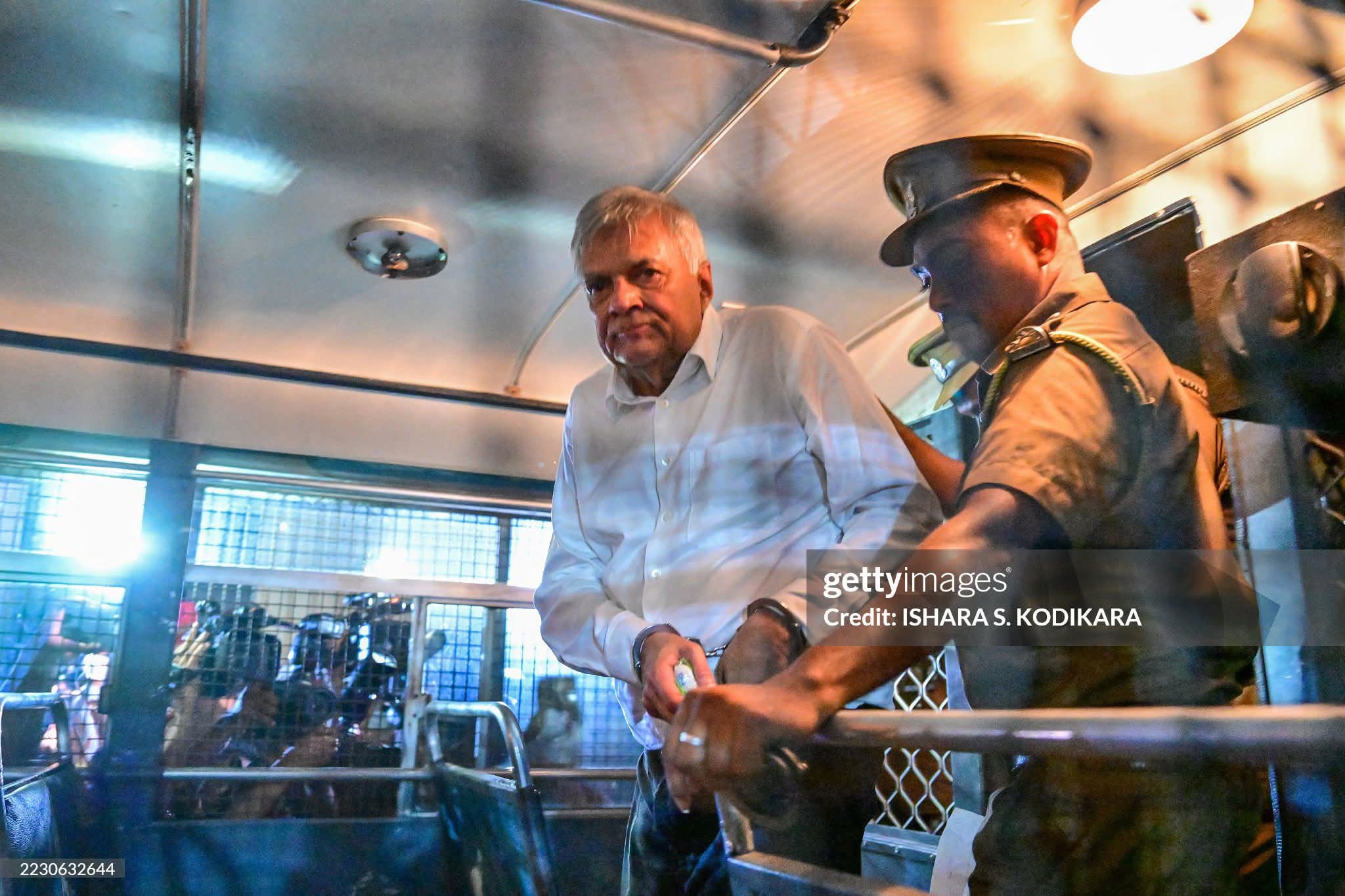
(Lanka-e-News -31.Aug.2026,10.30 PM) Twenty-one Special Determination petitions. Twenty-one separate legal assaults on the proposed 22nd Amendment, all converging on the Supreme Court of Sri Lanka at once, in a constitutional pile-up the island has never witnessed before. And behind the curtain, pulling strings with a choreographer's precision, stands the man the crowd loves to hate, former President Ranil Wickremesinghe. His own party colleagues watched him work the phones, the corridors, the back rooms — and could not resist the joke that cuts closest to the truth.
“The Leader didn’t fight this hard even for his own court case,” one senior UNP figure muttered. When a man defends a clause in the constitution with more ferocity than he defends his own freedom, you are no longer watching politics. You are watching theatre. And as any political strategist will tell you,
the better the villain, the better the blockbuster.
For the political elite, this is opera — a five-decade saga with a lead actor who refuses to leave the stage. For the people who have waited generations for accountability, it is something else entirely. It is justice, long delayed and now finally within reach. To understand how a technocrat became the nation's most reviled protagonist — and why Colombo's boardrooms still whisper his name like a prayer — you have to walk the full fifty-year length of the tightrope Ranil Wickremesinghe has been walking since before most of his critics were born.
The Master Strategist and the Curse of Being the Villain
Call him what you like — “the Machiavellian strategist,” “the political chameleon,” “the last man standing” — Ranil Wickremesinghe has authored the strangest chapter in the history of post-independence Sri Lankan politics. This is a man who has been counted out more times than any politician in the island's history, and who has clawed his way back from the grave of electoral irrelevance again and again. Strategists study him the way boxers study tape of a fighter who never gets knocked out for good.
“Give me a candidate who can lose an election and still run the country,” one veteran campaign strategist observed, “and I’ll show you the most dangerous man in the room.” That, in a single sentence, is the Wickremesinghe doctrine.
THE TRANSFORMATION OF POWER
• 1988–1989 — Crisis Management & State Preservation (the Ops Combine years)
• 2001–2002 — Peace Accord & Global Realignment (the Ceasefire with the LTTE)
• 2015–2018 — Elite Coalition Building & Constitutional Défense
• 2022–2024 — The Post-Aragalaya Single-Seat Presidency
• 2025–2026 — Judicial Warfare, the 22A Resistance & the Fight for Legal Survival
Five acts. One villain. A single, unbroken thread of survival that political strategists elsewhere would call a masterclass — and that ordinary Sri Lankans call something closer to a curse.
1988–1989: The Crucible of Counter-Insurgency
Rewind to the killing years of the second JVP insurrection, when the UNP state machine was being hunted down and executed man by man. A young Wickremesinghe did not flinch — he built the machine that fought back. Coordinating the state's military-police apparatus, known coldly as the “Ops Combine,” with party cadres on the ground, he helped fold anti-JVP vigilante muscle into a single, centralized counter-subversive engine. At the dark heart of that engine sat the Batalanda housing complex — an interrogation and intelligence node so notorious it later triggered its own Presidential Commission of Inquiry. Strategists still call this period a masterclass in preventing total state collapse. Survivors and the families of the disappeared call it something else: the birth certificate of Ranil the Villain, forged in a decade of extrajudicial blood that the state has never fully accounted for.
2001: The Ceasefire Agreement That Split a War — and a Nation
Skip the generals. Skip the war rooms. In 2002, Wickremesinghe signed a ceasefire directly with the LTTE, cutting the military establishment out of the loop entirely. It was audacious, and it worked — on paper. The economy stabilized. The LTTE itself began to splinter, cracking open with the Karuna defection. But to a nationalist electorate raised on the language of sovereignty and sacrifice, it read as something closer to treason: a backroom deal that legitimized the separatist project and handed a terrorist movement a seat at the table it had never earned through anything but violence.
2015 & 2018: The “Yahapalanaya” Experiments — Reform as a Trojan Horse
By 2015, Wickremesinghe had run the numbers and knew his own ceiling. So he did what master strategists do when they cannot win outright — he built a vehicle that could. Enter Maithripala Sirisena, the “Common Candidate,” engineered from within Rajapaksa's own camp to dismantle a decade of Mahinda's rule from the inside. It worked, spectacularly, for about a year. Then the coalition rotted from within, collapsing into the 2018 Constitutional Crisis — a full-blown attempt to remove him from the premiership that he survived only through relentless parliamentary trench warfare and a decisive Supreme Court ruling. He kept his job. He lost the argument. “Yahapalanaya” — the promised era of good governance — is remembered today not for reform, but for the Central Bank bond scandal that bled the public purse while insiders profited. The villain had won the battle and confirmed every suspicion about the war.
2022: Swallowing the Aragalaya Whole
Then came the impossible act. After the Aragalaya uprising physically drove Gotabaya Rajapaksa from the country, Wickremesinghe did something no strategist could have scripted: he became President while holding exactly one seat in Parliament — a single National List seat, no popular mandate, no electoral legitimacy in the conventional sense. He aligned instantly with the very SLPP the streets had just humiliated, stabilized the economy through an IMF program, and, in the eyes of the people who had risked their lives in protest, betrayed the revolution in real time. He did not crush the uprising. He absorbed it, digested it, and used its wreckage as a ladder. To the elite, this was crisis management of the highest order. To everyone else, it was theft in broad daylight — the single greatest act of political grand robbery in the island's modern history.
The Elite Counter-Perspective: Their Hero, Everyone Else's Villain
Here is the uncomfortable truth political strategists rarely say out loud in public: villains are never villains to everyone. To Sri Lanka's commercial, legal, and political elite, Ranil Wickremesinghe is not the antagonist of this story — he is its last line of defence. In their telling, he is the only leader capable of keeping the machinery of the post-1978 capitalist state running whenever the popular tide rises high enough to threaten to wash it away. Every “betrayal” the streets remember is, to this class, a “save.”
Strategic Virtues vs. “Politricks”
STRATEGIC VIRTUES: IMF-level macroeconomic stabilization; fluent international diplomacy; institutional continuity over street chaos.
“POLITRICKS”: elite patronage loops dressed as policy; constitutional loopholes exploited with precision; decades of clinging to UNP leadership despite defeats.
One thing both camps agree on — nobody plays the game better. The only dispute is whether the game itself is legitimate.
Beyond Doctrine: Wickremesinghe vs. JRJ vs. Mahinda Rajapaksa
Strip away ideology and look purely at the mechanics of power. Wickremesinghe emerges as Sri Lanka's defining Anti-Populist Technocratic Catch-All — a species of politician the island had never produced before him.
● Power Engine — JRJ: Institutional Authoritarianism. Mahinda: Charismatic Populism. Ranil: Technocratic Pragmatism.
● Catch-All Model — JRJ: a party machine fusing business and rural conservatives. Mahinda: an ethno-nationalist mass movement. Ranil: transactional elite coalitions stitched across party lines.
● Clientelism — JRJ: systemic state patronage. Mahinda: grassroots patronage and cash distribution. Ranil: institutional and parliamentary rules, bent to purpose.
● Key Leverage — JRJ: an absolute five-sixths majority. Mahinda: an unmatched popular vote base. Ranil: legal loopholes and crisis navigation.
JRJ built the walls of the fortress. Mahinda commanded the army that stormed it in his name. Wickremesinghe does neither — he doesn't need a mob, and he doesn't need a majority. He needs a voting bloc, a compliant lender, and a friendly bench. He negotiates where others mobilize. He operates the state's internal gears from the inside, extracting maximum leverage from precisely the moments — coups, crises, collapses — that would end lesser politicians overnight. That is not an accident of circumstance. It is, as strategists would say, the entire design.
The 22nd Amendment, the UK Fund Probe, and the Shadow of Chief Justice Surasena
Post-2024, the walls are finally closing in on multiple fronts simultaneously, and for the first time in fifty years, Wickremesinghe looks less like the director of the play and more like a character trapped inside it. Investigations are now underway into allegations that state funds financed his personal travel to the United Kingdom, tied to a university event in Wolverhampton — the kind of low-grade scandal that, for any ordinary politician, would already be a career-ending headline. For Wickremesinghe, it has stripped away the aura of untouchability he spent decades constructing.
At the same time, he has thrown himself into ferocious opposition to the proposed 22nd Amendment — legislation that would alter judicial retirement ages and restructure the composition of the superior courts under the current NPP administration. Dismiss this as constitutional idealism if you like, but observers are blunter about the calculation underneath it: the prospect of Chief Justice Preethi Padman Surasena remaining on the bench under extended terms represents a direct and existential threat to Wickremesinghe's legal defence. As this writer put it in Lanka-e-News, Sri Lanka's superior courts have long functioned as the true battleground where executive power, judicial appointments, and personal political survival collide. For Wickremesinghe, opposing the 22nd Amendment was never an abstract debate about constitutional theory. It is a defensive manoeuvre, executed in real time, to block a hostile judicial realignment before his own legal exposure catches up with him.
The Battle in the Supreme Court: The Final Theatre of the Villain
Every act of this drama has now converged on a single stage: the Supreme Court of Sri Lanka. If this fight could have been settled the way Wickremesinghe has settled every other fight of his career — behind closed doors, through elite bargaining, over quiet dinners with the right people — he would not be lifting a finger. But this arena is different, and he knows it. This is the one stage where he has always believed himself superior to both Mahinda Rajapaksa and J.R. Jayewardene: not on the streets, not in Parliament, but in the fine print of the law itself, where he is convinced no one alive commands more mastery of legal mechanics and constitutional architecture than he does.
THE SUPREME COURT BATTLEGROUND
On one side: the Government and the NPP administration, pushing the 22nd Amendment through to alter judicial terms. On the other: the opposition, the SOS movement, and the Bar Association of Sri Lanka, standing behind 21 Special Determination petitions that claim the amendment violates Articles 3 and 4 of the Constitution outright. Both sides converge on the same bench, in the same courtroom, for the same verdict — a verdict that will read as either a test of cold technical law, or a test of the constitutional conscience of the state itself.
Wickremesinghe has never once flinched from confronting the judiciary when it stood in the way of his plans. He warned, infamously, of “judicial cannibalism” whenever court rulings threatened to devour his executive agenda. For him, power answers to nothing but power. Unlike J.R. Jayewardene, unlike Chandrika Bandaranaike Kumaratunga, he has never sought the quiet dignity of a graceful exit, because in his own strategic calculus, only continued proximity to power can insulate a leader from the retrospective reckoning that eventually comes for everyone else.
And yet this judicial showdown exposes the one contradiction Wickremesinghe cannot legislate, litigate, or negotiate his way around:
● The Technical Trap — He is betting everything on the Court ruling along narrow technical lines: sovereignty clauses, referendum requirements, the fine architecture of separation of powers. If the bench plays the role he has written for it, he proves once more, as he has proven for fifty years, that he is the master of the machine. Another act. Another curtain call. Another blockbuster built on the back of the villain everyone loves to hate.
● The Bar and the Bench — But a courtroom is not a stage, however badly some actors want it to be one. It is a search for truth, not a venue for political performance. With the Bar Association of Sri Lanka and an army of black-robed lawyers standing against the 22A draft, the Supreme Court now faces the single most decisive test of its independence in a generation. Either it bends to the gravitational pull of the man who has bent every institution he has ever touched, or it proves, once and for all, that some stages cannot be scripted by even the greatest strategist in the country.
Because here is the line the political elite would rather you forget: for them, this is theatre, and the better the villain, the better the blockbuster — box office gold, a five-decade epic with the perfect antihero at its centre. But for the millions of ordinary citizens who have spent decades waiting for delayed justice, watching political manipulation dressed up as governance, the fate of the “great villain” is not entertainment.
It is not a plot twist to be savoured. It is the difference between a judiciary that performs for the powerful and a judiciary that finally, after everything, belongs to the people it was built to serve.
This final act will decide which Sri Lanka wakes up the morning after the verdict: one where the courts remain a stage for elite manoeuvring, or one where the bench stands, at last, as an independent pillar of justice — accountable not to Ranil Wickremesinghe, not to the NPP, not to the UNP, but to the sovereignty of the people alone.
By Gerard Adams
Collection of articles written by Gerard Adams
---------------------------
by (2026-08-31 17:24:16)
We are unable to continue LeN without your kind donation.


 Read 7260 Times
Leave a Reply


 0 discussion on this news