Eraj Raweendra Fernando: The Toy Pistol of the Deep State, and the Coming Legal Gunfight in Hulftsdorp
By Gerard Adams
A Nation That Mistakes a Punchline for a Warning
(Lanka-e-News -06.Sep.2026,10.30 PM) Sri Lanka loves a punchline. "Sellam Pistholaya," the toy pistol, became a national joke, a phrase reached for to mock the impunity of the powerful. But jokes are how societies bury warnings they are too tired to heed. When Eraj Raweendra Fernando, former Mayor of Hambantota, was found dead inside a Colombo apartment in September 2026, the press filed it as a private tragedy. That framing is not lazy — it is complicit. His death is a message, sent in the only language the Deep State speaks: silence.
Let the record speak first, because the words of Sri Lanka's own legal aristocracy indict the very system they now steer:
• Saliya Pieris, PC, at Aragalaya 2021: We need to understand the rights of everyone who is protesting. The nation is at a crossroads, and the path we choose will impact this country for generations to come
● The Batalanda Commission Report, on the absorption of the Left: "[The targets] included members of left political parties who were targeted by the JVP and who formed their own paramilitary groups. Some of the leaders went on to become ministers in succeeding governments and even represented Sri Lanka at international human rights forums."
● M.A. Sumanthiran, PC, at Matara 2021 on reconciliation: "If I am asked to sing the national anthem in Sinhala, I cannot, and therefore I will not sing the national anthem."
● Ali Sabry, PC, at a JVP youth seminar, July 2017: "The diversity we have in our country is not a curse; it is a beauty. A flower garden is more beautiful when it has flowers of different colours rather than flowers of just one kind."
Read together, these quotations are not decoration. They are the coordinates of a system that speaks the language of justice while manufacturing men like Eraj Fernando in its basement. He was not a rogue actor but the finished product of a design, the raw personification of the "Toy Pistol" (Sellam Pistholaya): a weapon built by a Deep State that recruits radical youth, arms them for its street wars, and discards them once their utility runs dry.
Eraj's arc - from left-wing youth organizer to the man who brandished an allegedly "fake" firearm at unarmed protestors in 2014 is the compressed biography of Sri Lanka's revolutionary Left gone feral. His death closes the book on 1980s street-level impunity. But do not mistake an ending for a resolution. It opens a more dangerous chapter, now written not on the streets of Hambantota but inside Hulftsdorp. The brutality has not disappeared; it has been laundered. Street thuggery has evolved into "legal gun battles" fought by the nation's most decorated lawyers. If the NPP fails to see this transition, it will govern a state mortgaged to institutionalised corruption and elite capture.
Blood and Pedigree: The Making of a Weapon
Eraj Fernando did not stumble into political violence; he was bred for it. Born in November 1968, he inherited a household soaked in ideology. His father was a frontline activist for the Communist Party of Sri Lanka. His mother's side placed him inside the powerful Edirisuriya family of Hambantota, whose ranks included his uncle, Advocate Tennyson Edirisuriya, a formidable lawyer and Sri Lanka Freedom Party (SLFP) MP for Tissamaharama. He was raised at the fault line where Left-wing radicalism met Southern establishment power, delivering him straight into the Sri Lanka Mahajana Party (SLMP), founded by Vijaya Kumaratunga and Chandrika Bandaranaike Kumaratunga in 1984.
That pedigree opened other doors too. By his early twenties, Eraj was a Production Coordinator on the film Dedunnen Samanaliyak (1990/1991), directed by Yasapalitha Nanayakkara, alongside lead actress Dilhani Ekanayake, briefly a man of the arts and the Left rather than of the gun. His commitment as an SLMP youth organizer earned him a seat on the world stage: he represented Sri Lanka at the 13th World Festival of Youth and Students in Pyongyang, North Korea, in July 1989. He came home to a country devouring itself.
1987: The Fracture That Made Killers of Comrades
By the mid-1980s, Sri Lanka's radical politics had split into two mutually loathing camps the fracture that explains why Eraj later needed a gun at all. On one side stood the Nationalist Trend: the JVP, armed with the ideology of Jathika Chinthanaya, waging militant war against the J.R. Jayewardene (JRJ) UNP regime and treating any compromise on the national question as betrayal. On the other stood the Internationalist / Left-Radical Trend: Colombo University's student movements, the SLMP, and the older Left parties sympathetic to the Tamil liberation struggle and pushing a devolved, socialist resolution to the ethnic conflict.
The signing of the Indo-Lanka Accord and the introduction of the 13th Amendment in 1987 detonated this fault line. What had been an ideological argument became a nationwide bloodletting almost overnight.
Two assassinations turned the temperature from combustible to lethal: the JVP's brutal killing of student leader Daya Pathirana, followed swiftly by the 1987 gunning-down of Vijaya Kumaratunga. These murders declared open season on an entire generation. Left-wing youth who had dreamed of socialist futures found themselves hunted by JVP assassins. Survival demanded arms, and arming themselves meant walking into the embrace of the state's security apparatus. This is the moment the "radical" became "recruit." Eraj Fernando was one of the recruits.
Norris Canal Road: The Laboratory Where Anger Became a Weapon
Every weapon needs a workshop, and for Eraj's generation, that workshop had an address. Consider the assault at the Colombo Public Library, where Sunanda Deshapriya was set upon by an enraged mob. Journalist Srilal Priyantha threw himself into the violence to shield Deshapriya, an act later documented in Ravaya. Searching for answers, Srilal went straight to the Norris Canal Road residence of Minister Rajitha Senaratne and there, lounging under Rajitha's protection, he found Eraj Fernando.
That single image says more than any commission report. Norris Canal Road was not a politician's home; it was a political laboratory — the exact site where raw street rage was refined and redeployed as state-sanctioned violence. Eraj did not hide from accountability there. He rested inside it.
The Toy Pistol Standard: How a Nation Learned to Laugh at Impunity
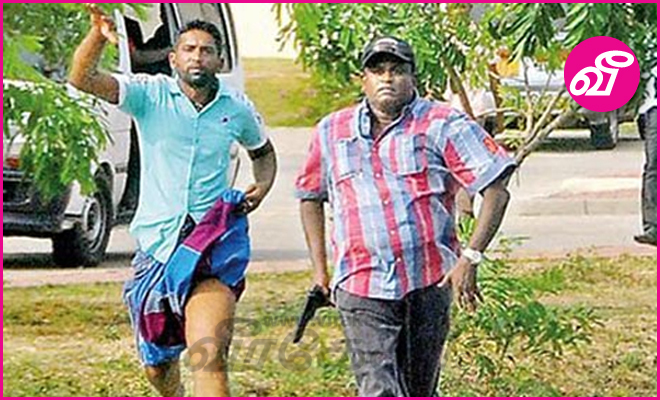
Once absorbed by the political elite, Eraj Fernando became Hambantota's frontline enforcer. His notoriety peaked on April 17, 2014, when UNP MPs on a fact-finding tour of Hambantota Port were met by a mob under Mayor Eraj Fernando's command. Cameras captured him chasing the MPs' vehicle, brandishing a handgun in broad daylight. His defense: it was merely a "toy pistol" (Sellam Pistholaya).
That excuse should have ended a career. Instead, it became a national catchphrase — because everyone understood, instinctively, that the "toy pistol" was never really about the gun. It was a test of the system's tolerance, and the system passed with flying colours. What the "toy pistol" defense actually proved was absolute, untouchable impunity: a law that looks away whenever the man holding the weapon has the right patron.
The Architecture of Impunity: 1977 to the Present
Eraj Fernando is not an aberration. He is the output of a machine under construction since 1977, as journalist Gerard Adams documented in landmark investigations for Lanka-e-News. Sri Lanka's Deep State is a multi-generational institution, built layer by layer on systemic impunity.
The foundation was poured during the 1977 UNP landslide, which institutionalised state-sponsored trade union thuggery. The structure grew bolder with the 1979 burning of the Jaffna Public Library, an act of cultural annihilation carried out in full view of senior cabinet ministers. It achieved total operational comfort during the Black July pogrom of 1983, when the machinery of state stood down and let the massacre of its own citizens proceed unimpeded.
The 1988–89 JVP insurrection was the moment this apparatus matured into a full counter-insurgency machine, building extra-judicial torture centres, most infamously the Batalanda complex. Torture camps need staff who know the terrain — radicals capable of hunting other radicals with precision. That marriage between intelligence agencies, elite politicians, and underground crime networks is the modern Sri Lankan Deep State in finished form. It survived the civil war, thrived on post-war triumphalism, and quietly compromised the security architecture that failed to prevent the 2019 Easter Sunday bombings. This is the operating system still running today.
Absorbed, Weaponized, Discarded: The Betrayal of the Radical Left
Here is the analysis this essay will not soften: in the fires of 1988–89, a substantial segment of Sri Lanka's radical Left was captured whole, hollowed out, and rearmed as an instrument of the Deep State. Intellectuals like K.L. Dharmasiri and C.A. Chandraprema supplied the ideological scaffolding. On the ground, men like Eraj Fernando, Salinda Bandara Dissanayake, Lakshman Premachandra, and Chandana Kathriarachchi carried it out. SLMP radicals were absorbed into a monetized, corrupted security network and turned against their own former comrades.
What followed was a pattern so consistent it deserves to be called policy: they used absorbed men only as long as they were useful, then sacrificed them the moment a better-connected replacement appeared. Lakshman Premachandra was the first casualty, discarded in favour of UNP crossover Duminda Silva, who, in the end, had him killed. Chandana Kathriarachchi was pushed aside for UNP strongman Gamini Lokuge. Salinda Bandara Dissanayake was cast off for UNP crossover Johnston Fernando. Even Rajitha Senaratne, patron of Norris Canal Road, proved too complicated for the system to manage cleanly.
And Eraj? Investigative leaks on Lanka-e-News describe his final months as consumed by a bitter "Medamulana frustration." The Rajapaksa dynasty he had defended with his toy pistol walked away once he became a liability. He was left to rot, a spent instrument, discarded by a state that had already extracted what it needed from his noise.
Hulftsdorp Is the New Hambantota
Eraj Fernando's lonely death carries a two-part message, and both halves demand to be heard. The first is aimed at the old guard: the era of raw street violence is ending, even as its last defenders wage a desperate rearguard action to preserve it. The second, more urgent, is a warning aimed squarely at the three most formidable "legal gunfighters" this state has ever produced: M.A. Sumanthiran, Ali Sabry, and Saliya Pieris.
The parallel is exact, and it should be unsettling. Just as the radical Left of the 1980s walked willingly into the Deep State's embrace, today's brilliant legal elite risk absorption into a new, sophisticated legal gerontocracy. In the late 1980s, the weapons were real guns disguised as toys, back-alley torture, and mobs deployed across Hambantota, Batalanda, and Norris Canal Road. In the 2020s, the battlefield has relocated to the Supreme Court and Hulftsdorp, and the weapons have been upgraded to fundamental rights petitions, injunctions, and writs — wielded, with formidable skill, by Saliya Pieris, Ali Sabry, and M.A. Sumanthiran.
At a recent gathering of the legal fraternity in Narahenpita, this elite celebrated its own courtroom victories: defense of the constitution, landmark triumphs before the Supreme Court, brilliant structural argumentation. All deserved, on its own terms. These lawyers have been handed a genuinely "legal gun," and they are pointing it, in good conscience, at the accountability of the Chief Justice and the judiciary itself. They believe, sincerely, that they are the last line of defense for the rule of law.
But belief is not immunity, and good faith is not strategic awareness. The Deep State does not need an uneducated thug with a toy pistol when it can route its interests through the refined machinery of Hulftsdorp, tying the state in procedural knots, delaying reform, and quietly shielding oligarchs' assets behind constitutional argument. When justice becomes a private game played by an untouchable fraternity of elite lawyers, the law stops serving the public and starts guarding the status quo the exact mechanism by which Eraj's generation was captured, only now the currency is precedent, not bullets.
What the NPP Must Do Before It Is Also Captured
The newly elected National People's Power (NPP) government, led by the JVP, stands at a historic fork in the road and does not have the luxury of getting this wrong. It must understand that this legal battle is not a partisan war it can win by simply outlasting the other side.
The NPP must resist the temptation to treat Sumanthiran, Sabry, and Pieris as permanent enemies of the revolution. These are the same lawyers who once stood against tyranny, who fought genuinely, and at real risk for the fundamental rights of ordinary people. To alienate them wholesale is not principled; it is strategically suicidal, because it hands the old Deep State exactly the polarization it needs to survive.
The real target is not the lawyers. It is the legal architecture that makes elite warfare possible in the first place. Once the immediate political noise settles, the NPP must move decisively and without further delay to deliver on the foundational commitments it was elected to fulfil:
1. Abolish the Executive Presidency. Not a symbolic reform, but surgery on the tumour of centralized, authoritarian executive power that has fed the Deep State since 1978.
2. Establish a genuinely independent prosecutor. Strip the Attorney General's department of its political leash and build a fully autonomous office empowered to investigate and prosecute state corruption without fear, favour, or a phone call from Temple Trees.
3. Empower the Ombudsman. Build an accessible, properly resourced, heavily weaponized public ombudsman's office that actually protects ordinary citizens from bureaucratic corruption and elite overreach, not a ceremonial office that exists to be ignored.
Delay is not neutrality. Delay is the choice the Deep State is counting on.
A Sad Pledge to a Failing State
Did I know Eraj? Yes, I did. I loved this kid then. Watching his final descent, reading it in the flat language of a police report, brings a grief with nowhere honest to go. I am sad that our politics could not stop a brutal civil war, could not prevent a catastrophic Left-on-Left bloodletting, and could not arrest the formation of a predatory Deep State now running on autopilot. We are a country fluent in impunity, unable to deliver justice against those who orchestrate it. And now that same state cannot even protect the lives of the enforcers it manufactured.
Eraj's trajectory is not unique; it is a blueprint, executed before in Kapila Chandrasena, the Airbus buyer for the dynasty, and in top policeman C.D. Wickramaratne. The mechanism is identical every time: the Deep State methodically corners a man until he is convinced, absolutely, that there is no way out or, worse, that his individual life has stopped being worth the fight to preserve.
In his final silence, Eraj Fernando left a pledge more honest than anything he said while alive: it is over. He could no longer convince himself his survival mattered to the architects of power who once found him useful. Read that precisely as a warning to the current generation of legal gunfighters now circling a decaying gerontocracy: it is not worth aligning with the Deep State. It never was.
This, finally, is the pledge that must be extracted from the newly elected NPP government, now, while there is still enough state left to save: recognise the sacred worth of a human life, and find the political fortitude to deliver in full, without excuse, everything promised to the masses who put you in power. The time for games is over. The state must be rebuilt before it finishes devouring everyone still standing inside it.
By Gerard Adams
Collection of articles written by Gerard Adams
---------------------------
by (2026-09-06 17:52:31)
We are unable to continue LeN without your kind donation.


 Read 828 Times
Leave a Reply


 0 discussion on this news