Rajeev, Look at Anuradhapura: Namal Is Blossoming — and the Black State Just Found Its New Face
By Gerard Adams
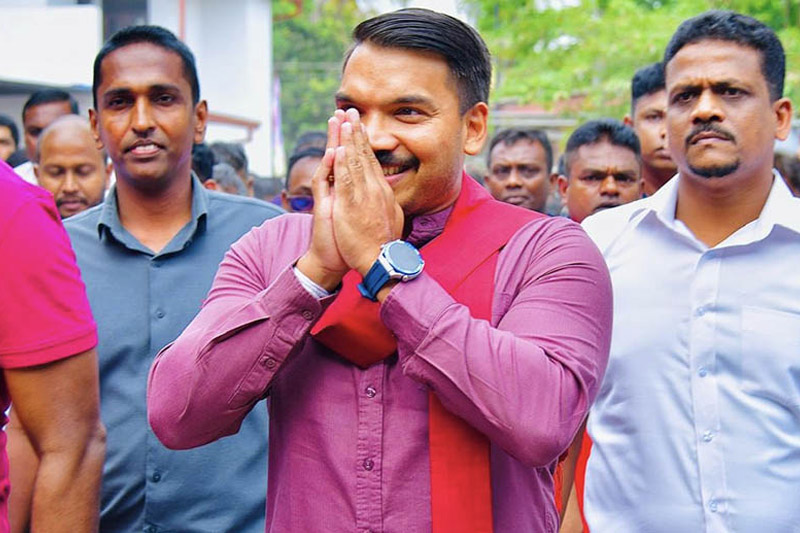
(Lanka-e-News -14.Sep.2026,3.00PM) Sri Lanka has arrived at a moment it can no longer talk around. In Parliament in late June, President Anura Kumara Dissanayake (AKD) said out loud what everyone already knew and no one in power had dared name: a "Deep State" has been operating inside the machinery of government itself. This month, he sharpened the label further, branding it the "Black State" — a parallel governance structure built and run by criminals, corrupt elites, and compromised officials, hiding in plain sight behind the furniture of the Republic.
At rallies in Beruwala and Bulathsinhala, AKD did not gesture vaguely at "corruption." He drew its anatomy. Financial Subversion and the "Black Economy" siphoned an estimated $1 billion out of the country through customs fraud and systemic tax diversion. Beside it sat a second engine: organized crime, drug cartels, and captured state institutions — military T-56 assault rifles sold to underworld figures, forged official passports issued by corrupt immigration officers. Put plainly: under past administrations, criminals and politicians were not merely tolerating one another from a distance. They were running one syndicate.
Watching the old order's remnants scramble to unite against anti-corruption reform, AKD did not bother with diplomatic restraint — he called the alliance what it looked like: "cobras, mongooses, and vipers," natural enemies suddenly sharing a den because the alternative was extinction. His thesis was a blade, not a paragraph:
"There cannot be two states in one country — a legitimate state established by the democratic will of the people and a parallel black state run by criminals."
That is the line in the sand. And the Black State is not retreating behind it — it is counter-attacking, in real time, through three converging events: the arrest of Namal Rajapaksa, the calculated repositioning of Ranil Wickremesinghe, and the institutional collapse of the Bar Association of Sri Lanka (BASL) under President Rajeev Amarasuriya. Follow the thread, and it leads straight to Rajeev's desk.
First Blood: Namal Named Prime Suspect in the Airbus Case
The ground shifted when Lankadeepa and the rest of the mainstream press ran the headline the old order hoped would never print: the Attorney General's Department had directed that Member of Parliament Namal Rajapaksa be officially named First Suspect in the notorious $2 million Airbus bribery case.
For years the file sat, buried under protective delay after protective delay. Then Additional Solicitor General, President's Counsel Dileepa Peiris, instructed the Criminal Investigation Department (CID) to name Namal as the primary perpetrator. The case reaches back to 2013, to the procurement of a 10-aircraft fleet for SriLankan Airlines, where a $2 million bribe — laundered through offshore entities — was traced directly to him. Arrested and remanded to Welikada prison, Namal's court appearance was the first real blow landed against the inner sanctum of the old political order in a generation.
What happened next exposed the fault line running through Sri Lankan politics more starkly than any policy debate could.
Ranil Wickremesinghe spoke first. Marking the 80th anniversary of the United National Party (UNP), he did not merely defend Namal — he weaponized history, calling the arrest "political revenge against the grandson of D.A. Rajapaksa," invoking D.A. Rajapaksa's status as a founding pioneer of the UNP in 1946 alongside D.S. Senanayake and S.W.R.D. Bandaranaike.
Then Mahinda Rajapaksa spoke — and said something far more dangerous to the old order than outrage. Visiting his son in Welikada, the former president told reporters, flatly:
"If you engage in politics, these things happen… we cannot simply call it political revenge — he must face it and go through the court process."
Mahinda's Cold Calculation vs. Ranil's Opportunism
Do not mistake Mahinda's statement for surrender. It was strategy, delivered with the precision of a man who has built and rebuilt a political dynasty out of exactly this material.
Mahinda knows persecution the way other men know weather. He was arrested during the Mulkirigala by-election campaign in November 1985. He attended his own mother's funeral in handcuffs. In the early 1990s, he was arrested again on his return from the UN Human Rights Council in Geneva, where he had gone to campaign against state-sponsored disappearances. He has lived the entire arc — victim, prisoner, president — and he knows the one rule that governs it all: in Sri Lankan politics, prison is not an execution chamber. It is anointment.
His statement to the press was not comfort. It was instruction. If Namal wants the crown — if he wants to lead the traditional political class and rebuild the fortress the old order lost — he does not get to complain about persecution. He has to wear it. He has to sit in the cell, absorb the trial as baptism, and emerge as the movement's living martyr.
The chain of command writes itself: the old political establishment splits into two currents — Ranil Wickremesinghe playing strategist, Mahinda Rajapaksa playing patriarch — and both currents converge on a single beneficiary. Namal Rajapaksa is anointed chief rival to AKD, while Sajith Premadasa (SJB) and Patali Champika Ranawaka are left standing outside the room where the decision was made.
Ranil's statement, by contrast, was pure engineering. By invoking D.A. Rajapaksa's legacy and condemning the arrest outright, Ranil did something far more consequential than defend one man — he anointed Namal Rajapaksa as the undisputed opposition alternative to AKD, walking straight past Sajith Premadasa and the Samagi Jana Balawegaya (SJB) as though they were not in the room.
Analysts warned Sajith and Champika for years that leaning on an informal non-aggression pact with the Ranil–Mahinda gerontocracy would end in exactly this: their political erasure. That warning has now come due in full. Ranil has bypassed Sajith's economic platform and Champika's nationalist-technocratic positioning entirely, throwing the full weight of his political machine behind Namal instead.
Why Ranil Chose Namal Over Sajith and Champika
Political analyst Prof. Nirmal Ranjith Dewasiri and other close observers have repeatedly dissected this dilemma facing the traditional opposition — and Namal's rise to the centre of opposition gravity is no accident. It is the calculated, almost clinical move of a desperate establishment choosing the one asset that still functions.
Ranil's calculus rests on four hard-nosed assessments of what Namal delivers that no one else can:
1. "Catch-All" stage presence. Namal can share a platform with regional firebrands like Dr. Ramanathan Archchuna and hardline Sinhala nationalists like Wimal Weerawansa in the same breath. Neither Sajith nor Champika can straddle that gap without bleeding their own base.
2. An unbroken Sinhala-Buddhist populist line. As the son of the president who ended the war, Namal carries ancestral, emotional weight with rural, traditional Sinhala-Buddhist voters that Sajith's policy-heavy ambiguity and Champika's technocratic tone simply cannot reach
.
3. An aggressive, disciplined fighting spirit. Namal hits hard and organizes harder — sharp parliamentary attacks, grassroots cells built nationwide, a level of party discipline the fractured SJB-UNP splinters cannot match.
4. The failed blockade of the 22nd Amendment. Ranil's parliamentary effort to stop the 22A — a constitutional mechanism built to strip executive protections from corrupt actors and strengthen anti-corruption institutions — collapsed. Legislative manoeuvring alone could no longer shield the establishment. The Black State needed a younger, populist street-fighter to carry the fortress forward. It found one.
The Trap Rajeev Walked Into: BASL and the Bar's Silent Complicity
This brings the story to the one institution that was supposed to stand above it all: the Bar Association of Sri Lanka, and its president, Rajeev Amarasuriya.
For decades, BASL earned its reputation as one of the most credible, independent professional bodies in the Commonwealth — a fierce guardian of judicial independence and the rule of law. But somewhere along the way, under the banner of defending "constitutional norms," elements of the elite legal establishment drifted into the gravitational pull of the Black State's self-preservation machine.
When the government moved to pass the 22nd Amendment — overhauling anti-corruption enforcement, accelerating judicial accountability, closing the legal loopholes financial criminals had relied on for years — the BASL executive did not stay neutral. It fought back, hard, dressing its resistance in the language of judicial independence and procedural integrity.
Then the trap sprang shut, at an event the BASL itself organized: the National Anti-Money Laundering (AML) Symposium.
There, Central Bank Governor Dr. Nandalal Weerasinghe delivered a number that should have ended careers. Between 2020 and 2026, across tens of thousands of complex property, corporate, and trust transactions handled by Sri Lankan lawyers, the legal profession filed a total of two Suspicious Transaction Reports (STRs) with the Financial Intelligence Unit. Two. The Governor did not soften it — he called the record "alarming" and "well below expectation."
Former Supreme Court Justice Buwaneka Aluwihare, chairing BASL's own AML Taskforce, delivered the uncomfortable verdict directly to his peers: legal privilege remains sacred, but a profession this noncompliant becomes the weakest link in the entire national defence against illicit money. His warning was unambiguous — lawyers cannot be allowed to shield or conceal crime behind the veil of professional privilege.
Read that sequence again, slowly. While Rajeev Amarasuriya and the BASL leadership were publicly mobilizing against the 22nd Amendment, the actual financial plumbing used by the country's elite criminals was running almost entirely unmonitored — inside their own profession, under their own noses. Ranil Wickremesinghe did not have to lift a finger to launder the Black Economy's reputation. He simply borrowed BASL's institutional prestige, pointed it at the 22A, and let the Bar fight his constitutional war for him — while the Black Economy's foundations stayed completely untouched.
The Bar's Long Record as the Black State's Legal Muscle
This is not a one-off lapse. It is a pattern, and the pattern has a body count of stalled cases behind it:
● Obstructing key investigations. When former SriLankan Airlines CEO Kapila Chandrasena was first questioned over the Airbus scandal, a legal team led by senior counsel, including Rienzie Arsecularatne, engineered procedural delays that stalled the case for years — insulating the political figures who actually pocketed the kickbacks.
● Boycotting courts to shield criminality. The legal establishment has staged court boycotts — not over human rights abuses, but out of indignation whenever lawyers or politically connected figures were finally called to account for gun battles, extortion, or gang ties.
● Packing courtrooms for extortion suspects. In high-profile proceedings — including cases tied to Rakiktha Rajapaksa and links to international drug kingpins like "Harak Kata" — teams of elite lawyers flooded courtrooms to intimidate prosecutors and secure fast bail through sheer institutional weight.
● Acting like a political party. Rather than functioning as a neutral officer of the court, BASL leadership has increasingly issued statements that read like opposition press releases — conveniently aligned with legislative goals of the political establishment, while the rot inside the profession itself went unaddressed.
The Bar's Crossroads: Two Roads, One Choice
The legal fraternity now stands exactly where it cannot pretend not to be standing: at a fork with no comfortable middle path.
Road One — Stay the Black State's Muscle. Keep acting as a legal shield for financial subversion. Keep cloaking illicit wealth in professional privilege. Keep fighting constitutional reforms that threaten elite impunity. Keep letting the Bar's moral authority be borrowed, used, and discarded by political operators like Ranil Wickremesinghe.
Road Two — Heed Aluwihare, Reclaim the Institution. Enforce real anti-money laundering compliance among members. Root out the ethical rot from the inside. Function as a genuinely independent guardian of justice — one that holds the executive accountable without becoming a tool for protecting the corrupt.
There is no third road. Every month of silence is itself a choice, and it is currently being made for Rajeev Amarasuriya, not by him. A profession that files two Suspicious Transaction Reports across six years of high-value transactions has already answered the question in practice — the only thing left undecided is whether its own president will admit it, or spend his tenure defending a number the central bank governor has already called indefensible.
Conclusion: The Question Rajeev Cannot Dodge
While Namal Rajapaksa sat in a cell in Welikada, the Sri Lanka Podujana Peramuna (SLPP) staged its massive "Janasatana" rally in Anuradhapura. Thousands of party loyalists gathered under Mahinda Rajapaksa's leadership. Namal's message — written from prison — was read aloud to a roaring crowd. In that single moment, his transformation was complete: prisoner into martyr, martyr into champion of the old political order.
Ranil Wickremesinghe's calculus has paid off exactly as designed. Namal Rajapaksa has blossomed into the premier alternative to President Anura Kumara Dissanayake, while Sajith Premadasa and Champika Ranawaka watch their political oxygen disappear in real time. The Black State, staring down the barrel of genuine accountability for the first time in a generation, has found its new face — young, defiant, and already crowned by a roaring crowd in Anuradhapura.
Which leaves one question, and it belongs to no one else but the man who leads the institution meant to stand above all of this:
So, Rajeev — look at Anuradhapura. Are you going to stand on the sidelines and watch Namal Rajapaksa blossom into the heir who inherits and protects the Black State's legacy? Or will you finally lead the Bar Association, the Attorney General's Department, and the wider legal fraternity to stand up, reclaim the integrity this institution was built on, and become the guardians of equal justice the people of Sri Lanka were promised?
The choice is the Bar's to make.
The judgment belongs to history — and history does not wait politely for institutions to find their courage.
Namal Rajapaksa is already crowned. Ranil Wickremesinghe has already placed his bet. Mahinda Rajapaksa has already given his son the only instruction that matters in Sri Lankan politics: endure it, and rise.
The only actor left standing at the crossroads, unmoved and undeclared, is the Bar itself — and by extension, the man who leads it.
Anuradhapura has already answered its half of the question.
Sri Lanka is waiting for the other half — from Rajeev.
Gerard Adams
Collection of articles written by Gerard Adams
---------------------------
by (2026-09-14 09:41:28)
We are unable to continue LeN without your kind donation.


 Read 5328 Times
Leave a Reply


 0 discussion on this news