
By Anubhavanananda
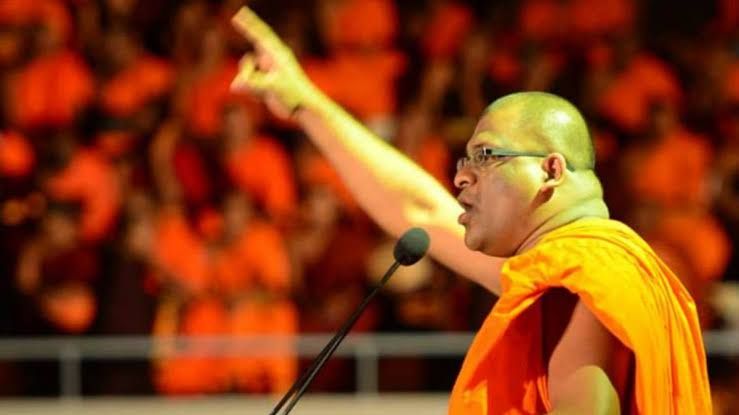
(Lanka-e-News -20 Oct 2026,11.30 P.M.) Galagoda Aththe Gnanasara, the leader of what I would describe as the “clerical underworld” in Sri Lanka, has once again been sent to prison—not for some trivial act of mischief, but for his conduct in defiance of the law.
On January 25, 2016, Gnanasara stormed into the Homagama Magistrate’s Court and created a scene while proceedings were underway in the case concerning the disappearance of journalist Prageeth Eknaligoda. He faced serious allegations of interfering with judicial proceedings, behaving in a threatening manner inside the courtroom, and acting in ways that could intimidate the presiding magistrate and lawyers involved in the case.
On August 8, 2018, the Court of Appeal found him guilty on four charges. The aggregate prison sentences imposed for those offences amounted to 19 years of rigorous imprisonment. However, because the sentences were ordered to run concurrently, the effective prison term was limited to six years.
In 2019, then-President Maithripala Sirisena granted Gnanasara a presidential pardon. The constitutional validity of that pardon was subsequently challenged in court. Following hearings on fundamental rights petitions filed by Sandhya Eknaligoda and others, the Supreme Court delivered a landmark ruling concerning the pardon on September 10, 2026.
Following that judgment, Gnanasara was returned to prison to serve the remainder of the six-year sentence imposed for contempt of court.
Gnanasara’s return to prison, and his appearance in court in civilian clothing, have caused considerable agitation among politicians ranging from Sajith Premadasa, Ranil Wickremesinghe and Dilith Jayaweera to Namal Rajapaksa. Almost all of them have seized upon the incident as an opportunity to attack the National People’s Power (NPP) government. It is not difficult to understand the opportunism behind this political response.
What is more complicated, however, is that some senior figures within the NPP government itself also appear troubled by Gnanasara’s return to prison. Two prominent examples are K. D. Lal Kantha and Lakshman Nipuna Arachchi.
Lal Kantha is not merely a powerful cabinet minister; he can also be regarded as an unofficial spokesperson for the NPP government. Speaking to the media, he described Gnanasara as a friend and went so far as to vouch for his honesty.
“Gnanasara Hamuduruwo is a friend of mine, too. But, of course, there is a law in this country. We did not make these laws. Nor did Gnanasara Hamuduruwo end up in this situation because of us. He was imprisoned in the same way in the past. This is not the first time.
“Then, we are told that around 63 Buddhist monks are in prison. Yet this issue did not arise while they were there.
“We can see that Gnanasara Hamuduruwo has always been used throughout history. He is an honest person. I know our monk. He has always been used. He knows that, too. Even today, people are using him for political purposes. If this were really about Buddhism or the interests of Buddhist monks, there are 63 monks in prison. People could speak up for them, couldn't they? But they did not. Why? Because those monks cannot be used for political purposes.”
Lal Kantha also expressed his opposition to the imprisonment of a monk in robes.
The question that arises here is straightforward. Gnanasara may be Lal Kantha’s friend. But can the NPP government and its politicians simply disregard the judicial decisions against him and his record of conduct?
Lakshman Nipuna Arachchi has devoted much of his life to the Janatha Vimukthi Peramuna (JVP) as a full-time political activist. He has also served in Parliament before. In recent times, there has been considerable discussion about why he was not appointed even as a deputy minister in the present NPP government.
Speaking about the removal of Gnanasara’s robes, Nipuna Arachchi said that he, too, felt deeply affected by the incident. He maintained that officials had acted in accordance with a court ruling and insisted that the NPP had no personal animosity or dispute with Gnanasara.
“Honestly, even we feel distressed by this. He is a monk we know. His radicalism is a separate matter. A monk, too, can have a certain degree of radicalism. Apart from that, we have no problem with the monk we know. However, the court delivered its decisions under a legal framework that was already in operation. The authorities have acted in accordance with those judicial decisions.
“We did not even know how these matters were handled inside prisons. We learned about it through this incident. Only afterwards did we look into what had happened. Then we discovered that there were apparently 63 monks serving sentences in prison.
“We certainly do not like this. As Buddhists, and as a Buddhist country, we do not like to see this happen. We do not even like to see a monk committing an offence, as ordinary human beings.
“Steps will be taken within two weeks to introduce the necessary legal measures and enact the required legislation. A committee has already been appointed for that purpose.”
These were the words of Lakshman Nipuna Arachchi, NPP Member of Parliament and chairman of the Colombo District Development Committee.
His remarks have caused dismay among many of us, myself included. We would therefore like to draw the attention of Lal Kantha and Lakshman Nipuna Arachchi to several facts concerning Gnanasara’s past conduct and the legal proceedings brought against him.
Gnanasara is currently serving a prison sentence in connection with the contempt-of-court case against him. In addition, several other incidents have resulted in legal proceedings or investigations involving him.
1. The Homagama Magistrate’s Court Incident (2016–2019)
Gnanasara faced legal proceedings over threats made against Sandhya Eknaligoda during court proceedings concerning the disappearance of her husband, journalist Prageeth Eknaligoda.
In June 2018, he was sentenced to one year of rigorous imprisonment, with the sentence structured to be served over six months. He was also ordered to pay a fine of Rs. 3,000 and compensation of Rs. 50,000. On appeal, the prison sentence was subsequently suspended for five years.
2. Statements Concerning the Quran and Islam (2025–2026)
On January 9, 2025, Gnanasara was sentenced to nine months’ imprisonment and fined Rs. 1,500 over statements alleged to have insulted Islam and undermined religious coexistence.
On June 23, 2026, the Colombo High Court rejected his appeal against that sentence.
3. Further Charges Concerning Statements About the Quran and Islam — Colombo High Court
The Attorney General filed indictments against Gnanasara over statements allegedly made around April 12, 2014, near the Kompannavidiya Police Station.
The case was taken up before the Colombo High Court in June 2026. On September 30, a warrant was reportedly issued for Gnanasara’s arrest after he failed to appear in court.
4. A Road Accident, Drunk Driving and Failure to Report an Accident (2000)
Reports indicate that nine charges were filed against Gnanasara under Colombo Traffic Court case No. 6315/2000. On September 20, 2000, he pleaded guilty to the charges and paid a fine of Rs. 12,000.
5. Disruption of a Press Conference by Ven. Wataraka Vijitha (2014)
On April 9, 2014, a press conference held by Ven. Wataraka Vijitha at a hotel in Kompannavidiya was forcibly disrupted.
In 2017, Gnanasara and six others were charged in connection with the incident under eight counts, including disrupting the event, using criminal force, and causing minor assault.
Reports stated that, in 2023, Gnanasara and the other defendants pleaded guilty to the charges and were ordered to pay Rs. 300,000 in compensation to the complainant.
6. Obstructing Police Officers in Welikada (2017)
Gnanasara was accused of obstructing police officers who were conducting a narcotics raid. Reports indicated that, in 2019, the Attorney General’s advice had been sought regarding an amendment to the charge sheet. The case was taken up before the Colombo Chief Magistrate’s Court.
7. Investigation into Statements Made Before the Aluthgama Violence (2014)
Statements made by Gnanasara at a rally in Aluthgama were alleged to have incited the anti-Muslim violence that erupted in the area in June 2014. The Criminal Investigation Department questioned him in July 2014.
8. Dispute over Ownership of an Apartment in Bambalapitiya (2023–2026)
Legal proceedings were initiated against Gnanasara and others over the possession and ownership of an apartment.
On June 1, 2026, the court permitted the complaint to be withdrawn following an agreement between the parties.
These are only some of the cases and investigations associated with Gnanasara. In addition, he has faced allegations involving attacks on evangelical churches, threats against their pastors, incitement of or support for ethnic violence in areas including Aluthgama and Digana, the use of obscene language and threats against Buddhist monks who opposed him, and attempts to drive those monks out of their temples.
In my political assessment, Gnanasara is a figure whose conduct has had far more in common with violent political activism cloaked in religious robes than with the role of a genuine Buddhist monk.
The Bodu Bala Sena organisation, which he led, operated with the blessing of Gotabaya Rajapaksa and, as alleged in public discourse, the patronage of military intelligence. It is widely alleged that the organisation served as a vehicle for Gnanasara’s brand of confrontational and violent political activism.
The activities of the Bodu Bala Sena and Gnanasara bring to mind those of the Brownshirts, the paramilitary groups associated with Hitler’s Nazi Germany. Those groups were used to intimidate political opponents and disrupt their organisations. In Gnanasara’s political activities, we can likewise identify methods of coercion, intimidation and the use of force.
My argument is clear. Gnanasara’s conduct represents a violent, fascist political tendency that has operated in opposition to freedom of expression, democratic values, the rule of law and ethnic coexistence. He has repeatedly behaved as though he were above the law.
Therefore, as I see it, Gnanasara cannot simply be described as a “radical monk”, as Lakshman Nipuna Arachchi suggests. He represents a form of violent, fascist politics conducted under the cover of Buddhist robes. We regard such a figure as a serious threat to democracy, peace and ethnic harmony in Sri Lanka.
That is why Lakshman Nipuna Arachchi’s assertion that the NPP government has no problem with Gnanasara, together with the sympathy Lal Kantha has expressed for him, raises serious questions. In my assessment, these responses are deeply troubling and deserve strong criticism.
Both men, along with the NPP government as a whole, should take a closer and more critical look at Gnanasara’s political role and his record of conduct.
Gnanasara even made an extremely degrading personal attack against President Anura Kumara Dissanayake’s elderly mother. He publicly claimed that Anura Kumara Dissanayake had been born only because his mother had been unable to obtain an abortion.
This was not merely an insult directed at the President’s mother. It was a degrading attack on the dignity of women more broadly. Why, then, are NPP leaders unable to adopt a clearly critical position towards someone who made such a statement?
That is the question we must put to Lakshman Nipuna Arachchi, who says he has no problem with Gnanasara despite the latter’s personal attack on the mother of his own political leader, and to Lal Kantha, who describes Gnanasara as his friend.
This is not a question of personal friendship. It is a question of political responsibility, morality and the rule of law. Can someone be exempted from criticism simply because he is a friend or a monk whom one happens to know?
Our position is clear. As laypeople, we may have concerns about the robes worn by Gnanasara, whom we regard as a monk who has incurred “parajika” under Buddhist monastic discipline. However, the institutional and disciplinary responsibility concerning the status of his robes rests with the Buddhist monastic establishment.
Our concern is with the violent, fascist politics, racism, intimidation, and defiance of the law that have been pursued under the cover of those robes.
We cannot treat the teachings of Gautama Buddha and Gnanasara’s political conduct as though they were the same. Protecting the dignity of the Buddhist Sasana does not mean accepting the conduct of everyone who wears a robe without question. It means critically examining actions that contradict the fundamental values of Buddhism.
There is, in our view, no meaningful connection between the Buddhist Sasana of Gautama Buddha and the political conduct of Gnanasara.
Lal Kantha and Lakshman Nipuna Arachchi may have no personal dispute with Gnanasara. But our concern is not with his private personality. It is with the political tendency he represents and the position NPP leaders ought to take in response to it.
Instead of remaining silent about Gnanasara’s conduct or speaking sympathetically on his behalf, NPP leaders must stand unequivocally for the rule of law and democratic values.
Lal Kantha and Lakshman Nipuna Arachchi may have no personal problem with Gnanasara. That does not make the questions surrounding his fascist political conduct any less urgent.
To us, Gnanasara represents the so-called clerical underworld: a fascist bully who has used the robes as a shield for his political activities. We see no connection between his conduct and the Buddhist Sasana established by Gautama Buddha.
That is where our position differs from Lakshman Nipuna Arachchi's and Lal Kantha's.
---------------------------
by (2026-10-20 18:13:22)


 Read 8406 Times
Leave a Reply
 0 discussion on this news