
By Anubhavanananda
(Lanka-e-News -31 Oct 2026,5.00 A.M.) Youth protests are spreading across several European countries, including France, Italy, and Albania. In France, students initially took to the streets to protest long-standing problems in the education sector. However, the demonstrations have since evolved into a broader expression of public discontent over rising prices of essential goods, including fuel, food and medicine, unemployment, and the collapse of hopes for a better future. The protests have also spread beyond Europe, reaching the African nation of Malawi.
Commenting on these developments last Thursday (22), United Nations Secretary-General António Guterres said public dissatisfaction was growing across Europe and other parts of the world. People, he noted, were taking to the streets to express their frustration over the rising cost of living.
“Everywhere, there is growing pressure over the prices of food, fuel and other essential goods. Interest rates have risen. The hopes of younger generations for a better future are increasingly becoming unattainable,” he said.
The Secretary-General also warned that conflicts were not merely intensifying but spreading further. He compared the situation to El Niño, a climate phenomenon that originates in one region but can alter weather patterns thousands of kilometres away, disrupting lives and livelihoods across distant parts of the world.
Conflicts, he observed, are fuelling further conflicts.
“We are now experiencing an El Niño of war,” he warned.
The UN Secretary-General also drew attention to the conflicts in the Middle East, Ukraine and Sudan. Civilians and civilian infrastructure—including homes, hospitals, schools, airports, power plants and energy facilities—have continued to face deliberate attacks in these regions.
However, Guterres stressed that the consequences of these conflicts were spreading far beyond the immediate war zones. The wars were disrupting energy markets, maritime transport, supply chains and financial systems.
A world already burdened by deep inequality is coming under further economic pressure as a result.
One of the most consequential developments to affect the global economy in recent years was Russia’s invasion of Ukraine, ordered by President Vladimir Putin. The invasion had a substantial impact on global fuel and grain prices.
Just as the economic repercussions of that conflict were beginning to ease somewhat, the United States and Israel launched a massive assault on Iran during the final week of January this year. President Donald Trump expected that the war could be won within a week and that Iran’s ayatollah-led government could be toppled.
Yet seven months after the attacks began, the United States has been unable to secure victory. Instead, Iran’s theocratic leadership appears to have emerged in a stronger position.
According to the United Nations Conference on Trade and Development (UNCTAD), approximately 38 per cent of global crude oil production, 29 per cent of liquefied petroleum gas (LPG), 19 per cent of liquefied natural gas (LNG), 19 per cent of refined petroleum products and 13 per cent of fertilisers pass through the Strait of Hormuz each week. This makes the strait a critical chokepoint in the global economy.
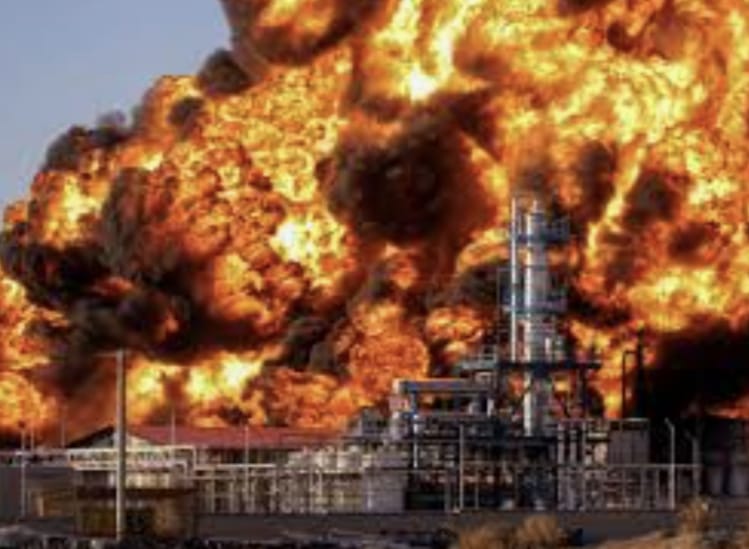
Iran’s closure of the strait and disruption of maritime traffic have driven up the prices of petroleum and other energy sources, as well as fertilisers. In retaliation for attacks against it, Iran has also periodically targeted oil production facilities and refineries in Gulf countries that host American military bases. The United States, for its part, has launched several attacks targeting Iran’s oil production infrastructure.
Iranian Attacks on 20 Oil Refineries in the Middle East
The war in the Middle East is affecting global oil markets in two principal ways.
First, damage to refineries reduces the supply of refined fuels such as petrol, diesel and aviation fuel. Second, damage to oil fields, export terminals or maritime transport routes reduces the availability of crude oil.
According to Kpler analyses, by October 22, approximately 20 oil refineries across the Middle East had been affected by attacks. In some facilities, strikes damaged processing units. At others, security risks and export disruptions forced operators to reduce production or suspend operations.
According to New Energy World, several major facilities affected by Iranian attacks include the following:
1. Ras Tanura Refinery, Saudi Arabia
The refinery has a processing capacity of approximately 550,000 barrels per day.
2. Mina Al-Ahmadi and Mina Abdullah Refineries, Kuwait
Drone attacks in March damaged operating units at both refineries. Together, these facilities form important components of Kuwait’s principal oil-refining system.
3. Sitra Refinery, Bahrain
Before the war, the refinery had a daily processing capacity of approximately 420,000 barrels. Damage to refining units and export restrictions have significantly reduced operations. During the third quarter of 2026, its output reportedly fell to approximately 100,000–120,000 barrels per day.
4. Ruwais Refinery, United Arab Emirates
The refinery had a processing capacity of approximately 820,000 barrels per day. An Iranian attack in March reportedly forced the facility to suspend operations completely.
5. Jizan Refinery, Saudi Arabia
The refinery has a processing capacity of approximately 400,000 barrels per day. Iranian attacks in July, together with damage to associated infrastructure, have left the facility out of operation.
How severely have American and Israeli attacks affected global oil production and refining?
According to estimates by the International Energy Agency (IEA), damage to refineries in the Middle East has taken more than 2.3 million barrels per day of refining capacity out of service.
Preliminary data published by the agency for August indicated that daily crude oil processing at Middle Eastern refineries had fallen by approximately two million barrels compared with pre-war levels.
A regional assessment conducted by the International Monetary Fund (IMF) in April 2026 stated that, when the broader damage to production and export infrastructure was taken into account, the reduction in overall oil production and export capacity—the volume of oil capacity lost—had exceeded 10 million barrels per day.
This figure does not represent capacity lost solely because of damage to refineries. Global oil consumption is approximately 100 million barrels per day. Consequently, even a supply disruption of several million barrels a day can have a significant impact, particularly when certain fuel products and regions are disproportionately affected.
Another important consideration is that oil production does not automatically translate into oil reaching the refineries that need it. Even when an oil field remains operational, maritime restrictions, damage to export terminals or sharply increased insurance costs can prevent crude oil from reaching buyers.
Similarly, a refinery may remain physically intact but still be forced to reduce operations if it cannot export the petrol, diesel or aviation fuel it produces.
According to an industry analysis by Kpler, supplies of refined fuels from the Middle East fell by approximately four million barrels per day between March and August compared with pre-war levels.
According to an analysis published by Kpler on August 20, 2026, Middle Eastern oil-refining operations cannot be expected to return immediately to their pre-war levels.
Production at some facilities is expected to recover gradually from the final quarter of 2026. However, restoring the region’s overall refining capacity to near pre-war levels could take until 2027. Some other assessments suggest that a complete recovery at certain facilities could take as long as five years.
1. Damage assessments and safety checks
Before a refinery can resume operations, the damage caused by fires, explosions, or attacks must be thoroughly assessed. Operators must also ensure that the facility meets the necessary safety requirements before restarting production.
2. Difficulties repairing specialised machinery
The large processing units, turbines, pumps and control systems used in refineries can take months to repair or replace.
3. Delays in obtaining replacement parts
Some components must be manufactured to highly specialised specifications. Procuring these parts can involve lengthy waiting periods.
4. Testing and restarting operations
Completing repairs does not mean a refinery can immediately operate at full capacity. Production must be increased gradually, in stages, while safety and operational reliability are verified. This process can take considerable time.
5. Resolving transportation and export problems
Even if a refinery returns to normal operation, disruptions to the transportation of crude oil and refined fuels can delay the restoration of supplies to global markets.
Repairing liquefied natural gas (LNG) facilities can also take considerable time. Severe damage to major LNG production facilities, such as Qatar’s Ras Laffan complex, could require years to repair.
Rystad Energy has indicated that the need to replace specialised turbines and other equipment could mean that some facilities take up to five years to recover fully.
Before the United States and Israel attacked Iran, the price of a barrel of oil on global markets was approximately US$62. By October 19, that price had risen to US$103.
The principal reason for the increase is the decline in supplies of both crude oil and refined petroleum products. However, rising prices are not confined to crude oil. In some circumstances, the prices of refined fuels can rise even more rapidly.
The main reason is that demand for diesel, petrol and aviation fuel continues even as refining output declines.
As we have explained, even if the war in the Middle East ended tomorrow and peace were established, oil-refining operations across the region would not immediately return to their pre-war levels.
Consequently, many countries around the world are likely to face higher energy costs over the coming years. This could put further upward pressure on inflation.
But the more alarming reality before us is the substantial risk that the Middle East could descend into renewed warfare rather than move towards peace.
Media reports have suggested that the United States and Israel are preparing to launch fresh attacks against Iran following the American elections scheduled for November 3. President Trump has also hinted at this possibility on several occasions.
Iran, meanwhile, has already declared that it is prepared to retaliate. Tehran has warned that if it is attacked again, it will strike Gulf countries aligned with the United States.
The ultimate consequence of such an escalation would be another surge in oil prices, leaving most people around the world to endure even greater economic hardship.
Under these circumstances, public anger, protests, and street movements against the deteriorating economic situation could spread further worldwide in the months ahead.
Postscript: In the second part of this article, I intend to examine the impact of rising oil prices on the Sri Lankan economy.
---------------------------
by (2026-10-31 01:13:56)


 Read 3198 Times
Leave a Reply
 0 discussion on this news