
Analysis by Ruwan Weerakoon
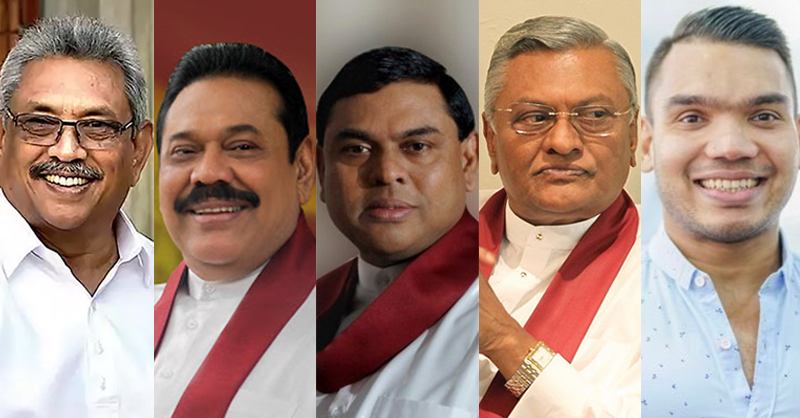
(Lanka-e-News -03 Nov 2026,4.30 A.M.) The Sri Lanka Podujana Peramuna (SLPP) once commanded a sweeping majority and looked unassailable. Today it is at a historical low. Its electoral base has shrunk dramatically. Its patriarch, Mahinda Rajapaksa, has withdrawn from the political frontline, physically and politically. Its second and third tiers of leadership, including Namal and Yoshitha Rajapaksa, are caught up in legal and corruption proceedings. And international pressure is bearing down on figures such as Basil Rajapaksa.
The question is no longer whether the SLPP can return to power. It is whether the party can survive at all.
From saviour to scapegoat. The goodwill and Sinhala-Buddhist nationalist fervour that carried the party to power in 2019 evaporated quickly after the 2022 economic crisis. Many citizens no longer see the SLPP as the force that rescued the nation. They see it as a principal architect of the country's financial ruin. That shift in perception is the foundation of everything that follows.
Courts as public vindication. Legal action against key family members is widely read as justice long overdue, not political persecution. Namal Rajapaksa faces a Trial-at-Bar over multi-count graft charges, including the SriLankan Airlines-Airbus transactions. Cases involving Yoshitha Rajapaksa continue, and international red notices and bribery probes surround figures like Basil Rajapaksa. Rather than stirring sympathy, each development reinforces the public's belief that corruption was institutionalised during the Rajapaksa years.
The ballot box has already spoken. The disdain has translated into hard electoral results. After punishing defeats, the SLPP is a marginal presence in Parliament.
The central question in analysing the SLPP's future is whether a political brand built around one family can survive when that family's core figures are incapacitated or convicted.
1. The crisis of succession. Mahinda Rajapaksa was the party's unifying glue. With him sidelined by age and health, and Namal Rajapaksa entangled in high-stakes trials, the SLPP has no unblemished, charismatic leader to turn to. That vacuum invites factionalism and mass defections, as remaining members scramble to protect their own political futures. In a party held together by loyalty to one name, the loss of that name's authority can quickly become a loss of cohesion.
2. The shadow of judicial proceedings. The legal pipeline runs through local corruption courts, permanent trial-at-bars, and international scrutiny. It will keep dominating headlines for the foreseeable future. As long as these cases involve core family members, the SLPP will struggle to rebrand or to offer the electorate a credible policy alternative. Every court appearance serves as a public reminder of past excess, and the party cannot talk about the future while the past is in the dock.
3. Marginalisation or adaptation? Two broad scenarios lie ahead.
The worst case: extinction or irrelevance. The party shrinks into permanent obscurity, mirroring other once-dominant political forces that collapsed after losing power and failed to adapt. If judicial outcomes bring major convictions, the SLPP name itself could become legally and socially toxic, something candidates avoid rather than seek.
The survival case: a niche opposition force. Remaining loyalists could attempt a structural overhaul: dropping dependence on the Rajapaksa surname, purging tainted elements, and rebuilding from local government upward. That is the only credible path. But in a political climate driven by an anti-corruption wave, carving out meaningful ideological space will be exceptionally hard. The party would be asking voters to trust a rebuilt organisation made up largely of people who stood with the old one.
The SLPP's trajectory is a cautionary tale about how quickly absolute political dominance can unravel under the weight of economic mismanagement and systemic corruption allegations. For the public, the current climate marks a structural shift toward accountability. For the SLPP, the present is an uphill battle for survival, and its future hinges entirely on whether it can distance itself from its dynastic past. That may prove mathematically and politically impossible.
---------------------------
by (2026-11-02 22:49:06)


 Read 2226 Times
Leave a Reply
 0 discussion on this news